
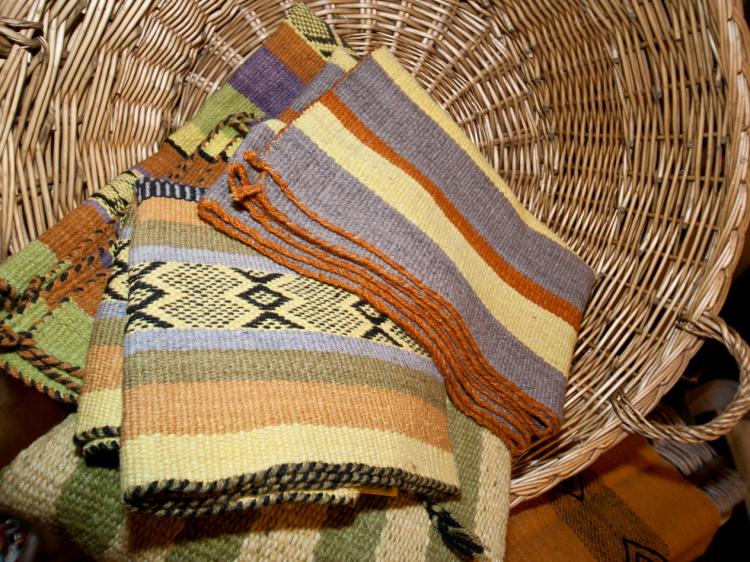
WOODSIDE, Calif.— On Saturday evening, Oct. 9, in Woodside, Calif., the Chol-Chol Foundation displayed woolen clothing and home décor items hand-woven by the indigenous Mapuche people of southern Chile. The handmade goods are sold to urban markets through a co-op.
The display was held at the Emily Joubert Home & Garden shop. During the event, the foundation’s design director, Jasmine E. Aarons, talked with guests about the products, the artisans, and the foundation. Ms. Timmie Jensen, a member of the Chol-Chol board, told about the foundation’s work.
When the foundation was established in 1971, it helped farmers and planted trees to fight poverty among the Mapuche people. But there was no money coming in for the farmers, and the foundation realized that the weaving the women did had the potential to support the community. So they set up one of the first co-operatives to use fair trade principles.
[etssp 133]Besides creating a self-sustaining local economy, the foundation also set the goal of preserving the traditional culture. The weaving project helped this goal by enabling the women to stay in the villages and follow traditional weaving practices instead of having to migrate to the cities to work as maids.
A museum close to the Mapuche region, in the Chilean city of Temuco, demonstrates the traditional crafts and helps preserve the culture. The region now has an elementary school, which helps solve the continuing problem of access to education.
Another goal of the foundation is to promote the idea of fair trade, making it accessible and desirable to mainstream shoppers.
The project evolved as the directors realized they needed a cultural bridge to connect rural workers and their traditional products with urban consumers who would feel great supporting traditional crafts if the products were appealing to them. Jasmine Aarons joined the project to take on the challenge of bridging that cultural gap.
Jasmine earned a B.S. degree from Stanford in Mechanical Engineering integrated with art and psychology. She had encountered the Mapuche when she was on a study trip in Chile.
When she gave a proposal to collaborate with the co-op, she said, she brought in an ad from Vogue showing a model wearing a bulky sweater. She showed it to the organizers to demonstrate her idea of bringing their products to the mainstream U.S. buyers. She helped them make the transition psychologically, to realize that their products could appeal to a broader market and to modern shoppers.
She told them, “Your articles are much nicer than this picture!” The idea fell on fertile ground—the women liked what she was suggesting.
“If you believe in someone and trust them, they will blossom. That’s what we did with these women,” Jasmine said. “It has to be through the heart of the community.”
As she promotes their products, she sends feedback. “Now we send them photos of their work being sold in fairs and stores, and they can see their products on Facebook—they can see the people’s appreciation,” Jasmine reported.
As the designer, Jasmine takes a product and develops it to get it in to production. To appeal to the U.S. mainstream market, she has designed some belts and some woolen scarves with large buttons with a more au courant look, moving away from the strictly traditional.
Continued on the next page…
 Friends Read Free
Copy
Facebook
Tweet
Friends Read Free
Copy
Facebook
Tweet