BANGKOK—The dirty floodwater that flows in front of Nidchapat Tulsukchuentanat’s small drink stall makes its way steadily along what is usually a busy, four-lane road heading toward the heart of Bangkok.
Behind Tulsukchuentanat’s stall is her hardware shop, which has been closed since Nov. 2 when the massive runoff from the north began to submerge her district of Bang Khen, some 7.4 miles from the financial center of the Thai capital.
“Before it flooded here, I went to help out at Don Muang Airport packing relief supplies [for flood victims],” said Nidchapat, referring to the Thai capital’s second airport, which is now inundated with water.
“Now that it has flooded here, neighbors have been helping each other, building sandbags, watching the water level, and keeping an eye on each other’s homes,” she said.
With Bang Khen residents being advised to evacuate, most of the district’s 100,000 plus residents have left but some decided to stay to wait out the flood and take care of their properties.
Not far from the drink stall, former attorney Tawee Sripanarattanakul and his wife sit in their near empty convenience store set up at the bottom of their concrete townhouse.
The 75-year-old says he is unimpressed by the government’s response to the four-monthlong flood crisis and says that he sees little cooperation between the Bangkok Metropolitan administration and the national government led by political novice Prime Minister Yingluck Shinwatra.
“In regard to protecting the life and livelihood of the people, the government is weak in this area. It looks like they are trying, but they are not efficient,” Sripanarattanakul said. “There’s a lot of boasting [from the government] if I may be so frank,” he added.
Since late July, Thailand has suffered heavier than usual monsoon rains, which forced authorities to open dam floodgates north of Bangkok. The resulting runoff of almost 500 billion cubic feet of water has killed more than 530 people, and swamped industrial and rural areas, as well as parts of the city.
“I came here to help”
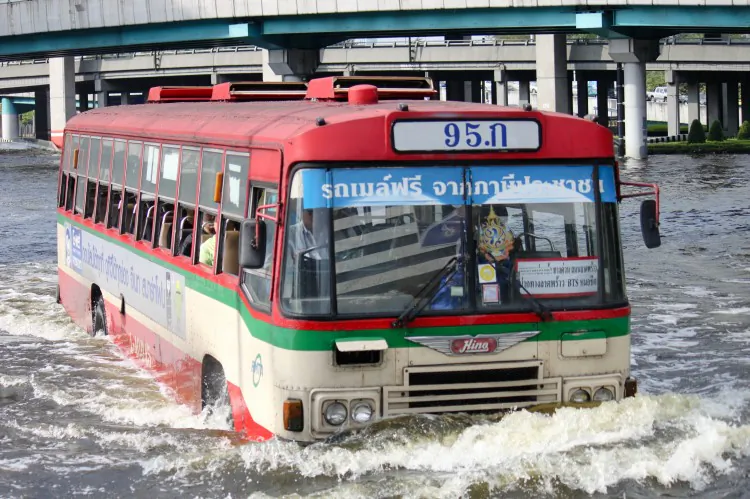
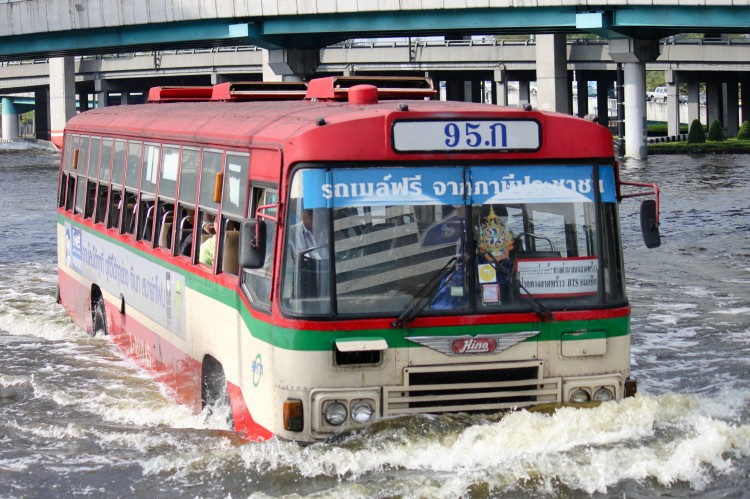
For those who have remained behind in Bang Khen District, transportation is available along the main road with the city’s buses, military trucks, and civilian four-wheel drives managing to plough through the water.
Many residents who stayed in their homes have brought in plastic boats or built rafts to navigate the flooded streets, while Thais from outside of Bangkok have arrived with boats to provide ferry services through the district’s backstreets where the water is waist high.
From the kingdom’s northeast, Samart Phudthapin, 36, has been ferrying Bang Khen residents in his boat for several days.
“I made this boat just to help people,” said Phudthapin proudly referring to his flat-bottomed stainless steel craft. “The cost of the materials for the boat was about 70,000 baht (US$2,277). … I am charging a fair rate, one that my passengers can pay and which cover my expenses,” he said. “I came here to help, not to make money.”
Earlier Samart and his boat had worked in the heavily flood affected district of Don Muang where boat drivers were charging flood victims exceedingly high rates.
“When I went to work in that area, people were being charged 1,000 baht ($32.53) for a short distance,” he said. “I couldn’t stay there long because I didn’t want to charge high fees for my boat service. I don’t want to contribute to people’s problems.”
A trip on Samart’s boat costs passengers no more than 50 baht (US$1.62). Samart says he works around the clock and catches a few hours sleep when he grounds his boat on a bridge across a flooded canal.
Next … Living on the second floor
 Friends Read Free
Copy
Facebook
Tweet
Friends Read Free
Copy
Facebook
Tweet