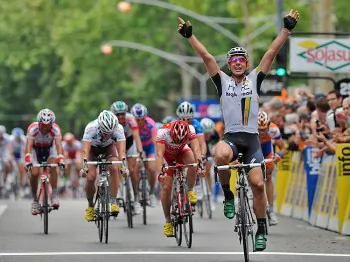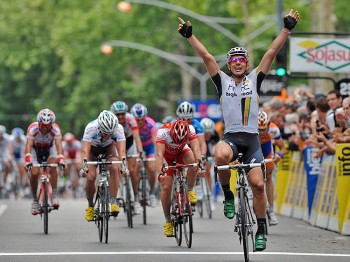
The Critérium du Dauphiné and the Tour de Suisse are the final two tune-up races for riders hoping to make it to the Tour de France. Riders use these races to hone their forms and show their teams that they have the legs and the heart to be chosen for the Tour de France, the most prestigious bike race in the world.
The 2011 Critérium du Dauphiné started Sunday with a prologue time trial, a very short race against the clock, which was won by Rabobank’s Lars Boom, followed by Astana’s veteran Alexandre Vinokourov and Sky’s Bradley Wiggins. Fourth was young HTC-Highroad’s John Degenkolb, with another veteran, BMC’s Cadel Evans, finishing seventh.
Vinokourov and Evans, near the end of their careers but still very strong, hope to win the Dauphine and the Tour. Vinokourov, 37, and Evans, 34, know they don’t have many more chances.
Van Den Broeck’s First Win
The next stage (called Stage One) was a more serious challenge, 144 kilometers of serious hills with a Category 2 climb to the finish. This offered the General Classification (GC) contenders a chance to open some gaps, but it also offered a chance for a breakaway to succeed.
Three riders—Sven Vandousselaere (Omega Pharma-Lotto,) Leonardo Duque (Cofidis,) and Vincent Jérôme (Europcar)—finally made a successful attack about a third of the way into the stage and opened a gap of about six minutes.
These riders were doomed to fail, because teams hoping for a GC (overall) win wanted to establish themselves here. Rabobank led the charge, with Astana and BMC right behind. With 10 kilometers (6.2 miles) to go, the peloton swept up the breakaway, setting the stage for the serious attacks on the final climb.
Seven kilometers from the finish, HTC’s Kanstantsin Sivtsov made his move, followed by Omega Pharma-Lotto’s Jurgen Van Den Broeck and Saxo Bank's Nicki Sorensen.
These three struggled bravely for a few kilometers before Thomas Voeckler (Europcar) took a stab at catching them. He got nowhere as the peloton pushed the pace. A kilometer later, Van Den Broeck decided to head out on his own, leaving his weakening compatriots to the teeth of the peloton.
BMC, riding for Cadel Evans, pushed the pace, trying to catch Van den Broeck as the climb steepened in the final kilometer, but the Lotto rider wouldn’t quit. With 500 meters to go, Katusha’s Purito Rodriguez attacked, followed by Alexandre Vinokourov.
Rodriguez’s final burst nearly brought him to the Lotto rider, but Jurgen Van Den Broeck held on to take his first professional win by six seconds. Alexandre Vinokourov’s final effort earned him the leader’s yellow jersey.
“I spent the last five weeks training in the mountains,” Van Den Broeck told Versus after the race. “I haven’t had a rest in the last five weeks. So the legs were not super but they said when I attacked it was strong. It is incredible for morale to win the stage.
“During the race, my legs felt good, and I thought, ‘Why not attack in the final if I am good?’ I saw the HTC guy going and my teammate Jurgen Roelandts said ‘Come on, go!’ so I went. The group almost came back. I said, ‘Okay, I’ll play all or nothing,” when they came within 10 meters.”
Next…A Sprint with Some Twists
 Friends Read Free
Copy
Facebook
Tweet
Friends Read Free
Copy
Facebook
Tweet