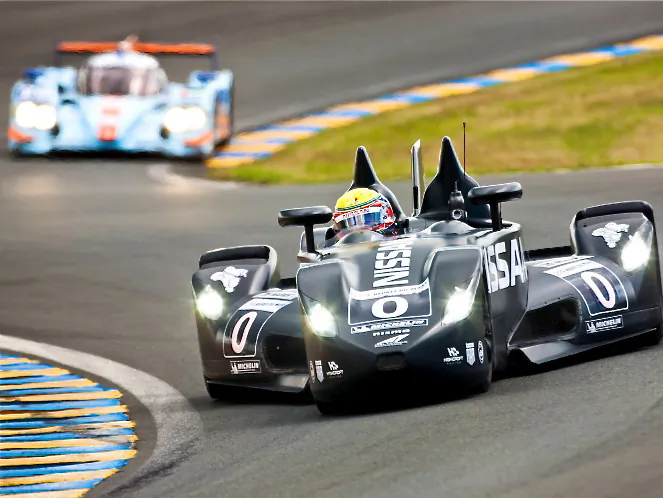

Every year the organizers of the Le Mans 24-hour race assign the final garage stall, No. 56, to a car using ground-breaking or unique technology. This year the stall went to the Nissan DeltaWing, the unique tricycle-shaped prototype that set out to prove a car using half the fuel and half the tires could achieve performance comparable to the conventional cars on the grid.
Despite getting punted into a wall after six hours of racing, the DeltaWing proved its proposals amply.
As designer Ben Bowlby said on the Highcroft Racing website, “At the end of the day, the little Nissan DeltaWing, weighing only 500 kg [1,100 pounds], powered by the 300-horsepower Nissan DIG-T engine and using Michelin tires, was able to run basically with half the fuel and tire consumption and yet show all of the speed of a typical Le Mans prototype.”
Equally important, the car was a fan favorite—something of a surprise to the online enthusiast community, but in keeping with informal polling done at the car’s on-track debut at Sebring in March. Some “purists” apparently hate this tiny triangular design, but most fans think it is wonderful—truly innovative, the result of the sort of clean-sheet, outside-the-box thinking that has always advanced sports-car racing.
The car was built on a very tight budget, in a very short amount of time. It had minimal testing and zero development; its first race was the hardest sports-car race in the world, the Le Mans 24.
The car didn’t finish, through no fault of its own. Frankly, not many people expected it to finish; its undeveloped ultralight gearbox was a failure waiting to happen. The mishap, which sidelined it during qualifying, is a perfect case in point: the car hit a curb hard and the fire extinguisher went off, something that would have been found and fixed had the car had any development time.
What the car did accomplish is amazing. Like it or hate it, the car matched the pace of much more powerful, much better-funded and developed cars. The DeltaWing showed that there are entirely new ways to design cars that go fast with less.
So what now for this one-of-a-kind car? Ben Bowlby hopes it will find a home in a major racing series.
“In the future, let’s hope we can bring it back as a race car, and not just an experimental vehicle,” he said. “We’d love to see a future for cars of this type, which are all about high efficiency, low drag, low drag, and low consumption.”
Given that the car’s major funder, Dr. Don Panoz, also owns the American Le Mans Series, it seems likely the DeltaWing will get to race again, though maybe only as an unclassified demonstration car, as it did at Le Mans.
Is the DeltaWing the way of the future? Hopefully not. Imitative is exactly what the DeltaWing is not, and a grid full of identical machines would miss the essence.
What makes more sense is an entirely new class of racing vehicles, based on the DeltaWing’s principles: greater recyclability, lower environmental impact, smaller carbon footprint, and above all, freedom of design.
ALMS could set a minimum weight of 1,100 pounds, mandate the same driver protection as current cars, and let designers do their best. As long as the car is crash-worthy, let it run—three wheels, nine wheels, wings or no wings. Let’s see innovation return to sports car racing.
The Epoch Times publishes in 35 countries and in 19 languages. Subscribe to our e-newsletter.
 Friends Read Free
Copy
Facebook
Tweet
Friends Read Free
Copy
Facebook
Tweet