“To add a nice flavor to the exhibit,” said Kevin Gonzalez, one of the tour guides or "explainers" at the NYSCI, “The explainers are each dressed as one of the inventors.” Gonzalez wears a brown robe and a cloth around his head to represent Moses Maimonides (1135–1204), a famous doctor and philosopher.
Mary Record, director of communications at the NYSCI, calls the exhibit “a ‘wow’ experience for people.”
Science appears as magic in the introductory movie. The learning stations, however, show that the entire exhibit is based on the Golden Age of Muslim civilization. The inventors were men and women of different faiths, originating from Morocco in the west to as far as China in the east, from Bosnia in the north to Mali in the south.
For his role as an explainer, Gonzalez had to become familiar with the exhibit and know the historical facts and scientific principles involved. His job is “to communicate this in conversations with the visitors,” Gonzalez said.
In the 7th to 17th centuries, some Muslim scholars were looking for order and logic in the world and became astronomers, philosophers, or physicists. Others wanted to improve people’s quality of life and became surgeons, cartographers, architects, or inventors of ingenious mechanical devices. Seven learning stations give credit to the Muslim foundations of our modern world.
Gonzalez tells the visitors that his name is Moses Maimonides and that he lived as a Jewish doctor in a Muslim world. “One thing that we learned in the Muslim world is that everyone received the same kind of [medical] treatment. It was free treatment for everyone,” Gonzalez said.
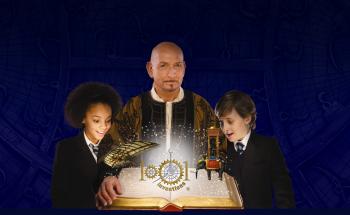
Besides Maimonides, the visitor gets to know various other scholars. When three students are sent to the library to study “the impact the Dark Ages had on the modern world,” Ben Kingsley magically turns into Al-Jazari, a Turkish inventor, and displays figures from the Muslim Golden Age: Ibn Al-Haytham (965–ca. 1040), who studied the eye and invented the first camera; Abbas Ibn Firnas (810–887), who is said to have made an attempt to fly using wings (he broke both legs because he had forgotten to construct a tail); and the female astrolabe-maker Al-Ijliya (944–967), who lived in Syria.
“A lot of the things that we take for granted now [and] that we accept as fact now had [their] foundations in the Muslim world," Gonzalez said. "In the age which they call the Dark Ages it wasn’t so in the Muslim world.”
The Emblem of the Exhibit

“It is ingenious the way he did it," Gonzalez said, comparing the elephant clock to simple time devices such as hourglasses. "This one was timed by water; how long it actually takes to flood a little container inside [the elephant] that will pull down a system of pulleys that we don’t even see.”
According to the explanatory information at the exhibit, the decor on the elephant clock was a celebration of "the diversity of humankind” at the time—the elephant represents India, a phoenix relates to Egypt, two dragons are inspired by Chinese culture, and the figurines wear Arab dresses. One of the amazed students in the introductory movie calls it a “United Nation[s] clock."
In his role as Moses Maimonides, Gonzalez said of the bygone era: “There was actually a lot of harmony back then." But Europe was in a state of turmoil. Maimonides and others had to leave Spain because of the Spanish inquisition. “It would get very difficult for Jews and any kind of person that was not Christian back then. But the Muslim civilization embraced you, would give you the best kind of jobs, the best kind of treatment possible.”
Among the scholars portrayed are Al-Jahiz (781–ca. 868), a “writer and scientist of African descent, born in Basra, an Iraqi port town," and Zheng He (1371–1435), a Muslim Chinese from Beijing, who “built the largest wooden vessels that ever sailed.” The vessels were “five times bigger than those of Columbus, who sailed decades later,” according to the learning stations’ explanations.
Even though the exhibit is based in history, is peppered by religious themes, and is featured in a science museum, one can see the deep sense of culture that permeates through each piece. It reminds viewers that science is not created in a vacuum but rather through the activity of cultural exchange. The exhibit itself is a testament to the power of sharing knowledge.
Read more…Studying as Precious Gift
 Friends Read Free
Copy
Facebook
Tweet
Friends Read Free
Copy
Facebook
Tweet