MARANA, Ariz.—Jessica Cox has spent a lifetime proving that the ability to soar above the clouds has nothing to do with having arms.
The word “can’t” has never been part of her mindset. Instead, her response has always been simple: “Watch me.”
For more than two decades, Cox has defied expectations, becoming the world’s first licensed armless pilot and a leading international advocate for people with disabilities.
On May 15, the 43-year-old was inducted into the Arizona Aviation Hall of Fame at the Pima Air & Space Museum. She said she hopes that the recognition will help grow her nonprofit work and inspire others to look beyond perceived limitations.
Cox was one of three inductees this year, according to Andrew Boehly, the museum’s director of collections.
“We hope that her induction into the Hall of Fame and life story will inspire young visitors to overcome adversity and their own challenges,” Boehly told The Epoch Times.
Cox speaks openly about being born without arms because of a rare birth defect—a topic she discusses with remarkable ease.
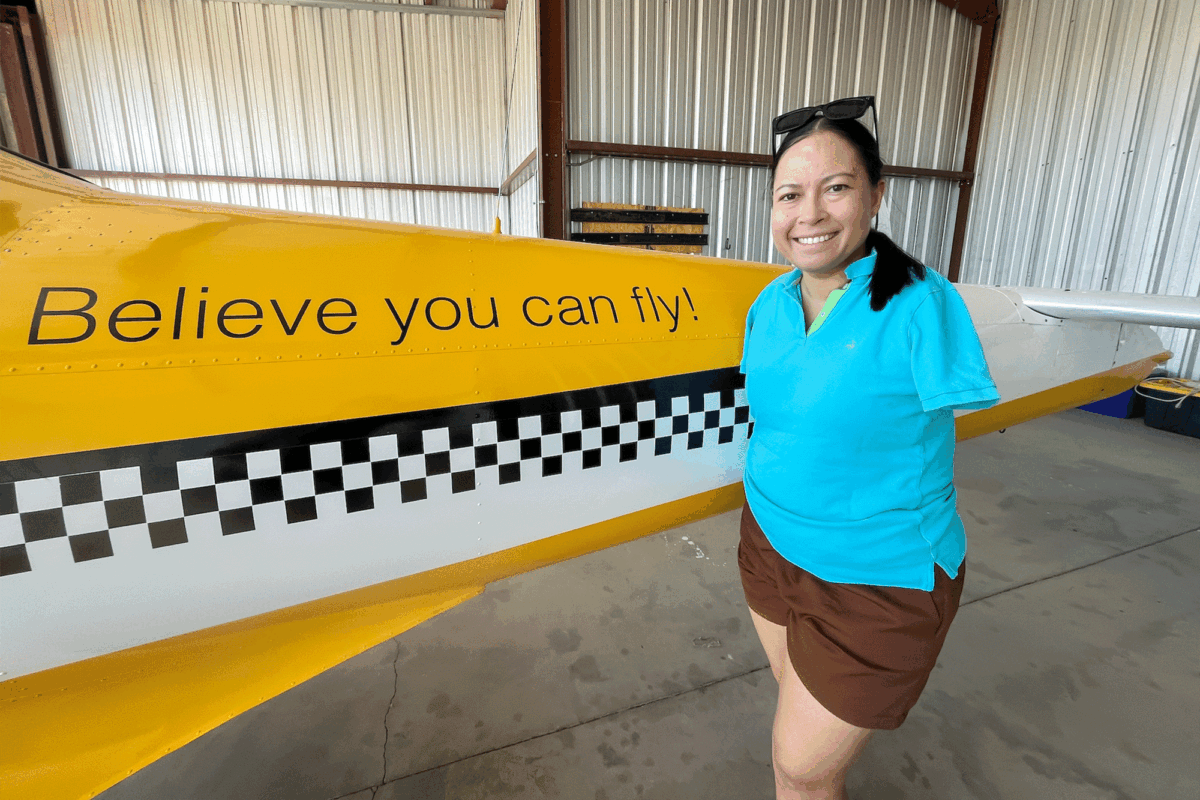
“If you put arms on me, I wouldn’t know what to do with them,” Cox said while wearing summer shorts, a blue blouse, and sunglasses, her hair pulled back.
“I’m so used to it. This is so my normal.
“I’m not reminded how shockingly different it is until I meet people for the first time.”
Believe You Can Fly
On a hot morning at Marana Regional Airport, about 20 miles northwest of Tucson, Cox used her toes to punch the combination into a lock securing the hangar that houses her foundation’s ERCO 415-C Ercoupe light-sport aircraft, built in 1946.
Emblazoned on the vintage plane’s fuselage is a message that doubles as her personal motto: “Believe you can fly!”
That philosophy has taken Cox farther—and higher—than she once thought possible.
“It’s all about overcoming your fears,” she told The Epoch Times.
“I’ve been an [international] speaker for 20 years, and I wanted to say to everyone: Do things that scare you sometimes. Never let fear stand in the way of an opportunity.”
Inside the cockpit, she settled in and checked the dashboard, reflecting on a childhood marked by constant reminders that she was different and people who told her that she could not do certain things.
She met those expectations with anger.
“I was angry about a lot of things as a kid,” Cox said. “It made me angry that I didn’t have something that everyone else did. That people treated me differently.
“It was very infuriating for me.”
Refusing to accept barriers, Cox expanded her own boundaries, learning to handle complex tasks using only her feet. She drives a Dodge Durango SUV with an unrestricted license like anyone else and pumps her own gas.
According to the Amputee Coalition, there is no centralized global database tracking how many people without arms hold driver’s licenses. However, licensing authorities require proof of physical control of a vehicle, often through custom modifications.
She pushed her physical abilities further still, earning a fourth-degree black belt in tae kwon do in 2019. She also took up surfing and scuba diving.
In her mid-20s, she turned to flying, setting a Guinness World Record by using only her feet to control the aircraft.
Flying Into History
In 2008, she made history as the world’s first licensed armless pilot.
“It was pretty dang hard—physically, emotionally, psychologically,” said Cox, who founded Rightfooted Foundation International in Tucson in 2017.
“A lot of testing. Everything was by the book.”
The group works to help children with upper bilateral limb differences live independently.
Although many organizations support children with disabilities broadly, few focus exclusively on this underserved community, according to the organization. It seeks to close the gap with practical tools, encouragement, and a support network that helps children thrive. Among its assistive tools is a custom-made dressing hook that helps children dress themselves.
“It’s all about starting everything worthwhile ‘on the right foot,’” Cox said.
To advance its core mission and message of hope, Rightfooted Foundation International acquired a postwar Ercoupe with a twin-boom design and a single engine.
The aircraft’s fuel tank holds just 20 gallons, burning about 5 gallons per hour at its top speed of roughly 100 miles per hour.
Cox barely fits into the cramped cockpit and must lean back at an awkward angle to operate the throttle and controls with her right foot.
“There’s no autopilot,” she said, laughing. “It’s basically what you see is what you get. I reach for the controls with my foot like a normal hand—otherwise, I’d be two left feet.
“I guess I have to have some coordination. Absolutely.”
Ready to Upgrade
The vintage dashboard remains largely original, and Cox has logged about 100 flying hours and at least 20 solo flights in the plane while traveling across the country.
“I’ve been training my body to do the things that are difficult,” Cox said. “When you land, you pull back on the yoke. That pulling motion isn’t muscle memory. I had to develop the abdominal strength to do it.
“I was terrified of it. It was a challenge—overcoming fears.”
Cox is the author of “Disarm Your Limits,” an autobiographical guide to facing fear and overcoming limits through faith and determination.
There are no walls but the ones we place in our path, Cox said.
“You can climb over the wall,” she said. “Walls are only there to stop the people who don’t want it badly enough.”
Through her foundation, engineers, university partners, and aviation volunteers are building the world’s first long-range aircraft with foot controls to replace the Ercoupe.
Dubbed “The Impossible Airplane,” the project aims to extend the foundation’s reach—and give Cox the ability to travel farther, faster, and more safely with specially designed controls.
Completion is expected in July.
“For me, it’s a reminder of how capable I am,” Cox said, looking ahead to the new plane’s arrival.
“I’ve spent my whole life being told that because I don’t have arms, I won’t be able to do this, this, and this.”
One day, Cox decided that she could fly.
The rest is aviation history.
 Friends Read Free
Copy
Facebook
Tweet
Friends Read Free
Copy
Facebook
Tweet