
A September Anthropic report revealed that Chinese state actors used AI assistant Claude to spy on dissident and religious communities, including practitioners of Falun Gong and staff at The Epoch Times’ sister outlet NTD.
The report also found that an Iranian-linked group had used Anthropic’s Claude to track and target U.S. Navy ships in the Middle East.
A survey of Epoch Times readers indicates that a majority acknowledged the risk that foreign AI-driven surveillance poses to the country and agreed that the United States should impose sanctions on those involved in transnational repression.
Foreign Surveillance and Repression
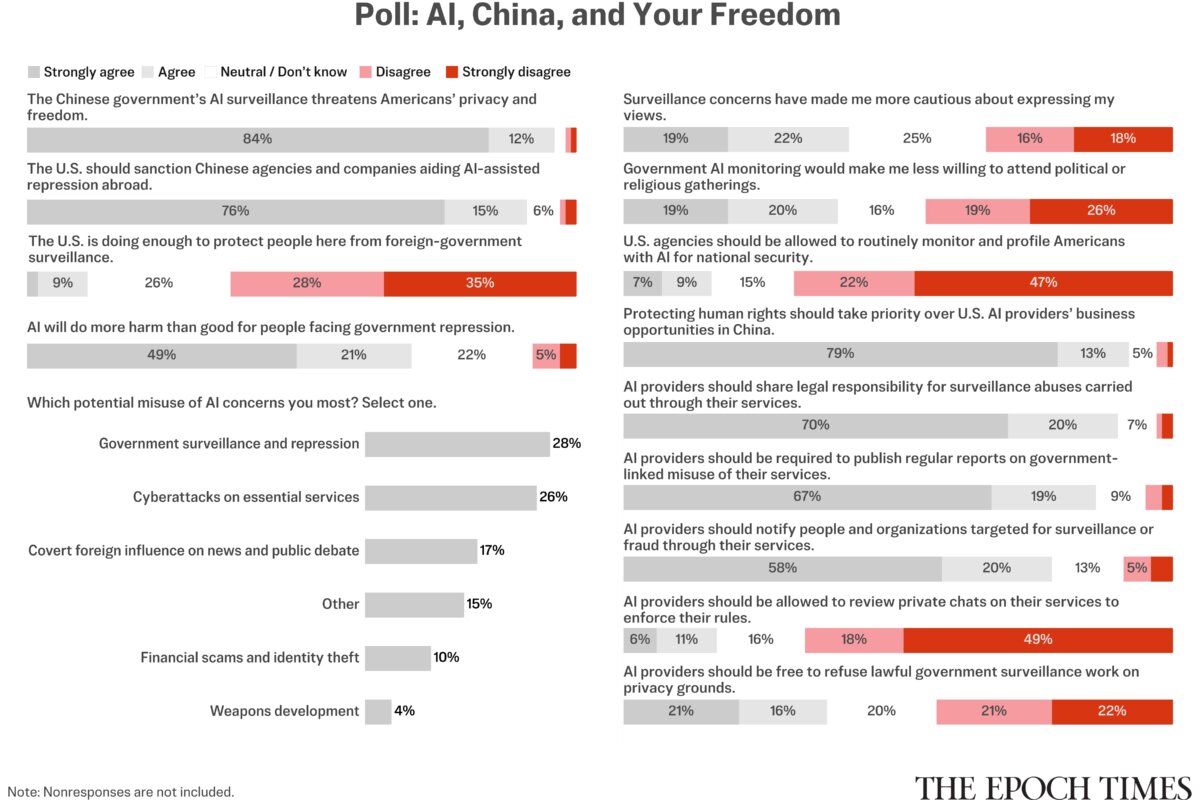
Most readers—96 percent—who took the survey agreed that the Chinese government’s AI surveillance threatens Americans’ privacy and freedom, with 84 percent strongly agreeing.
Meanwhile, 91 percent agreed that the United States should sanction Chinese agencies and companies aiding AI-assisted repression abroad.
More than 60 percent of those surveyed said the United States is not doing enough to protect people here from foreign-government surveillance.
Seventy percent of respondents agreed that AI will do more harm than good for people facing government repression.
When asked what potential misuse of AI concerns them most, nearly 30 percent of sampled readers cited government surveillance and repression. More than a quarter cited cyberattacks on essential services as their greatest concern. Others said covert foreign influence on news and public debate (17 percent), financial scams and identity theft (10 percent), and weapons development (4 percent) are the primary worries.
How AI Affects Users
Readers are mixed on whether AI monitoring compromises their freedom of speech.
Roughly 40 percent of those polled said surveillance concerns have made them more cautious about expressing their views.
Another 39 percent of survey respondents agreed that government AI monitoring would make them less willing to attend political or religious gatherings.
More than one-third did not feel surveillance made them more cautious about expressing views (34 percent) or attending political gatherings (45 percent).
Still, a majority (69 percent) of readers said that U.S. agencies should not be allowed to routinely monitor and profile Americans with AI even for national security reasons.
“All surveillance should require judicial review, approval, and oversight,” a reader commented.
AI Providers and Responsibility
When asked about providers’ role in government AI surveillance, a majority of readers believed AI companies should prioritize human rights over business and share responsibility when their technology is misused.
Ninety-two percent of those who took the survey agreed that protecting human rights should take priority over U.S. AI providers’ business opportunities in China.
“We don’t know what we don’t know yet,” a reader said, “Everything in China is under some surveillance or control by the [Chinese Communist Party], even U.S. companies operating there.”
A similar share, 90 percent, said AI providers should share legal responsibility for surveillance abuses carried out through their services.
Amid foreign monitoring, AI companies need to increase transparency and inform the public about bad actors, according to readers.
Eighty-six percent of respondents agreed AI providers should be required to publish regular reports on government-linked misuse of their services.
More than three-quarters agreed AI providers should notify people and organizations targeted for surveillance or fraud through their services.
But two-thirds of survey respondents disagreed with the idea that AI providers should be allowed to review private chats on their platforms to enforce their rules.
Readers were divided on whether AI providers should be free to refuse lawful government surveillance work on privacy grounds, with 37 percent agreeing, 43 percent disagreeing, and the rest remaining unsure.
The Epoch Times conducted this reader survey on Sept. 16–17, 2026, by email and social media, generating 684 responses. Friends Read Free
Copy
Facebook
Tweet
Friends Read Free
Copy
Facebook
Tweet