EUROPEAN MARKET INSIGHT
In the run-up to last weekend’s much-anticipated European Union (EU) summit, the Euro Stoxx 50 benchmark equity index lost 0.76 percent in volatile trading to close at 2,337 for the week.
The closely correlated euro was unchanged to close at 1.39, but this price masks the wild swings that occurred on the ebb and flow of the headlines concerning the EU summit that started last Saturday.
No Action to Solve Debt Crisis Yet
The eyes of global stock and currency market participants were squarely on Europe last weekend. Financial markets had rallied over the previous four weeks on the promises of EU leaders to find a comprehensive solution for their ailing sovereign debt problem and undercapitalized banking system.
Credit Suisse estimates that the banking system would need 400 billion euros (US$554 billion) just to meet the higher end of regulatory requirements. Sovereigns that include Italy and Spain—downgraded by Moody’s to A1- from Aa2-—need some support mechanism for issuing new bonds to replace existing stock in case market funding will become too expensive. Morgan Stanley estimates the volume of bonds to be rolled over to be around 1.7 trillion euros (US$2.36 trillion) to the end of 2013.
Yesterday afternoon though, in what the markets will take as a—albeit somewhat anticipated—disappointment, the EU summit did not produce an action plan, but postponed the decision to another meeting on Wednesday. The EU also shifted responsibility to the G-20, which it expects to “approve an ambitious action plan containing specific commitments and measures from all G-20 countries to respond to the serious challenges emanating from the current economic slowdown.”
German and French Politics Slow Down Process
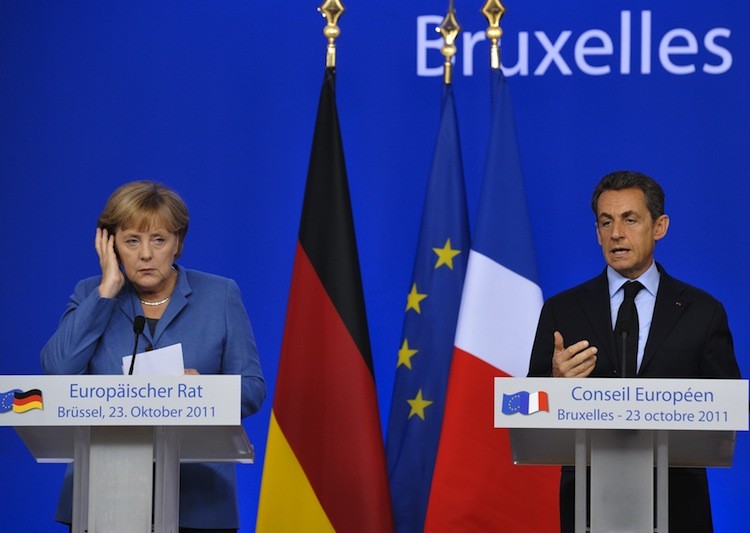
However, the two most important people to manage the crisis, German Chancellor Angela Merkel and French President Nicolas Sarkozy, made clear that they understood what is at stake last week.
Sarkozy told the U.K. Telegraph newspaper last Wednesday, “If there isn’t a solution by Sunday, everything is going to collapse.” According to Bloomberg, however, Merkel said earlier yesterday that “no formal EU decisions” could be expected on the day that Sarkozy had defined as the point of no return for the eurozone. German magazine Der Spiegel reports that she first has to get approval from the budgetary committee of the German Parliament in order to proceed with the bailout plans.
The head of said committee Ulrich Scharlack had said last Thursday that German guarantees under the current configuration of the European Financial Stability Facility (EFSF) cannot exceed the already pledged 211 billion euros (US$292 billion). The EFSF is similar to a European version of TARP and many market commentators believe that without an increase of the guarantees, it will not have enough funding to reach the goals of bank recapitalization and sovereign debt protection.
This example again illustrates how difficult it is to manage a federation of 17 sovereign states that share one single currency. Merkel even added to the complication by saying that “bank recapitalization concerns all 27 EU members,” which means countries like the U.K. that do not share the euro but are part of the EU. With incentives so vastly different, it is perhaps hardly surprising that there is no political solution yet to this complicated economic problem yet.
Next…Excess Debt and Leverage at the Heart of the Problem
 Friends Read Free
Copy
Facebook
Tweet
Friends Read Free
Copy
Facebook
Tweet