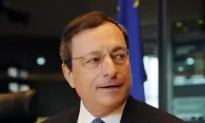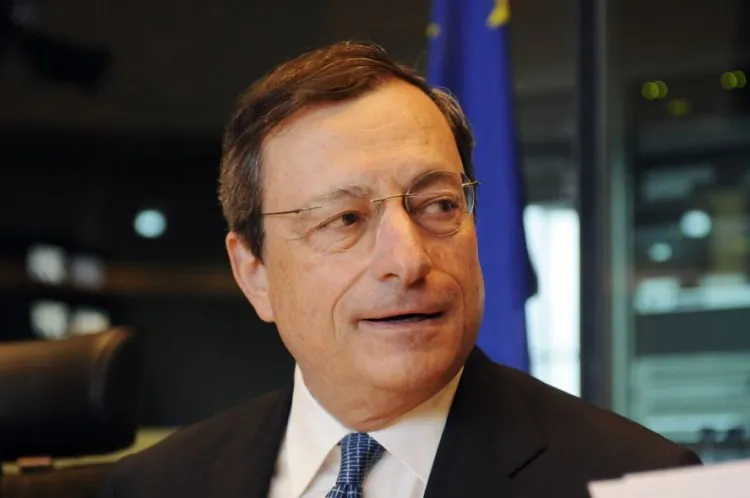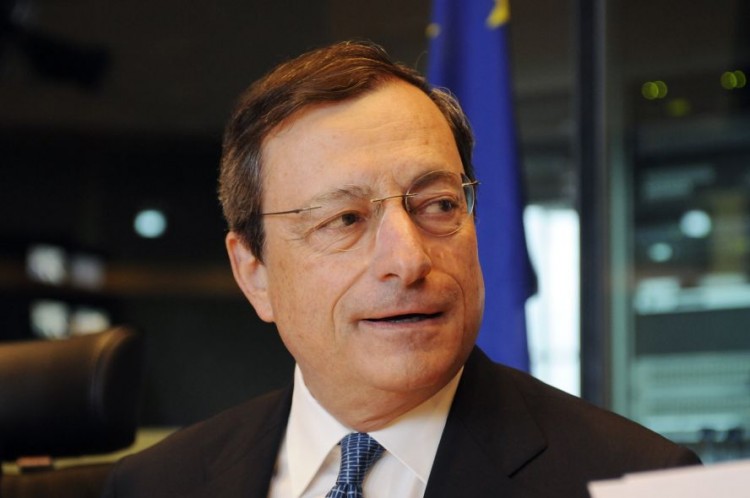

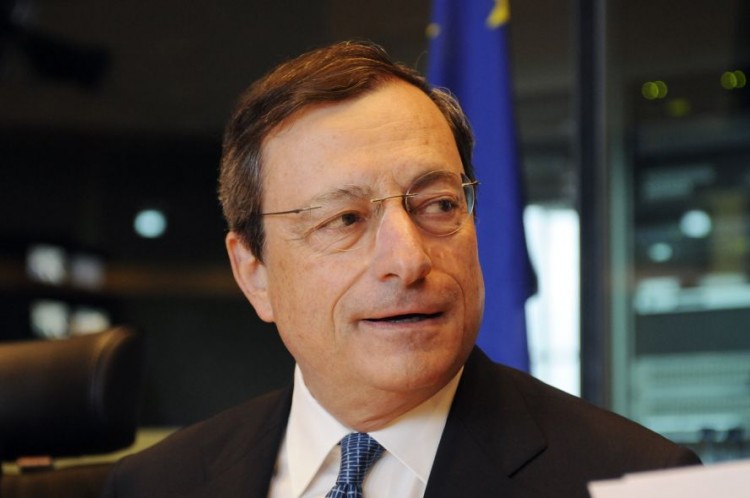
European Central Bank (ECB) President Mario Draghi spoke at an investment conference in London Thursday and surprised markets with his reassuring statements: “Within our mandate, the ECB is ready to do whatever it takes to preserve the euro. And believe me, it will be enough.”
The comments were welcomed by market participants as both the ECB’s and the Fed’s silence and lack of action facing a sell-off in global equities and a sharp deterioration in European fixed income markets did not inspire confidence.
The minute the president’s words hit the tape, stocks in Europe and the common euro currency turned up. Both the Spanish and the Italian stock markets closed up 5.5 percent for the day, the EURO STOXX Index gained 3.9 percent and the euro gained $0.014 to close at $1.23. The S&P 500 closed up 1.8 percent in New York trading.
Spanish bonds, which have been under pressure, also rose in price as leveraged short-sellers covered their bets. Draghi noted that if sovereign yields are disrupting the policy transmission of the ECB, it would be in its purview to address the problem.
What Will the ECB Do to Stem the Eurocrisis?
Economists are now speculating as to exactly what measures the ECB will use to soothe markets.
In a note to clients, chief European economist at Mizhuo International in London, Riccardo Barbieri Hermitte explains the different policy options.
According to Hermitte, the traditional methods would be extending the Securities Markets Program (SMP), in which the bank buys, for example, Spanish and Italian bonds and sells German bonds without an expansion of its balance sheet. This would bring down yields on those bonds.
Another option would be launching another long-term refinancing operation (LTRO) where banks could pledge shorter-dated sovereign bonds as collateral for cash at the ECB for the duration of three years. At the beginning of the year, the central bank had already expanded its balance sheet by 1 trillion euro ($1.23 trillion) through this method according to ECB data.
Both of these methods are different from quantitative easing (QE) that the Fed undertakes, which Hermitte would prefer: “LTROs came at the cost of saddling the banking systems with large holdings of government securities. QE, on the other hand, would see the ECB increasing its portfolio of ‘peripheral’ bonds and the banks enjoying a welcome liquidity injection.”
Goldman Sach’s Dirk Schumacher agrees in his research published yesterday: “[The SMP and LTRO program] would probably provide only short-term relief and a firmer commitment would be needed to have a lasting effect on peripheral bond markets.”
ECB More Constrained Than Fed Due to Bundesbank Heritage
Both economists think there are some obstacles to overcome for really unconventional measures—such as QE—to be implemented. “The decision to buy the bonds of specific countries is clearly a controversial one and is made more difficult by strong German opposition,” says Hermitte. While Schumacher is of the opinion that “there is some legal uncertainty about whether this is feasible.”
The ECB is modeled after the German central bank and explicitly prohibits direct monetary financing in primary markets in its Article 123, as Draghi himself noted in a press conference in December 2011: “This treaty embodies the best tradition of the Deutsche Bundesbank, whereby monetary financing has always been prohibited.”
It is probably no coincidence then that Draghi chose to utter his remarks right after the German chancellor started her summer vacation Wednesday and therefore was not available to comment on his remarks.
Hermitte is betting on the ECB to move as early next week: “I would expect similar comments by Draghi at next week’s ECB press conference and perhaps even a policy announcement.”
The Epoch Times publishes in 35 countries and in 19 languages. Subscribe to our e-newsletter.
 Friends Read Free
Copy
Facebook
Tweet
Friends Read Free
Copy
Facebook
Tweet