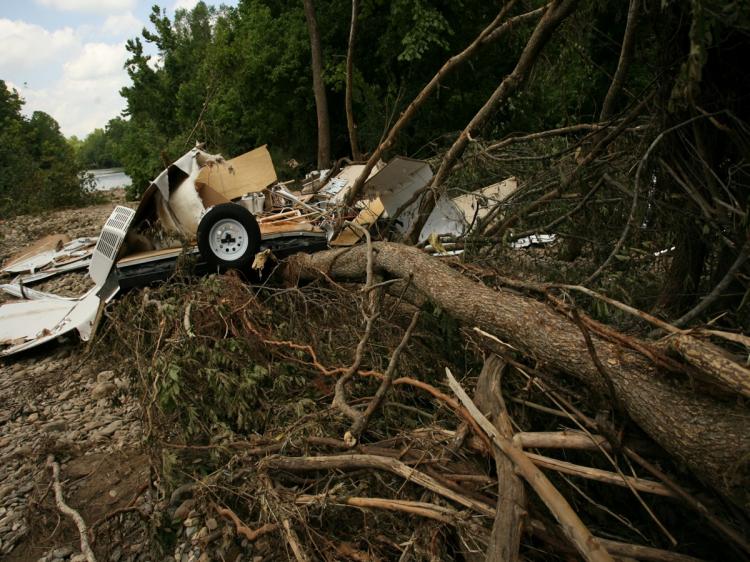
Flash floods come on fast and unexpectedly. During the flash flood last week on the Little Missouri River in Southwest Arkansas, the water rose over 20 feet in five hours. Twenty people sleeping on the banks died. The torrent ripped up asphalt and lifted cars.
“'Be prepared' is the name of the game,” said Dr. Robert Holmes, national flood specialist with the USGS. Holmes was part of a team of scientists who went to Arkansas to study the flood site.
“Be cautious and conservative in picking your location where you’re going to camp,” he said in a telephone interview.
Holmes said campers should look at nearby water channels and notice the slope of the banks; there will usually be a flat area above the initial slope of the banks. This flat area is known as the floodplain.
Floodplains are the areas first inundated during floods. “You want to be above that [flat] location because that’s definitely floodplain, it’s flat there for a reason,” Holmes said.
Campers should listen to weather reports because rain upstream causes floods lower down.
Flash floods usually happen after long or heavy rains from thunderstorms or hurricanes. The severity of flooding depends partly on surrounding land conditions. Tributary streams, especially in mountainous areas with hard, steep, dry terrain are prone to flash floods because rain water flows quickly into the stream instead of soaking into the ground.
Dam failures can also cause flash floods.
 Friends Read Free
Copy
Facebook
Tweet
Friends Read Free
Copy
Facebook
Tweet