
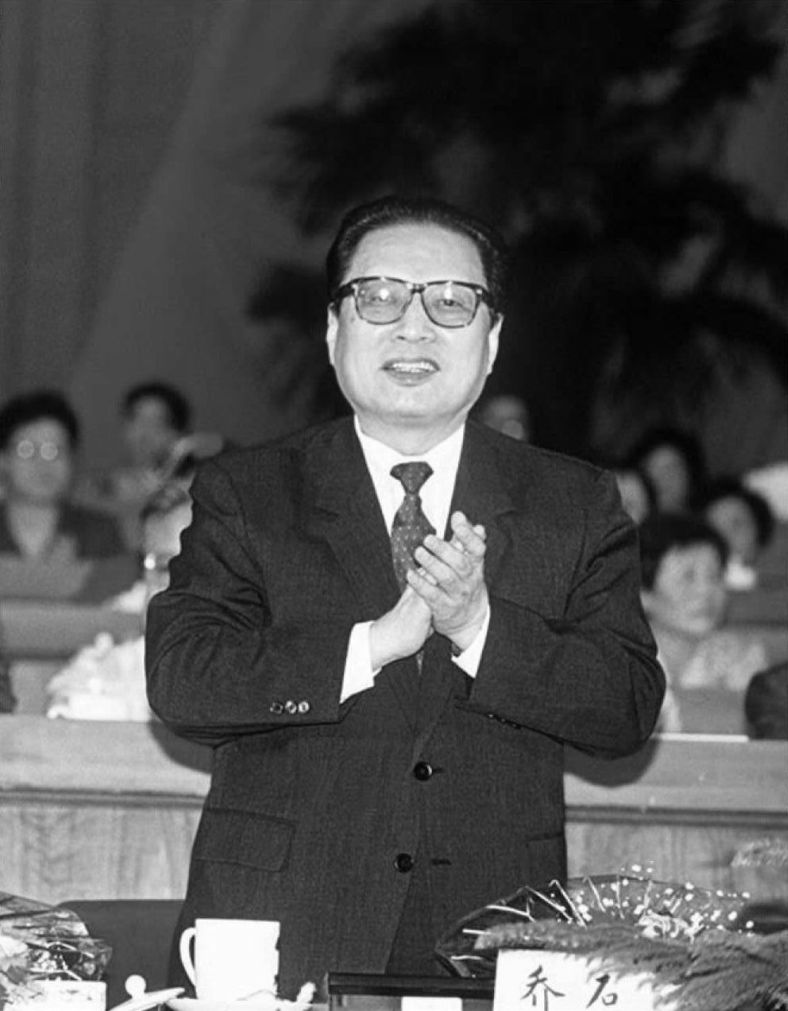
A retired Party official who was a foe to former Party leader Jiang Zemin recently published a book of speeches and writings, raising questions about whether he may be attempting to influence events before the Chinese Communist Party’s (CCP) leadership changeover expected later this year.
The publication of the volume is the first time that it has been mentioned in China’s public sphere that the Political and Legislative Affairs Committee (PLAC), the powerful Party organ that controls the security forces, was once dissolved in 1988. A small leading group briefly replaced it.
The committee was reconstituted in 1990, after the Tiananmen Square massacre, as a means of stepping up the crackdown on dissent. The fact that Qiao Shi published this fact now, in a highly sensitive political time in China before the leadership changeover this year, is significant, according to Lin Zixu, a political columnist.
“The material for this book was already prepared; the contents are from over 10 years ago. So the question is why Qiao Shi suddenly publishes a book mentioning such sensitive political issues now. There’s definitely meaning to this,” he wrote in a recent column.
“This is definitely helping the reformists” who would not mind seeing a restriction in the powers of the committee, Lin said.
Qiao Shi was once the third most powerful member of the Party, as chair of the National People’s Congress, often called the rubber-stamp legislature, from 1993 to 1998. Despite the fact that he was in charge of the Political and Legislative Affairs Committee (PLAC), Qiao Shi was known as something of a liberal Party member, as far as the CCP is concerned.
It was Qiao Shi who, in 1998, concluded that “Falun Gong has hundreds of benefits for the Chinese people and nation, and does not a bit of harm.” Hardliners in the security apparatus, including Luo Gan, the sidekick of Jiang, had been agitating for a crackdown against the quickly-growing spiritual practice, but Qiao Shi’s investigation halted that—at least temporarily (Jiang initiated the persecution the following year, in 1999).
The new book is a compilation of Qiao Shi’s speeches on democracy and the rule of law from 1985-1998, when he held senior positions in the CCP.
Columnist and Internet commentator Lu Guoping said: “Whether China’s democracy and legal system has progressed, stagnated, or regressed has been a sensitive topic for a decade. Qiao’s advocacy of democracy and his motivation to repeat his prior statements is worth noting.”
Qiao Shi was head of the PLAC from 1985 to 1992, thus including the period of its brief dissolution.
However, he headed the organization before it came to possess the immense powers it was given during the persecution of Falun Gong. Since then it has gained 1.5 million armed police, which are used to violently crack down on protests across China. It is also in charge of China’s police force, secret police, prisons, and labor camps. It was the PLAC that orchestrated the elaborate persecution of Chen Guangcheng, the blind human rights lawyer who exposed forced abortions in Shandong Province.
“When Qiao Shi served as secretary of the PLAC people could accept this agency; no one blamed the agency for any chaos, nor was abolition of this agency strongly demanded,” said Tong Zhiwei, East China University of Political Science and Law Professor, via Sina Weibo.
Since Tong is writing from China, he left unstated the implication in his remark, which is that things have changed quite a lot since then.
Click www.ept.ms/ccp-crisis to read about the most recent developments in the ongoing crisis within the Chinese communist regime. In this special topic, we provide readers with the necessary context to understand the situation. Get the RSS feed. Get the new interactive Timeline of Events. Who are the Major Players? 
When Chongqing’s former top cop, Wang Lijun, fled for his life to the U.S. Consulate in Chengdu on Feb. 6, he set in motion a political storm that has not subsided. The battle behind the scenes turns on what stance officials take toward the persecution of Falun Gong. The faction with bloody hands—the officials former CCP head Jiang Zemin promoted in order to carry out the persecution—is seeking to avoid accountability for their crimes and to continue the campaign. Other officials are refusing any longer to participate in the persecution. Events present a clear choice to the officials and citizens of China, as well as people around the world: either support or oppose the persecution of Falun Gong. History will record the choice each person makes.
Read the original Chinese article.
The Epoch Times publishes in 35 countries and in 19 languages. Subscribe to our e-newsletter.
 Friends Read Free
Copy
Facebook
Tweet
Friends Read Free
Copy
Facebook
Tweet