
Between 1990 and 2010, according to the World Bank, the number of people living in extreme poverty worldwide was cut in half. This dramatic achievement, which was actually a major Millennium Development Goal, happened several years ahead of schedule. The reduction in extreme poverty varied from region to region, with great gains made in Asia and not much progress achieved in Africa. In East-Central Europe, the drop was roughly comparable to the global average.
There is, however, a statistical anomaly in the data for East-Central Europe. For the 10-12 million Roma living in the region, the overall economic situation has gotten worse over this period of time. Since 1990, Roma have experienced catastrophic increases in unemployment and discrimination. In Serbia, for instance, 60 percent of the Roma population lives in extreme poverty, in Albania 40 percent. In Romania and Hungary, the poverty rates for Roma are far higher than the majority population. There has been little if any improvement in the last decade.
This gap in poverty alleviation results between Roma and non-Roma communities has been the subject of intense discussion in governmental and civil society circles. For the last two decades, American foundations, European charities, and the European Union have all poured money into attempts to rectify this situation. One of the first and most important institutions in the region to translate these funds into successful projects on the ground was the Autonomia foundation, founded in 1990 by Andras Biro.
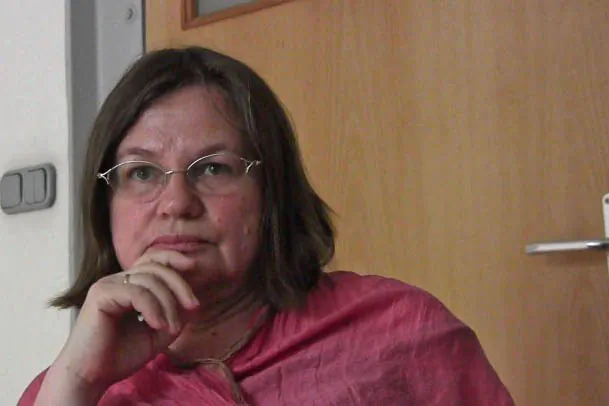
In 1993, I interviewed Anna Csongor, who was a program officer with Autonomia. She described the successes and failures of Autonomia’s revolving loan program, based on the Grameen Bank example, as well as the innovative project monitoring system.
When I returned 20 years later to re-interview Anna Csongor, she had already been serving for many years as the executive director of the organization and was just then preparing to leave the job. Hungary was now part of the European Union, and its social welfare institutions were considerably more developed. But Autonomia, and the Roma community in Hungary, faced many of the same challenges as before, in part a legacy of the government’s failure in the first years of transition to address the disproportionate cost of economic dislocation shouldered by Roma. “It was a tragedy when so many Roma people were kicked out of jobs,” she pointed out our conversation in her office in Budapest last May. “Everybody lost their jobs, but it was Roma first. By the time the system was able to do something about poverty and unemployment they were already five years unemployed.”
Autonomia was dedicated to involving Roma in the process of creating their own economic enterprises. Csongor remembers a project to grow watermelons. “There were periods when it collapsed when the market was bad, but they learned how to cultivate something else such as tobacco,” she told me. “They got practice, and they built up their self-confidence. And the majority population developed a different attitude. They saw that the Roma weren’t just waiting for welfare but were actually producing something. There were lots of similar projects, mostly agricultural. Those continued until the welfare system developed into a structure in which income generation was no longer possible.”
As Hungary developed its social safety net, Autonomia shifted its focus. With European funding, it began to provide capacity-building trainings and workshops. “We provided support to an organization that set up an after-school operation,” she told me. “We provided support for the first mentoring after-school operation in this northeastern village. It was quite good. It was so well marketed that in the second round of these projects, it became world famous. They created a network. Of course, we were lucky because they had the skills. But they were lucky because they had our mentoring support. They could absorb a lot of money and deal with 450 children. That was a really positive investment.”
In the end, Csongor has come full circle in her thinking on what can make a difference in Roma communities. “I started with education and thought that education was everything,” she related. “I went along different paths and now, again, I think education is everything. In between I thought it was a complex issue and you have to take into account economy and local structures. But lately, I think if you don’t do anything with education or you make a mistake with education, then anything you do in the field of economics won’t make a difference. When we made the interventions in the wage-earning or income-generation life of people, we thought, ‘Okay, now everything will change and the children will go to school and they will have a better chance in the local structure if they have more income.’ That’s okay. But still, if there is not solid education at school, nothing will change.
We talked about her experiences as a social worker during the Communist period, her research into Roma education, and her belief in the urgent need for all Hungarians to sit down and discuss their perceptions of Roma and themselves.
The Interview
Do you remember where you were and what you were thinking when you heard about the fall of the Berlin Wall?
I must have been at home. I think I was watching TV. I remember the enthusiasm, the common feeling, but I don’t know whether it was just the moment or the moments after and the discussions. I think I was with friends at the time. It was a time when we used to get together a lot, sharing this sort of experiences even if it was on TV.
What were you doing in those days in 1989? Were you a student?
I was born in 1951, so I was quite an adult. I used to work in an institute set up for educational research. I was a sociologist. By then I was divorced. I lived with my son near here.
As a sociologist, you focused on education?
Yes, the education of Roma children.
When did you start that work?
My son was born in 1981. Until then, I was a social worker. It was quite enjoyable work, unique, and I loved it. But then I had to end it, because I had my own family, and I couldn’t take care of other people’s families. I was at home for a year or so, and then this institute was set up and I was invited to go there around 1982.
When you were a social worker, you worked in Roma communities?
Yes.
What motivated you to work in Roma communities?
That’s a very long story. I don’t know if you want to spend time on it.
If it’s an interesting story!
For me, it’s interesting! I come from a family that is intellectual. My grandfather was a lawyer; my other grandfather was a judge. My parents went to university. My mother, for instance, had received a doctorate and was a linguist. Everyone in the family expected me to be a scholar. I went to university to be an English teacher, because my mother was originally an English and Hungarian teacher and then became a linguist, so that was a family tradition. However, already in high school, I had some experience in sociology. We had very special teachers who took us to the villages and made sociological surveys and provided an immersion experience, which was unusual at the time.
While I was at university, I joined an illegal activity, criticizing existing socialism from the Left. We had an understanding in my group, among my friends, that somehow the system wasn’t practicing what it preached. We had this F category for physical workers. At school, either you were either an F or a P as a peasant. There was also a third category, and that was me — not a worker or a peasant. But when we went to university we realized that there were very few pupils from peasant and worker families, and we thought that was totally unjust and we should do something about it. We put together a project. I wouldn’t call it catch-up courses because it was much more than that. It was playing democracy and teaching high-level things and having very special teachers with us, sharing what we had access to with those we thought didn’t have such access.
After a short period, I also moved into a commune, which was quite fashionable in intellectual circles at the time. We did a lot of extra learning — reading books and discussing books. That’s a leftist sort of activity: living together and talking a lot. By the end of university, I thought I would be a teacher of English or a scholar in literature somewhere. I was interested in medieval English drama. I wrote my thesis on this. But still I thought that this was totally boring. I imagined that all my life I would be in an office and a library, reading books and writing books and maybe teaching other people English drama. This was interesting but still…
Then everything changed, and I decided to go to the countryside. I was living in the commune, and I left the commune with a new lover. But I couldn’t move home. My parents said I couldn’t do that unless I was married. Okay, so we didn’t marry. Instead we went to a village. This was my first husband. We started to teach mostly Roma. It was a very attractive situation because we were the only real intellectuals in the village, and we loved the children, and the children loved us. It was very romantic.
What were you teaching?
I was teaching almost everything. You can imagine the situation: a small school and a shortage of trained teachers. They were very happy to get somebody with a university diploma. My husband was an economist who also taught Russian. We taught almost everything that was needed there. That’s how it started. And we learned lots of new things like political economy. In those days, there was a lot to learn about: for example, the real history of the workers’ movement or the real history of the Soviet Union. This was called the flying university.
There was one in Poland.
Yes, I think that was the model. Somehow we remained in touch with these circles. Then we decided to leave the village because it became unbearable. If we had stayed, we would have become the directors sooner or later because this was the second half the 1970s, and the situation wasn’t so harsh. This would have happened if we had behaved. But we did not behave. We did things that were quite innocent but were provocative for the locals, like allowing children with no bathrooms at home to come to our flat and have a bath there.
You did things for Roma that were provocative for non-Roma?
No, no. In a school where the basic value is discipline, then you don’t have the children in your home. In our school, the headmaster walked down the corridor listening to make sure the classes were quiet, and my classes were never quiet. We played dramas and such things. I was the new generation of teacher. It was embarrassing for him, maybe even challenged his authority. The whole place was rather feudal. We could have stayed. But an issue came up where we had a fierce debate, and it was decided. He wanted to persuade me to stay and my partner to leave, because he thought he was always going to cause problems in the future. Anyhow, we came back to Budapest.
I didn’t think about going back to university, to literature and so on. It was quite a coincidence that someone asked me if I was interested in helping with a survey of Roma. The survey was made by Ottilia Solt, one of the leading figures of the opposition. A philosopher and sociologist, she was employed by a research institute and made a survey of Gypsy children in Budapest. I participated in the survey and fell in love with it. She was not only a researcher, she was also a politician in the sense of putting into practice what you learn from your research. She also arranged, in some of the districts in Budapest where many Roma lived, for the local government to employ someone like a social worker. Officially, there were no social workers at that time, but someone took responsibility for maintaining contact with these Roma families and ensuring their wellbeing. So, a local consulting instituted employed me to work with families on educational issues and what to do with their children. I worked there for ten years. This was in the 20th district of Budapest. There is no such a thing as the best part of life. But really, this was the best part of my life.
It was the best part of your life because you enjoyed working as a social worker and you enjoyed the interaction with the families.
Both. And I was totally free. I have been totally free all my life, never having a boss. Even here at Autonomia. There was a boss who was a psychologist and a very nice woman. She liked what I was doing but didn’t totally understand what the whole thing was about.
When I had that job, I had the impression that I was having an impact, that something was happening. I was like a relative who was not living with them but they could turn to me. I was 23 when I started. You can imagine that this was a very big challenge. I don’t know how I even dared, but I dared because I didn’t really think about it. It was an important experience. There were a lot of interactions, and I was quite successful, I don’t know why or how. When my son was born, I felt that emotionally I couldn’t share myself. I spent a lot of time with them. I drank with them. It was my life. It was my identity. It was not a job. When you don’t have any other responsibilities, it’s easy to be part of it. That was until 1981, and in 1982 I went to work at the research institute on education.
Can you give me an example of what it meant to be successful in that social work?
For example, if a family lost their housing, then I could fight for it and the housing was restored. When a child was taken into custody, I could make arrangements for the child’s return. In those days, the offices I had contact with were full of people who might have been racist or anti-poor. But still they could be touched. And the system was not very well organized. So if you argued for each case in an emotional way, then in most of the cases you could be successful. By now, there is a welfare system, with lots of requirements and paperwork that you have to fill in and do this and do that before the system decides whether you are eligible or not. This was the case during socialism as well, but there were special cases. It was not just using family connections. It was easier to make the bureaucrats understand the human side. Of course this was a limited sample. But they were not bad people. They were just part of the system. They said, for instance, “You have to queue up if you want a council flat, and you’ll have to wait five years.” My clients — or my partners or my people — they were so poor and so neglected that it was obvious that they needed help.
In my first year when I went there, I understood that some of the children very much need preschool courses. I was not trained for that, but I did a lot of reading and made contact with an old preschool teacher, and we put it together. It was a total success. We made quite a long course for young Roma children. Maybe it was not professional, but it was very enjoyable and quite efficient. It had something to do with the ownership. I worked in a local structure where everything was owned by local council. I used the premises of the local cultural house, which was a council space, and I used the knowledge of a woman who was a teacher who didn’t charge anything because she too was a council employee. Nothing cost money. It was just human resources and premises. Somehow it was easy.
Then you left the social work and worked for an institute, which focused on educational research.
The education of Roma children. Those with whom I started the research in 1974, we sort of grew up together. We still had our groups for discussion. That’s why I’m telling you that when the Berlin Wall fell, I must have been in one of my circles, which is very different from what it’s like now. We had a lot of informal gatherings. People just dropped in. It was a loose period. And we were young.
Before you left the commune and moved off to the village, did you have any contact with Roma?
It’s interesting that you ask this. A friend of mine and I were just discussing this issue: when we met Roma in our life. I went to school in this district, which was a mostly intellectual and middle-class neighborhood. However, all this middle-class housing had these backyards where the less fortunate people lived. I had classmates who didn’t have a window to the street but only a window to the yard. Some of them were really poor. They didn’t have cake but only bread with jam on it. Those were my earliest memories of children being poor. But I don’t think we had any Roma classmates. I might have met Roma people in the secondary school — when I went to these villages to do sociology. The style of these camps was that we also danced and played together. If I had pictures from that time, which I don’t have, there might have been Roma children. But it wasn’t real contact. I also remember seeing Gypsies selling things on the road, but here again there was no real contact. They were rather exotic. They were outsiders.
Of course I had contact with Roma when I was teaching in the village, and later when I was a social worker, I remember a girl about my age who was totally black. She was very ambitious, but she was totally depressed. She felt that being black meant that she was surrounded by prejudice and couldn’t go anywhere. This wasn’t a shock for me on the cognitive level because I knew about this prejudice. But I had never directly encountered this sort of feeling before. She married someone and went abroad because she said that she couldn’t do what she wanted in Hungary. This was in the 1970s. So, the 1970s for her were different than for me. Then I had to admit that life is not so nice for some.
In my family, to be sure, everybody wanted me to have a doctorate. But there was also in my family a belief that you have some social responsibility for those who are not so lucky. It was not a direct way of educating children — that you should give money to those begging on your way home from church. We didn’t go to church, and it wasn’t like that. My mother, when she finished being a linguist because she was on a blacklist, began teaching. I heard stories about her supporting some of the poor children with boots and other kinds of physical support.
When you did research, you were doing research nationally on Roma education at all levels?
Mainly elementary.
You were looking at disparities in educational achievements and also what was available in terms of infrastructure?
Both: achievements and conditions. And it was very easy because the disparities were so obvious.
Was there anything surprising that you learned during the research?
I wouldn’t call it surprising. I would rather call it a tension between the structural issues and personal attitudes. For example, I was sure from the very beginning that segregation was not good, that separation was not going to help anyone in the future. This was a structural issue: you shouldn’t have separate Roma classrooms. On the other hand, we met with many very committed and devoted teachers who were working with very neglected Roma children. These very nice teachers were doing something very good. It was not a burden for them: it was something that they wanted to do. They didn’t want to get rid of it, either, because if these children participated in mainstream education they would have been rejected. These teachers were also marginalized, as if they had been infected through contact with the Roma. They were a separate class among the local teachers.
One of the narratives about Roma in the region is the reversal that took place after 1989. The employment rate for Roma in the region was rather high under Communism, and that reversed after 1989. The educational system followed a similar trajectory. You saw a deterioration in general of the situation for Roma. But hearing you, I realize that the educational situation for Roma before 1989 was not so good either.
No, it wasn’t.
Would you say that there was a sharp decline from that low level before 1989 or merely a continuation of an already bad situation?
That’s not an easy question. On the one hand, the situation was totally absurd. Under the socialist condition there was the same free obligatory education. But there was also a group of people who didn’t get that education or got it at a low quality. These families were shown the place of their children in the school. After a while, the parents said, “Okay, my child has a place in the special school where the mentally handicapped children are, and that’s it. That’s our school. Now, leave me alone.” They didn’t even think of fighting against it.
There was an exam system for children before they entered the first class – for children that the kindergarten had some doubts about. This happened in the places where I was working. I saw kids that were bright and fantastic. But still I suspected that they were not going to be approved by the school because of their test scores. So I cheated. I gave them a higher grade so that they could go to a better school.
A kind of affirmative action.
Yes! But after a while, in spite all the good will and efforts, the school system somehow figured out who was eligible for mainstream schooling and who was not, and that was quite typical for the system.
Still, I don’t want to say that during socialism it was okay. It was not okay. But if the father was an unskilled worker, then for the children the position of semi-skilled worker became possible. The child could go on to work at the factory with non-Gypsy coworkers. If it worked well and he could assimilate, then he could go on to the secondary labor market and make some more money. Somehow he could slowly be part of the system. When he became part of the system, his children could go a little further. I can’t say that it was an open system, but there was a possibility of mixing. And maybe those were who ambitious enough and lucky enough to live where there were good places to work available could advance. If the stars aligned, then you could make it. The factories were full, the kindergartens were full — somehow it all looked positive.
But in the second part of the 1980s, everything was over. It was a tragedy when so many Roma people were kicked out of jobs. Everybody lost their jobs, but it was Roma first. By the time the system was able to do something about poverty and unemployment they were already five years unemployed. The educational system didn’t change, and families didn’t trust the educational system at all. The teachers got frustrated, and the school administrators got frustrated. Within a very short time, the Roma and poor children found themselves at the bottom layer of education. At the other end, the school system opened up with lots of private schools and a big market for education. The talented and well-to-do families could do anything.
Also the talented and well-to-do Roma families?
The sociological surveys on Roma are blamed for not recognizing the talented and well-to-do families. The definition of Roma is quite loose. The only real survey I consider okay uses the definition that Roma is anyone considered Roma by the neighborhood. That’s a relative concept. Those who don’t look like Roma or act like Roma are not considered Roma in the surveys.
And they don’t self-identify as Roma?
No, they don’t. On the other hand, a Roma intellectual movement started in the second half of the 1970s, a group that was not going to assimilate. They were involved in music and art and so on. That might have been a very thin layer. But I saw them and made friends with them, and they were part of my life. I wonder if they are now part of the political system, whether they’re still visible.
 Friends Read Free
Copy
Facebook
Tweet
Friends Read Free
Copy
Facebook
Tweet