
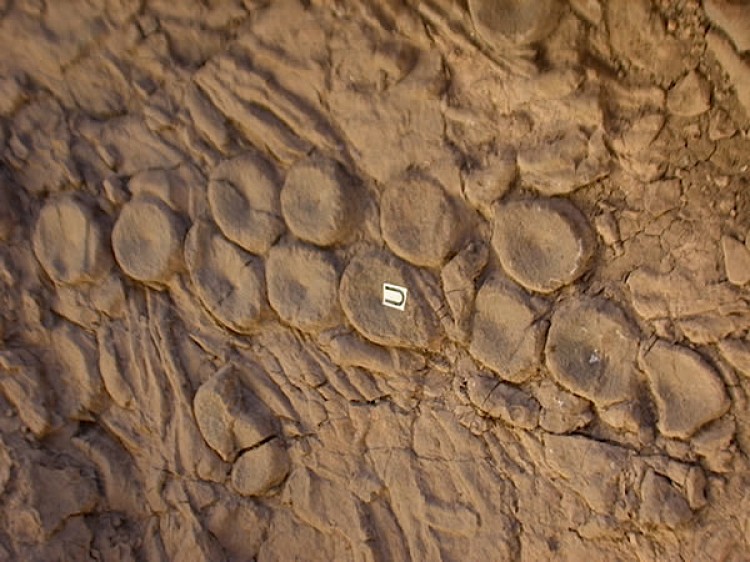
A kraken’s lair that dates back to the Triassic period—250 to 200 million years ago—may have been identified at Berlin-Ichthyosaur State Park in Nevada.
At the site are at least nine fossils of giant ichthyosaur, Shonisaurus popularis, which were squid-eating reptiles about 45 feet (14 meters) in length, comparable to sperm whales.
These remains have long perplexed researchers, including palaeontologist Charles Lewis Camp of University of California, Berkeley, now deceased.
"Charles Camp puzzled over these fossils in the 1950s," said Mount Holyoke College paleontologist Mark McMenamin in a press release. "In his papers he keeps referring to how peculiar this site is. We agree, it is peculiar."
Camp hypothesized that shonisaurs died from a toxic plankton bloom or accidental stranding. But more recent work on the nearby rocks suggest this was a deep water environment, which is what attracted McMenamin to the site.
"I was aware that anytime there is controversy about depth, there is probably something interesting going on," McMenamin said.
"It became very clear that something very odd was going on there. It was a very odd configuration of bones."
The bones appear to have been purposefully arranged, and various degrees of etching suggest the animals did not die simultaneously. Some of the fossils have twisted necks and broken ribs.
McMenamin believes they may have been accumulated there by an enormous octopus, estimated to be around 100 feet (30 meters) long, twice the size of the modern Colossal Squid Mesonychoteuthis.
"Modern octopus will do this," he said. "I think that these things were captured by the kraken and taken to the midden and the cephalopod would take them apart."
Furthermore, the geometric arrangement of bodies appears quite complex with the ichthyosaur vertebral discs stacked in closely fitting double line patterns. In fact, this pattern resembles that of the suckers on a cephalopod tentacle, rather like a self portrait.
The tale is reminiscent of a discovery made at Seattle Aquarium a few years ago when sharks were mysteriously being killed. Nighttime video footage showed that a large octopus was the perpetrator.
Octopus Preying on Shark at Seattle Aquarium
"We think that this cephalopod in the Triassic was doing the same thing," McMenamin said. "It was either drowning them or breaking their necks."
However, as octopuses have soft bodies, fossil evidence of such a kraken would be hard to come by, unless its beak or mouth parts had been preserved at the site. Evidence for the proposed monster is therefore circumstantial.
"We’re ready for this," McMenamin said. "We have a very good case."
McMenamin will present his findings at the Annual Meeting of The Geological Society of America in Minneapolis today, Oct. 10.
 Friends Read Free
Copy
Facebook
Tweet
Friends Read Free
Copy
Facebook
Tweet