
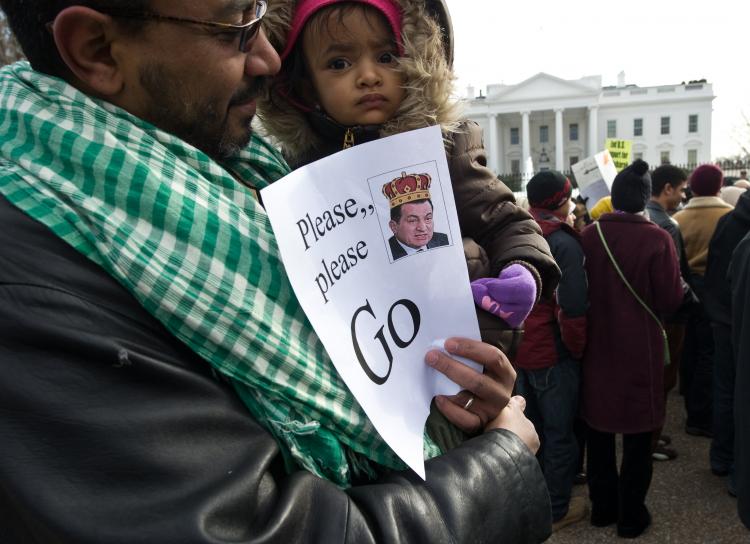
In Cairo, mass street demonstrations led by Egypt’s youth have triggered widespread international concern that the unrest and potential ousting of Egypt’s 30-year President Hosni Mubarak will open the stage for an Islamic extremist group to come into power. In particular, the Muslim Brotherhood is seen as the main threat.
The Muslim Brotherhood, which has existed in Egypt since 1928 and was formally banned in 1954, has had a tumultuous history of assassinations and subsequent persecution by the Egyptian government. The Muslim Brotherhood are considered an extremist Islamic group and responsible for the assassination of Egypt’s prime minister in 1948, Egypt’s President Anwar Sadat in 1981, and an attempted assassination of Egypt’s President Gamal Nasser in 1954, who was still prime minister at the time.
Regarding concerns about the Muslim Brotherhood, young activists are quick to point out who started the protests.
“The Muslim Brotherhood did not organize this. This is a grassroots movement going on in Egypt,” said Hossam Mansour, 30, spokesperson for the group outside the White House.
Even while officially “banned” in Egypt, in 2005, Muslim Brotherhood candidates, running as “independents,” won 88 of the 454 (approximately 20 percent) parliament seats in Egypt. In the most recent elections in December 2010, however, they did not win a single seat in what was widely considered an election rigged by the Mubarak regime.
While clamping down on Islamists to gain public support, for decades, Mubarak’s government had attempted to frame the Muslim Brotherhood as the only alternative. Egyptians who supported Mubarak did so as an alternative to the Muslim Brotherhood.
“Egyptians are religious only on the cover as a result of what Saudi Arabia is doing,” said Amir Mansour, 30, one of the EAC activists outside the White House.
The extremist form of Islam penetrating Egypt in recent years is Salafi Islam (also called Wahhabi Islam), which is the prevailing form of Islam in Saudi Arabia.
According to Nasser Weddady, civil rights outreach director of the American Islamic Congress (AIS) and Hands Across the Middle East Support Alliance (HAMSA), “The government did everything to look the other way to facilitate their arrival,” referring to the Salafi movement fueled by funding from Saudi Arabia.
Mubarak leveraged the Salafis as a rival Islamic group to keep the Muslim Brotherhood in check, says Weddady.
Egypt has been a country of predominantly moderate Muslims, while the Salafis are even “more extreme than the Muslim Brotherhood,” says Weddady. He blames Mubarak for allowing the widespread and yet unwelcomed social change in Egypt.
“Right now, we all agree on what we don’t want—as long as it is a liberal alternative and we have plenty of them,” said D.C. activist Hossam Mansour, people like him will accept it. He then went on to list acceptable alternatives to Mubarak, like Noble Peace Prize winner Mohamed ElBaradie and Ayman Nour, leader of the El Ghad party, who spent three years in jail for his pro-democracy perspectives.
The protesters representing the mass Egyptian population—where the median age is 24—are trying to show that it is neither the current regime nor the Muslim Brotherhood that will be allowed to lead Egypt going forward.
 Friends Read Free
Copy
Facebook
Tweet
Friends Read Free
Copy
Facebook
Tweet