

The avocado you picked up at the grocery store almost certainly started its journey at a family farm in Mexico.
From there, a packing company bought, sorted, and shipped it to the United States.
Stateside, a distributor bought it and shipped it to the grocery store in your town.
By the time you paid a dollar for that avocado, it had passed through the hands of perhaps four companies, each competing with several others for a slice of the fruit trade. That single dollar covered all the costs: growing, packing, shipping, displaying, and ringing it up at the checkout stand.
Competition like that is the heartbeat of a sound economic system, according to noted economist Friedrich Hayek. He called it the most efficient way to deliver goods to consumers.
Now think of something more personal, such as the life-sustaining pill your mother takes to manage her chronic illness.
That drug is manufactured by a pharmaceutical company. From there, it’s typically sold to a pharmacy benefit manager, shipped to a retail pharmacy, prescribed by a doctor, and ultimately paid for, mostly, by an insurance company or by Medicare or Medicaid.
Like the avocado, the pill changes hands several times.
But there’s a crucial difference. In this case, every hand it passes through—from factory to pharmacy counter—probably belongs to the same sprawling healthcare corporation. Even the doctor writing the prescription might be on that company’s payroll.
Your $15 co-payment is just a small part of the cost that you can see. The rest is paid by a massive corporation—largely to itself—with money that ultimately comes from employers or taxpayers.
This is vertical integration: one entity controlling nearly the entire supply chain.
Nearly all Americans now get their medications—and often much more of their healthcare—through a handful of companies that dominate almost every link from manufacturing to consumption, including the payment itself.
Some experts argue that this model is a net win. By streamlining their supply chain, these giant corporations cut waste, improve convenience, and lower prices for patients, even as they earn a healthy profit.
Others see it differently. They argue that vertical integration smothers competition, letting a handful of companies set prices for manufacturers and consumers alike. This reduces patient choice, some say, as these companies steer patients to their own services and drive up the cost of the medicines people need to stay alive.
Which is it?
Here’s a closer look at how giant corporations shape the medical marketplace and affect taxpayers, seen through the story of the world’s largest healthcare company.
Premium Increases
UnitedHealth Group leveraged vertical integration to become the largest health corporation in the world by revenue and the third-largest corporation of any kind in the United States.
The company began in the 1970s as a small group of health maintenance organizations, then grew by acquiring insurance companies and care providers such as physician practices and pharmacies.
By the early 2010s, Forbes ranked UnitedHealth Group the 22nd largest U.S. corporation.
Then it hit an inflection point.
In 2015, the company paid $13 billion for Catamaran, a large pharmacy benefits management company. Pharmacy benefit managers are the middlemen in the drug supply chain. They negotiate prices with drugmakers and manage distribution and payments for insurance companies.
That made United one of the big three vertically integrated companies, alongside CVS Health and The Cigna Group.
Catamaran was the last significant independent player in the Medicare Part D market, according to KFF, a health policy research group.With Catamaran gone, 80 percent of Medicare Part D patients were handled by just three benefit managers—and the insurance companies that own them.
That consolidation had an immediate impact.
Medicare Part D premiums increased by up to 58 percent for most customers within a year, according to the National Bureau of Economic Research.
Even those who had been using Catamaran and stuck with UnitedHealth saw no cost savings, the researchers reported.
“If you are the only game in town, you set your prices, and there is evidence all over of how that has actually driven up costs,” said Elizabeth Mitchell, president and CEO of the Purchaser Business Group on Health.
Mitchell spoke about the effects of vertical integration in a February forum with KFF.
Revenues for OptumRx, the benefit manager owned by UnitedHealth, increased by more than 50 percent in the fourth quarter of 2015, according to company documents. And UnitedHealth Group shot up to No. 6 on the Fortune 500 list within two years.
UnitedHealth Group did not return a request for comment.
Higher Drug Prices
Brand-name drug prices, which had been rising for years, also hit an inflection point during this period of vertical integration.
Per-unit spending on brand-name drugs increased by an average of 80 percent for Medicare Part D from 2013 to 2021, according to an Epoch Times analysis. Because new medications are often very expensive, the analysis included only drugs market throughout the entire period.
That’s nearly five times higher than inflation and more than double the rate of other drug spending.
Medicare’s per-unit spending on Humalog, an insulin medication, increased by 86 percent over that time. Lantus, another insulin medication, increased by 93 percent. The price of Eliquis, a blood thinner, increased by 123 percent.
That price spike was intentional, according to the Federal Trade Commission (FTC).The FTC alleged that UnitedHealth Group, CVS Health, and The Cigna Group and their respective pharmacy benefit managers—OptumRx, Caremark, and Express Scripts—engaged in anti-competitive practices to inflate drug prices.
According to the 2024 complaint, the three companies strong-armed manufacturers into raising prices on certain drugs, especially insulin, while simultaneously increasing the rebates on those medications.
Pharmacy benefit managers make money from rebates they receive from drugmakers. So the higher the rebate, the more the benefit manager makes.
And benefit managers largely control which drugs an insurance company will pay for. So they were able to coerce manufacturers into raising prices to keep their medications covered by the big three, according to the FTC.
All three companies denied the charge.
UnitedHealth Group said in a statement, “This baseless action demonstrates a profound misunderstanding of how drug pricing works.”
Benefit managers pass most of the rebate on to the insurance company that actually pays for the drugs. But for the big three companies, that’s an in-house transaction.
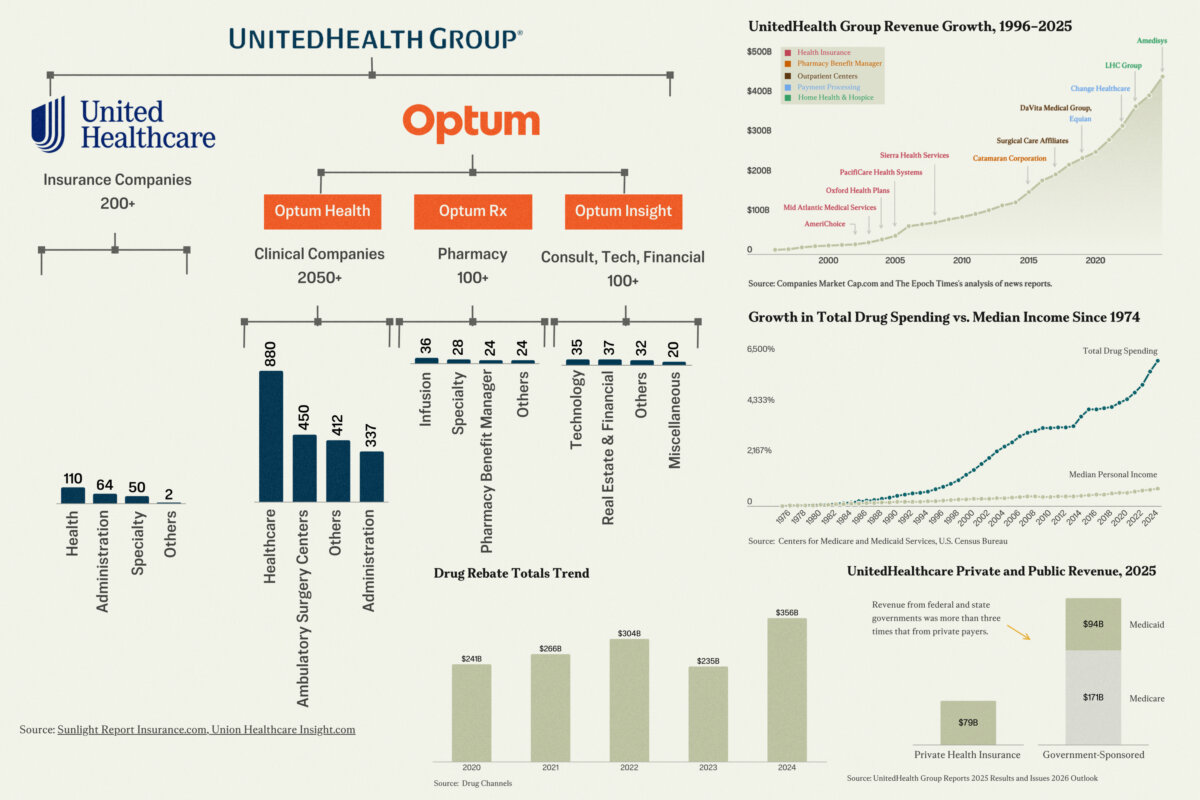
The total amount of rebates and discounts paid by drugmakers reached $356 billion in 2024.
The prices of Humalog dropped by 70 percent and of Novolog by 75 percent in fiscal year 2024, the year after the mandatory $35 insulin copay took effect in Medicare Parts B and D.Taxpayers Pay More
Taxpayers paid a hefty price as well.
Governments provide the bulk of revenue for the big three vertically integrated health companies, so any increase in drug prices hits both federal and state budgets.
Medicare Part D spending on brand-name drugs increased by more than $100 billion from 2013 to 2023.
Overall, American spending on prescription drugs, including generic drugs, rose by nearly 8 percent to $467 billion in 2024.
Taxpayers are UnitedHealth’s largest customer, accounting for about three-quarters of its revenue.
Higher Cost, Less Choice
The real loser in this arrangement was the patient, according to the FTC. That’s because copays are generally based on retail prices, so people with high deductibles and copays find themselves paying more when prices increase.
In some cases, patients may have paid more for their insulin than their insurance companies did, the FTC stated.
Patients also have reduced options in the marketplace when dealing with vertically integrated companies, according to an FTC report.
Vertically integrated insurers often steer patients toward their affiliated businesses by restricting payments to out-of-network providers.
Avocado sellers want consumer loyalty, too, and they offer discounts to keep customers coming back.
However, customers who do not like the price or selection at one supermarket can easily switch to another. No one who buys an avocado on Jan. 1 is under contract to buy all their groceries from the same store for the rest of the year.
Yet consumers dealing with a vertically integrated company are virtually locked into using certain health care providers.
For people with employer-sponsored insurance, the employer chooses the health care company and its network of hospitals, doctors, mail-order pharmacies, and other providers.
An insurance company may prevent patients from receiving 90-day prescriptions from competing pharmacies or charge higher copays at pharmacies they do not own, according to a report by the House Committee on Oversight and Accountability staff.That does not always reduce costs, according to a review by the Washington State Pharmacy Association, which found that using mail-order pharmacies in the state costs payers and patients more than traditional pharmacies—up to six times more for brand-name drugs.
Vertically integrated insurers sometimes pay significantly higher prices to their own mail-order pharmacies for some medications, according to the FTC. So while the patient’s out-of-pocket expenses may be lower, the overall cost—supported by patients’ premium payments—may be higher.
‘Simply Not Happening’
Defenders of vertical integration argue that it lowers costs, and the industry portrays itself as standing up to pharmaceutical companies.
“For every $1 spent on [pharmacy benefit manager] services, [they] reduce costs by $10,” the Pharmaceutical Care Management Association stated on its website.
Gail Boudreaux, CEO of Elevance Health, told members of Congress on Jan. 22. that “consolidation actually should take friction out, drive affordability and drive simplicity.”
But it doesn’t, Rep. Lloyd Smucker (R-Pa.) said.
“You would expect, if a marketplace is working properly, that perhaps under consolidation, we would see lower, or at least slower growing premiums in highly concentrated markets,” Smucker said in a Jan. 22 congressional hearing.
“But that’s just simply not happening today.”
Caremark, Express Scripts, and OptumRx have agreed to settle their lawsuits with the FTC in 2026 without admitting wrongdoing.
The initial consent agreement published for Caremark and Express Scripts, the first to settle, indicates that they will agree to make changes requested by the FTC. That includes basing prescription drug deductibles and copayments on net prices rather than list prices.
In the decade after acquiring Catamaran, OptumRx revenue increased by 220 percent or about $10 billion per year.
UnitedHealth Group is now a holding company owning some 2,700 corporations providing health insurance, pharmacy benefit management, primary care, outpatient surgery, drug sales, data analysis, real estate services, and managed care, among other things.
Annual revenues for the big three vertically integrated healthcare corporations now top $1 trillion.
And these three companies set prescription prices, collect rebates, manage benefits, and, in many cases, write prescriptions and sell drugs to an estimated 270 million Americans every year.
 Friends Read Free
Copy
Facebook
Tweet
Friends Read Free
Copy
Facebook
Tweet