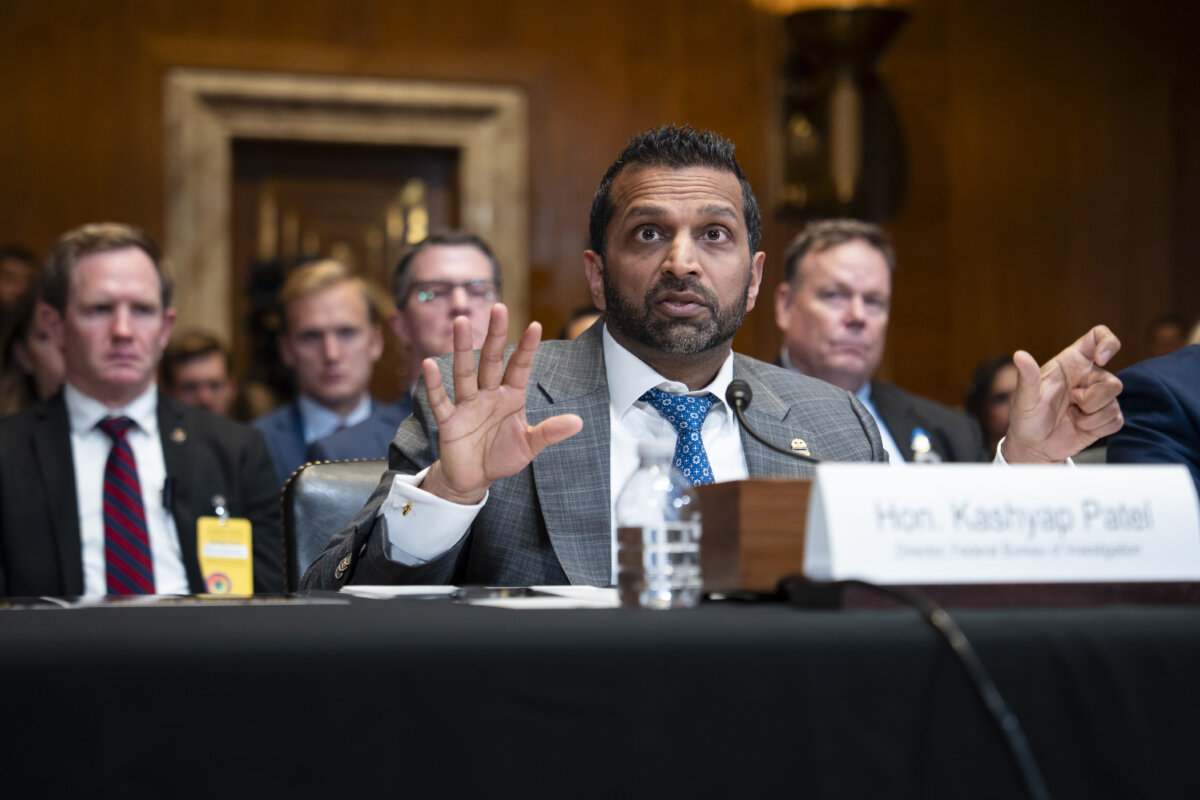

The FBI has arrested 113 active spies from foreign nations, agency director Kash Patel said on July 8.
“[The arrests mean] our tech stays home and our defense secrets stay locked down,” a video shared by Patel on X said. “But the FBI didn’t stop there. They forced 62 removals of Chinese spies in 2026 alone.”
The video stated that this has shattered the deep cover operations of the Chinese Communist Party (CCP) against the United States.
The House Committee on Homeland Security released a report in February 2025 detailing multiple cases of espionage conducted by the CCP in the United States since 2021.
The cases, spread across 20 U.S. states, involved the transmission of sensitive military information to Beijing, stealing trade secrets to benefit the regime, transnational repression schemes targeting Chinese dissidents, and obstruction of justice. Every 12 hours, the FBI opened new cases to counter Beijing’s intelligence operations, according to the report.
The report noted that the CCP’s theft of U.S. intellectual property amounts to roughly $4,000 to $6,000 annually per American family of four after paying taxes.
In one prominent case, a senior adviser to the State Department was arrested in October 2025, accused of taking thousands of top-secret documents and meeting with Chinese officials. The individual allegedly downloaded and saved documents related to U.S. fighter jets and weapons capabilities.
On Jan. 12 this year, the Department of Justice (DOJ) announced that a former U.S. Navy sailor was sentenced to 200 months in prison for spying for Beijing.
The person had access to sensitive national defense information about the amphibious assault ship USS Essex, such as its weapons, propulsion, and desalination systems. These ships are a “cornerstone of the U.S. Navy’s amphibious readiness and expeditionary strike capabilities,” according to the DOJ statement. The sailor sold critical information to a Chinese intelligence officer for $12,000.
More recently, on June 4, the DOJ announced that a U.S. citizen pleaded guilty to acting as an agent for China. The man, who lived in China, would travel to the United States to meet with individuals who could provide him, and ultimately the Chinese Ministry of State Security, with important information.
Digital Threats, Cartels
The video shared by Patel also said that the FBI has been successful in countering cyberthreats.
On Jan. 8, the FBI issued an alert warning about a North Korean state-sponsored cyberthreat group targeting American entities with a QR code phishing scheme to steal sensitive information. As of last year, threat actors from the group targeted academic institutions, think tanks, and U.S. and foreign government entities.
Last month, the DOJ said that 13 internet domains backed by suspected Chinese agents were seized by authorities. The domains were used to target Americans with security clearance to access classified government information.
The FBI is now targeting cartels as foreign terrorists, which has led to the arrests of about 4,800 cartel members, the video said.
Despite the ongoing crackdown, cartels are shifting drug trafficking tactics. During a Senate committee hearing on May 12, top law enforcement officials raised concerns about some Mexican cartels’ moving operations to Canada to manufacture and distribute fentanyl.
Terry Cole, head of the Drug Enforcement Administration, said there have been “significant seizures” of fentanyl in Canada over the past months.
At the hearing, Patel said: “The drug traffickers got smart with the securitization of the southern border and moved it up [to Canada]. So we’re tackling that with our seize partners.”
 Friends Read Free
Copy
Facebook
Tweet
Friends Read Free
Copy
Facebook
Tweet