Commentary
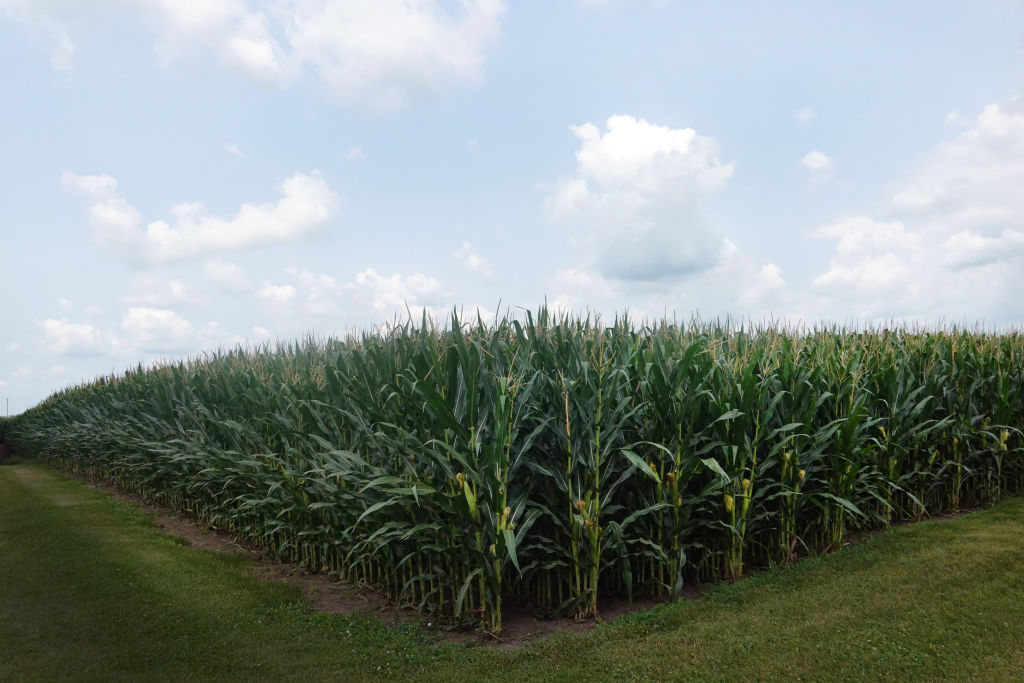
“There’s no food here.” The statement jolted me out of my gawking reverie at the heartland of America. The driver my Amish hosts had sent to pick me up at the airport in Champaign, Illinois, knew I was impressed by mile after mile of corn and soybeans on land flat enough to play billiards.
I was speaking as a guest of the Amish at their American signature event, Horse Progress Days, held every year in early July. It rotates locations around Illinois, Michigan, Ohio, and Pennsylvania, attracting as many as 40,000 folks, primarily Amish, to celebrate a way of life that each year appears more archaic.
From my rolling-hill farm in Virginia’s Shenandoah Valley, these seemingly horizonless flat miles of corn and soybeans showcase everything that is wrong in American agriculture. In 30 miles, I didn’t see a farmer. I didn’t even see a tractor. Occasionally, a massive grain elevator with Syngenta or ADM (Archer Daniels Midland) prominently emblazoned on the side sprouted from the landscape, an interruption in the otherwise monotonous fields of corn and soybeans.
In the 30-mile run from the airport to the hosting Horse Progress Days farm, I saw one piece of old, broken-down boundary fence, perhaps 100 yards long. Otherwise, no fences. Once we got into the heart of the Amish community, we saw fences around horse paddocks, but no cows, sheep, pigs, or chickens. It was an animal-less landscape.
As the driver and I conversed and I vocalized my awe at fields bigger than most Virginia farms, he matter-of-factly dropped the bombshell: “There’s no food here.” It seemed like an innocent observation, but it captured in a nutshell this place without life, without sustenance.
You can’t eat soybeans. You can’t eat field corn. In fact, half the soybeans are exported, and nearly half the corn goes to ethanol production. Saturated with chemical fertilizers and genetically modified organisms, these monocultures exist only because the federal government takes a portion of my hard-won earnings in taxes to make sure an agriculture this absurd continues to exist.
While nothing is inherently wrong with corn or soybeans as animal feedstocks, subsidizing the production of twice as much as we need is imbalanced on numerous fronts. Especially when we’re desperate for beef that would truly be profitable on perennial prairie forages.
Illinois, like all the other “fly-over” mid-America regions, imports 95 percent of its food. Even the food locals eat, made from corn and soybean derivatives, is largely exported to processing facilities before being imported in a box or can for human consumption.
The fundamental flaw in this agricultural system is that it is segregated rather than integrated. The fertilizer comes from a foreign country; the seeds come from highly centralized industrial facilities; train cars bring in chemicals from elsewhere; the grain is exported, much of it to feed animals in concentrated animal feeding operations; the animals are processed somewhere else, and then the meat, poultry, or eggs are shipped across the country to urban outlets a thousand miles away.
The biological and ecological cycles don’t exist here. Indeed, a stranded traveler would starve to death in these luxuriant fields. During my two days at the festival, many young aspiring farmers, both Amish and English (that’s what Amish call anyone non-Amish), lamented the high cost of land, making it difficult for them to start an enterprise. “Why is it so expensive?” I asked.
The answer never wavered: “Government subsidies that artificially inject billions into corn and soybeans, creating a false sense of profitability.”
Every time one of these aspiring young farmers gave me that answer, I couldn’t help but think about the $12 billion the Trump administration recently gave soybean farmers to help them through their 2025 average $100-per-acre loss.
Was I justified in resenting these subsidies? To even resent these farmers who demand subsidies when the world is awash in their product? Are these farmers so disconnected from market reality and politicians so spineless as to think it’s virtuous to take money from me and give it to an absurd system?
I felt righteous indignation well up in my soul as I looked across these square miles of chemicalized, eroding farmland that had once grown food.
It fed Native Americans with berries, animals, tubers, nuts, and waterfowl. It was a diverse, abundant ecosystem that fed the folks in its womb. In pre-European times, it produced more food than it does today; not all of it was eaten by humans, but it was more total food. Today, it’s a wasteland of abundance, utterly dependent on taxpayer largesse and Conquistador poisons. Defending and funding such an ecological and societal disaster cannot be justified.
Just 50 years ago, this land had fences. It had pastured livestock. It had multitudes of farmers and thriving small towns. Some century-old barns still stand, vacant and stark, as out of place in these monoculture fields as the grain elevators.
Not long ago, these lands supported many farmers, all of whom grew diversified crops, forages, and livestock in biologically representative rotations, self-fertilizing through closed loops of production and waste. What farms sold represented a small leak in an otherwise relatively self-regenerating cycle. And a large part of their production stayed within the state to feed proximate communities.
This subsidized and unnecessary corn-bean debacle is a perfect example of hitting the bull’s-eye on the wrong target. We’ve learned how to mine, transport, chemicalize, and invent massive equipment, but nobody asks, “Why do we need this much corn and beans?” Such a simple question, but the answer is profound. We’ve become extremely successful at the wrong thing.
Unfortunately, these farmers have become dependent on the welfare state and believe they deserve to be paid to grow unnecessary crops. If half of them went out of business tomorrow, it wouldn’t affect America’s food supply at all. As Al Gore would say, that’s an “inconvenient truth.”
We should quit stealing taxpayer income to prop up an oversupplied market. That’s just the economic angle. I haven’t even mentioned a dead zone the size of Rhode Island in the Gulf of Mexico (America), eroded soil, and depleted aquifers from irrigation. The ecological dysfunction is just as devastating as the economic and social.
Eliminating all subsidies would force farmers to contemplate their decisions based on market conditions. Isn’t that a novel thought?
Views expressed in this article are the opinions of the author and do not necessarily reflect the views of The Epoch Times.
 Friends Read Free
Copy
Facebook
Tweet
Friends Read Free
Copy
Facebook
Tweet