
WASHINGTON—Immigration may not be a primary concern for most voters, but it could be a defining issue for many Asian-American and Latino voters.
Asian-American communities and Latinos rate the economy, jobs, and health care ahead of immigration, says Dr. Karthick Ramakrishnan, political scientist at the University of California–Riverside. But immigration is an important litmus test, he said.
Candidates’ attitude toward immigration is an important factor in “forming their opinions and impressions of candidates and parties,” Dr. Ramakrishnan said. Although voter turnout is expected to be lower than in 2008, Latino voters contributed significantly to Obama’s success in the last election.
Asian-Americans are presently leaning toward Obama in the election, although one-third remain undecided, according to Ramakrishnan, who is also director of the nonpartisan National Asian American Survey (NAAS).
Among Asian-American voters, different ethnicities trend toward different candidates, with Indian and Korean voters trending toward Obama and Filipinos toward Romney.
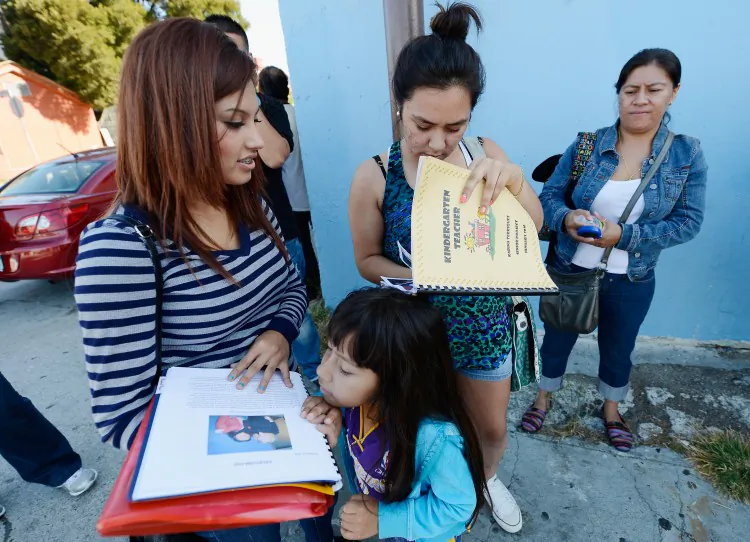
Several states have passed laws targeting undocumented immigrants that have impassioned Latino voters.
President Obama is presently the favored candidate among Latinos, says Angela Maria Kelley, vice president of immigration policy at the Center for American Progress, citing approval ratings in excess of 60 percent.”I think with the Hispanic-dominant voters, he is even higher,” she said.
Obama lost some of his Latino supporters when the deportation of undocumented immigrants increased in his first term. Deportations reached a record high of around 400,000 according to the Pew Research Center, and the media often reported cases of families torn apart.
“I don’t think it is easily erased in the memories of many people in this country” Kelley said.
The president has continued to push for the DREAM Act (Development, Relief, and Education for Alien Minors), which would grant a path to citizenship to children of undocumented immigrants.
While the DREAM Act has languished in Congress, Obama issued an executive order this June that offered a temporary solution. The Deferred Action for Childhood Arrivals program provides a two-year reprieve from deportation for around 2 million undocumented youth, allowing them to work legally and go to school.
“The president went a long way in closing this gap by announcing the deferred action program,” Kelley said.
Candidates’ Policies
Obama favors comprehensive immigration reform and strict border control, outlined in a blueprint for immigration reform. He supports a path to legalization for an estimated 11 million undocumented immigrants, many of whom came to America during the boom years in the 1980s and 90s, when labor was needed and immigration enforcement relaxed.
Mitt Romney also advocates immigration reform and strict border control. He has proposed building a “high-tech fence to enhance border security” but he is opposed to programs like the deferred action program, which he says will encourage illegal immigration.
“Governor Romney opposes all ‘magnets’ that entice illegal immigrants to come to our country,” his campaign website states.
Immigration enforcement presently comes under federal jurisdiction, but Romney would like to see the states able to vigorously enforce immigration laws, and seems unconcerned about the possibility of racial profiling or inequitable enforcement. He expressed disappointment when the Supreme Court ruled against most of the 2010 Arizona immigration law SB 1070 (later amended by HB 2162), proposing “more latitude, not less, to the states.”
Obama praised the Supreme Court ruling saying, “A patchwork of state laws is not a solution to our broken immigration system—it’s part of the problem.”
Work-Visa Processing
Mitt Romney would like to see more H-1B visas granted to high-skill job creators and innovators, and has particularly advocated for increasing the number of visas for foreign-born students who specialize in STEM (science, technology, engineering, and math) fields to fill positions where employers have shortages.
He would like to see fewer requirements for work visas, the speed of visa processing increased, and quotas for countries reviewed.
Obama also supports reform of the H1-B visa process, but does not explicitly advocate increasing the visa quota.
Economist Pia Orrenius, assistant vice president of the Dallas Reserve Bank and a former adviser on immigration to the Bush administration, says research has “overwhelmingly” shown that high-skilled immigrants benefit the economy, yet it remains a much neglected area.
“We have very strict limits on high-skilled immigration, despite the fact that is it so beneficial,” Orrenius, a visiting scholar at the American Enterprise Institute told The Epoch Times. Both Democrats and Republicans say they support it, she said, “but we really haven’t seen anyone come together on it.”
Tipping the Balance
Although Asian-Americans, whose high-tech skills are sought after, will likely benefit from visa reforms, it is not the issue affecting community attitudes the most, says Ramakrishnan. Asian-Americans have been most influenced by the tone of the debate on immigration, he said.
“Generally speaking, on the Republican side, you have activists that just speak generally about immigration in pretty negative and restrictive ways,” Ramakrishnan said. Language used during Republican primary debates particularly unsettled Asian-Americans, who felt marginalized by the attitudes expressed, he added.
That same negative tone, combined with a harsher position on undocumented immigrants and support for certain state laws, has turned Latinos, who once supported Republican President George W. Bush in large numbers, away from Republicans, Kelley believes.
For Latinos, all they see from Republicans is “enforcement and enforcement all the time,” she said.
With the election still a month away, there is room for positions to shift on presidential candidates. While immigration isn’t getting much attention on the campaign trail, Kelley expects it to have a more prominent place in the presidential debates.
“Immigration tends to pop its head up in all kinds of unlikely places when no one expects it,” she said. “It tends to be an issue that gets attention.”
The Epoch Times publishes in 35 countries and in 19 languages. Subscribe to our e-newsletter.
 Friends Read Free
Copy
Facebook
Tweet
Friends Read Free
Copy
Facebook
Tweet