
In the more than 125 years since the United States helped liberate Cuba from Spanish rule, the relationship between the two countries has shifted from close economic and military ties to ideological hostility, economic sanctions, and isolation.
As Cuba faces one of its most severe crises in decades, questions about the island’s future and the possibility of a U.S.-backed regime change have once again come to the spotlight.
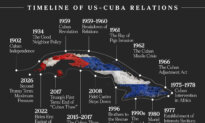
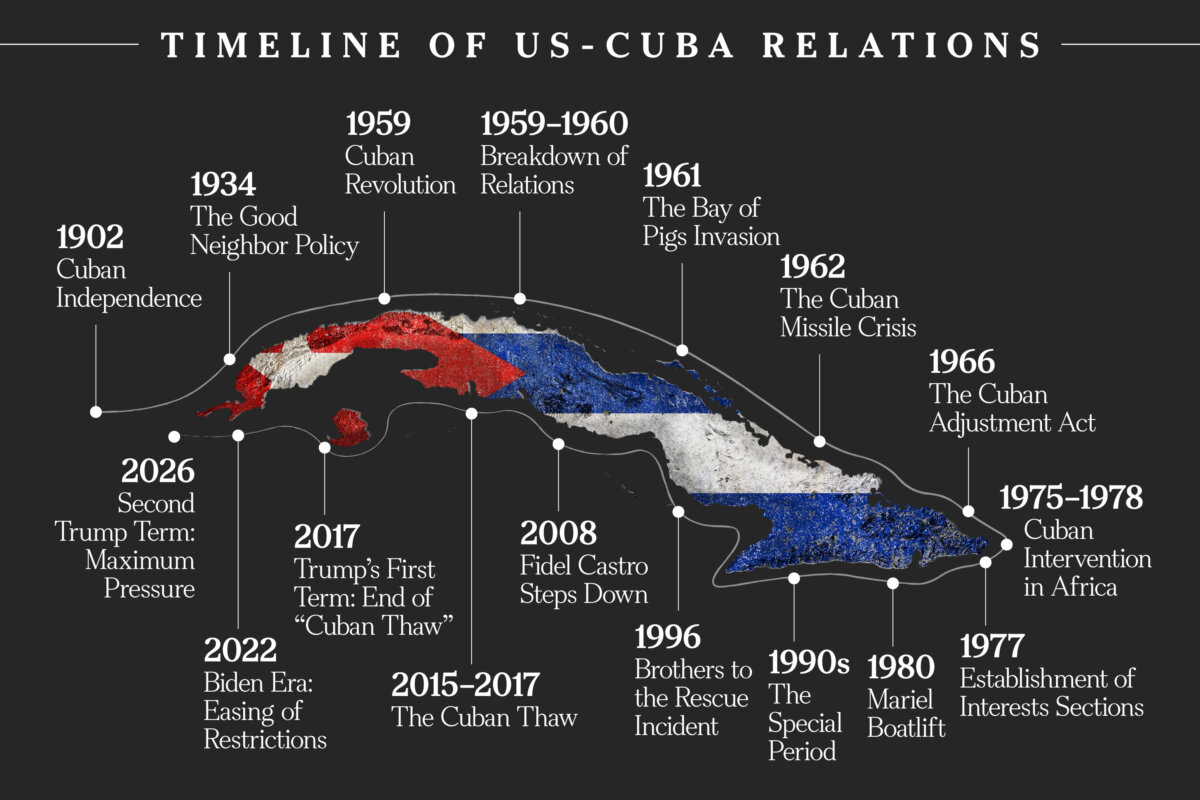
Here is a timeline of key moments that have shaped U.S.–Cuba relations since 1898.
Cuban Independence, 1902
In 1898, the United States intervened in Cuba’s war for independence against Spain, helping bring an end to more than four centuries of Spanish colonial rule on the island.
The intervention followed the explosion and sinking of the USS Maine in Havana Harbor on Feb. 15, 1898. Although the cause of the explosion remains disputed, the incident intensified U.S. calls for action. The Spanish–American War began in April that year, and U.S. forces defeated Spain in less than four months. As a result, Spain relinquished sovereignty over Cuba.
After a brief U.S. military occupation, Washington granted Cuba formal independence in 1902. As a condition of ending the occupation, the U.S. government required Cuba to adopt the Platt Amendment into its constitution. The amendment granted the United States the right to intervene in Cuban affairs to defend the island’s independence and lease 45 square miles of land and water at Guantánamo Bay for its coaling and naval stations.
The Good Neighbor Policy, 1934
In May 1934, President Franklin D. Roosevelt abrogated the Platt Amendment by signing the Cuban–American Treaty of Relations, as part of his Good Neighbor Policy toward Latin America. Roosevelt focused on cooperation and trade instead of using military force to keep the region stable.
Even after the Platt Amendment ended, the United States kept its permanent lease on the Guantánamo Bay naval base. In 1934, the yearly lease payment rose to $4,085 in U.S. dollars from $2,000 in gold coins.
Cuban Revolution, 1959
On Jan. 1, 1959, Fidel Castro’s guerrilla movement overthrew U.S.-backed dictator Fulgencio Batista. Castro then assumed leadership of Cuba and remained in power until 2008.
The United States initially recognized the new government. Throughout 1959, Castro publicly denied being a communist.
Just four months after the revolution, the 33-year-old leader traveled to the United States for an 11-day goodwill tour. President Dwight D. Eisenhower declined to meet him, choosing to leave for a golfing trip in Georgia. Instead, Vice President Richard Nixon hosted Castro for a meeting lasting nearly 2 1/2 hours.
“He is either incredibly naive about Communism or under Communist discipline—my guess is the former,” Nixon concluded after his meeting with Castro.
Castro’s visit attracted a lot of media attention, with reporters repeatedly questioning him about communist infiltration within his government. Despite his broken English, he gave many interviews and public remarks denying the speculation. On NBC’s “Meet the Press,” for example, he stated that he was not a communist and did not agree with communist ideology.
Breakdown of Relations, 1959–1960
Soon after returning to Havana, Castro introduced radical agrarian reforms that affected many American-owned sugar plantations in Cuba. These measures raised concerns in Washington, and relations between the two countries began to deteriorate rapidly.
At the same time, the Cuban government became closer with the Soviet Union. In February 1960, Cuba hosted Soviet Vice President Anastas Mikoyan for a 10-day visit, which resulted in a trade agreement and a $100 million low-interest loan for the island.
Tensions escalated further in June 1960, when the U.S. Congress considered legislation to cut off sugar purchases from Cuba. Castro accused the United States of trying to undermine his government and threatened that he would nationalize everything Americans owned in Cuba, “down to the nails in their shoes.”
When American-owned refineries refused to process Soviet crude oil, Castro responded by seizing the facilities in June 1960.
The following month, the Eisenhower administration cut Cuba’s sugar quota, a major turning point in U.S.–Cuba relations and the foundation for a decades-long U.S. economic embargo on the island.
In retaliation, the Cuban government nationalized most U.S.-owned properties on the island, deepening the rift between Washington and Havana.
The Bay of Pigs Invasion, 1961
In January 1961, during the final days of his administration, Eisenhower closed the U.S. Embassy in Havana, formally breaking diplomatic ties with Cuba.
Three months later, President John F. Kennedy authorized the CIA-planned Bay of Pigs invasion. About 1,500 U.S.-trained Cuban exiles landed on Cuba’s southwestern coast in an attempt to overthrow Castro’s government. The operation ended in a humiliating defeat for the United States.
The death toll for Cuban exiles was more than 100, and about 1,100 survivors were taken prisoner and later repatriated.
The failed operation strengthened Castro’s ties with Moscow and led him to formally declare the socialist nature of the Cuban revolution.
Determined to remove Castro from power, Kennedy authorized a major covert campaign called Operation Mongoose in November 1961. He put his brother, Attorney General Robert F. Kennedy, in charge of overseeing the operation, which involved economic and psychological warfare and paramilitary operations to overthrow the communist regime. The campaign was disbanded following the Cuban missile crisis in 1962.
The Cuban Missile Crisis, 1962
In July 1962, Soviet Premier Nikita Khrushchev secretly made an agreement with Castro to deploy nuclear missiles in Cuba as a deterrent against a future U.S. invasion. Construction of missile sites began later that summer.
On Oct. 14, 1962, a U.S. U-2 aircraft took several pictures showing the Soviet nuclear missile sites under construction. The discovery brought the United States and the Soviet Union to the brink of nuclear war.
Kennedy warned Khrushchev and demanded the removal of the missiles. He also ordered a naval quarantine of Cuba.
The 13-day Cuban missile crisis ended when Khrushchev agreed to dismantle and remove the missiles in exchange for a public pledge from Washington not to invade Cuba. The peaceful resolution to the crisis strengthened Kennedy’s image domestically and internationally.
As part of a separate and confidential agreement, the United States also removed its Jupiter missiles from Turkey the following year.
The Cuban Adjustment Act, 1966
The Cuban population in the United States increased to 439,000 from 79,000 between 1960 and 1970 as many dissidents and refugees fled the communist regime.
To address the influx of Cuban exiles, Congress passed the Cuban Adjustment Act, granting permanent residency and a path to U.S. citizenship to any Cuban national who had lived in the United States for at least one year. President Lyndon B. Johnson signed the bill into law on Nov. 2, 1966.
Cuban Intervention in Africa, 1975–1978
In the mid-1970s, Africa emerged as a battleground in the Cold War between the United States and the Soviet Union. Cuba joined the competition, dispatching its own troops to the continent.
To promote communism in Africa and elevate Cuba’s international standing, Castro began to deploy tens of thousands of troops to support Marxist movements in Angola (1975) and Ethiopia (1977). The move complicated U.S. efforts to normalize relations with Havana.
In 1977, Cuban troops were also directly involved in an internal purge in Angola after a split within the ruling communist People’s Movement for the Liberation of Angola Party. Amnesty International and historians estimate that between 30,000 and 80,000 Angolans were killed or disappeared during this violent crackdown.
Establishment of Interests Sections, 1977
When President Jimmy Carter assumed office in 1977, he worked to normalize relations with Havana. He also lifted restrictions on travel to Cuba.
During this period, the United States and Cuba also agreed to open “interests sections” in Havana and Washington with the official support of the Swiss government, establishing a direct but limited channel for official communication.
Mariel Boatlift, 1980
The Mariel boatlift was a large-scale exodus from Cuba that exposed the serious economic crisis on the island and widespread dissatisfaction with the communist regime. Between April 1980 and October 1980, approximately 125,000 Cubans fled to the United States from Mariel Harbor.
The crisis began when a group of Cubans hijacked a bus and crashed through the gates of the Peruvian Embassy in Havana to seek political asylum. Within a few days, more than 10,000 people poured into the embassy grounds, demanding to leave the island. Because of overcrowding, people climbed into the trees, onto the iron gate, and even onto the embassy roof.
In response, Castro announced that anyone wishing to leave Cuba could do so if he had someone to pick him up from Mariel. Thousands of Cuban Americans in Florida arranged boats to rescue their relatives.
The regime labeled those departing Cubans as gusanos (worms) and traitors, and organized mobs to intimidate and harass them.
Miami’s population increased dramatically, and many voters criticized Carter for not handling the crisis well. This criticism played a part in his loss to Ronald Reagan in the 1980 presidential election.
The Special Period, 1990s
The collapse of the Soviet bloc between 1989 and 1991 was both a political and economic shock for Cuba.
For three decades, the Soviet Union heavily subsidized the Cuban economy by purchasing Cuban sugar at inflated prices and selling oil to the island at significant discounts.
When the Soviet Union collapsed, that support vanished almost overnight. In response, Castro declared an extended state of economic emergency known as the Special Period (Período Especial). Throughout the 1990s, Cubans faced famine, food and medicine shortages, frequent blackouts, and a collapse of the transportation system.
In the late 1990s and early 2000s, Cuba found a new economic lifeline when Hugo Chávez, a socialist, assumed power in Venezuela in February 1999.
Brothers to the Rescue Incident, 1996
In February 1996, Cuban military MiGs shot down two unarmed civilian planes operated by Brothers to the Rescue, a Miami-based humanitarian group, killing three U.S. citizens and one lawful resident.
The humanitarian group initially flew missions to spot Cuban rafters at sea and assist the U.S. Coast Guard in rescuing them. Over time, it also became involved in political activism, conducting flights near Cuba and occasionally entering Cuban airspace to drop anti-Castro leaflets over Havana.
An independent investigation by the International Civil Aviation Organization found that the two planes were shot down in international airspace. The incident drew fierce international condemnation and hardened President Bill Clinton’s stance toward Havana.
Soon after the incident, Congress passed the Helms–Burton Act, which reinforced and codified the long-standing U.S. economic embargo on Cuba into law.
On May 20, 2026, the U.S. Justice Department indicted Raúl Castro, former president and defense minister of Cuba, on murder charges for his alleged role in the 1996 incident.
Fidel Castro Steps Down, 2008
In 2008, Fidel Castro resigned as Cuba’s president after 49 years in power because of health issues. His formal resignation cleared the way for his brother, Raúl Castro, to assume the presidency, marking the end of an era.
Fidel Castro died in 2016 at the age of 90.
Raúl Castro held the presidency until he stepped down in 2018. He also left the leadership of the Communist Party of Cuba in 2021. Miguel Díaz-Canel took over both positions after him.
The Cuban Thaw, 2015–2017
In December 2014, following 18 months of secret negotiations brokered by Pope Francis, President Barack Obama announced that the United States would reestablish diplomatic relations with Cuba, ending 54 years of official isolation.
“We will end an outdated approach that for decades has failed to advance our interests,” Obama said in a White House speech.
This started a period of normalized relations between the two countries, known as the Cuban Thaw, from July 2015 until June 2017.
In May 2015, the Obama administration officially removed Cuba from the U.S. State Department’s State Sponsors of Terrorism list.
In July 2015, both countries reopened their embassies in Washington and Havana for the first time since diplomatic ties were severed in 1961.
During his first term, Obama also eased restrictions on Cuban Americans traveling to Cuba and removed the cap on remittances they could send to family members on the island.
In 2016, Obama used executive actions to ease Cold War-era travel restrictions by permitting commercial flights and cruise ships to operate between the United States and Cuba.
On March 20, 2016, Obama took a major step in the normalization of relations and traveled to Cuba for a three-day visit. He became the first sitting U.S. president to visit Cuba since President Calvin Coolidge in 1928.
During his visit, Obama met with Raúl Castro, attended a baseball game between the Tampa Bay Rays and the Cuban national team, and delivered a speech broadcast across Cuba.
Trump’s 1st Term: End of Cuban Thaw, 2017
After President Donald Trump took office in 2017, the U.S. government quickly reversed the Cuban Thaw policy, calling it a “one-sided deal.”
On June 16, 2017, Trump signed a national security presidential memorandum in Miami’s Little Havana that moved U.S. policy back to economic containment. The order banned direct U.S. financial transactions with Grupo de Administración Empresarial S.A., the military group that controls much of Cuba’s economy. The administration also tightened travel restrictions.
Trump also blamed the communist government for the unexplained health problems affecting American diplomats in Havana, known as Havana syndrome. In late 2017, he withdrew more than half of the staff from the U.S. Embassy.
In 2019, the Treasury Department also announced new limits on money transfers to Cuba as part of tighter U.S. sanctions.
In a historic move, Trump also allowed U.S. nationals to sue entities that benefit from property confiscated by the Cuban regime, a provision of the Helms–Burton Act that earlier U.S. presidents had usually waived.
The amount that Fidel Castro’s government confiscated is roughly equal to $9 billion in today’s dollars, according to estimates. Nearly 6,000 individuals and companies are now seeking compensation from the Cuban regime.
In January 2021, just days before leaving office, the Trump administration also put Cuba back on the State Sponsors of Terrorism list.
Biden Era: Easing of Restrictions, 2022
During his time in office, President Joe Biden decided not to restore the Cuban Thaw, but he did loosen some restrictions Trump imposed.
At the start of his term, Biden planned to review U.S. policy toward Cuba. However, the 2021 protests in Cuba changed those plans. In response to the Cuban regime’s harsh crackdown and mass arrests of protesters, Biden called Cuba a “failed state” and condemned its regime.
However, in 2022, Biden eased several Trump-era restrictions, particularly those on travel, visas, and remittances.
2nd Trump Term: Maximum Pressure, 2026
Trump’s return to the White House has brought back the “maximum pressure” campaign against Cuba, leading to a breakdown in formal relations between the two countries.
Following a U.S. military operation in Venezuela that resulted in the capture and removal of regime leader Nicolás Maduro on Jan. 3, Washington restricted oil shipments to Cuba. By cutting off subsidized Venezuelan oil, the Trump administration removed Cuba’s most critical economic lifeline. As a result, Cuba has entered a severe economic and energy crisis.
In recent weeks, Trump has intensified the U.S. pressure campaign by expanding sanctions on state-owned businesses, government agencies, and senior officials.
One of the most significant escalations since the Cold War occurred on May 20, when Raúl Castro was indicted on murder charges in the United States.
Washington’s latest actions signal that the goal is no longer to influence Cuba’s leaders but to hasten the regime’s collapse.
Conditions in Cuba continue to deteriorate, with daily blackouts and severe shortages of food, clean water, and basic medicine. Public frustration has fueled protests across the island.
Meanwhile, the arrival of the USS Nimitz and its strike group in the Caribbean on May 20 has fueled speculation that a U.S. military operation may be imminent.
Correction: A photo caption in a previous version of this article misstated which president wrote a letter to Cuban politician Tomás Estrada Palma. The Epoch Times regrets the error.
 Friends Read Free
Copy
Facebook
Tweet
Friends Read Free
Copy
Facebook
Tweet