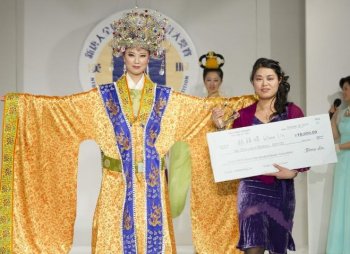
The costumes, called Hanfu, are traditional clothes of the Chinese and were designed by professionals from around the world who competed in New Tang Dynasty TV’s third Global Han Couture Design Competition.
Some of the costumes suggested the lucid streams along the southern banks of the Yangtze River, some were reminders of the glorious royal court of the capital’s Forbidden City, and some resembled the lightness and elegance of fairies shown in the mural art of Buddhist temples.
The handcrafted pieces, each telling an ancient story, brought Chinese history alive on the runaway stage.
Taking a closer look, even the inner garments featured hand-embroidered patterns that were previously drawn repeatedly as sketches by the contestants. When it comes to Hanfu, not even one inch from head to toe is left plain.
As audience member Christian Bernard recalled, the show was a “visual symphony of design, colors, fabrics, and jewelry.”
Please note that the article continues below.
[etssp 131]
Each of the costumes showcased clothing from the Tang (618–907), the Song (960–1279), or the Ming (1368–1644) Dynasty—three important periods when the Han ruled China over neighboring minority groups and their culture flourished.
While the main styles remain similar, each dynasty incorporated its own variations.
The Tang Dynasty was the most prosperous time in terms of culture and economy, so its people dressed in bright colors and prestigious styles. Women of the court liked long, wide and loose sleeves, sometimes long enough to trail on the ground when they walked.
Clothing of the following Song Dynasty inherited most of the late Tang styles. Yet the people praised preservation and added a more scholarly aspect to the clothing as Confucian studies flourished during the dynasty. Thus light and elegant colors were favored.
The Ming Dynasty’s first emperor personally directed the nation in reviving Hanfu after China was previously ruled by the Mongolians, who influenced the way the Chinese dressed. Clothes makers in the Ming Dynasty added more details to the designs. Handcrafting was well-developed, and more jewelry was attached to the garments and worn as accessories.
Usually people consider Qipao, the ethnic costume of the Manchurians, to be Chinese because the Manchurians ruled throughout the last dynasty, named the Qing Dynasty (1644–1912). Actually, Qipao is Manchurian and not Chinese.
Thus the authenticity of the style was one of the most important judging criteria in the competition, along with color combination and fabric selection. In order to learn about how people dressed in ancient times, the contestants had to research historical books and artworks.
 Friends Read Free
Copy
Facebook
Tweet
Friends Read Free
Copy
Facebook
Tweet