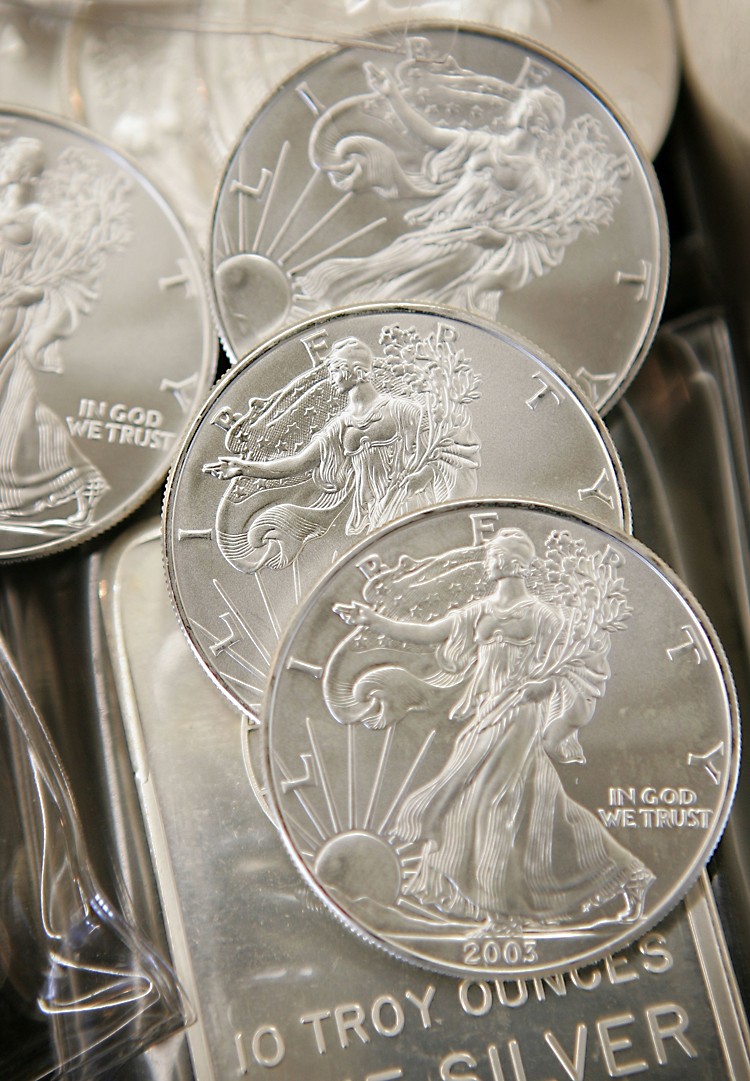
Silver, just as gold, has been monetized and doesn’t need a lending institution or broker to be bought or sold in the markets of any country. In spite of that fact, it might be difficult to carry a lot of the metal from place A to place B in large quantities.
“Both precious metals [gold and silver] are treated in the fiscal markets as “money,” the same way bonds and currencies are treated,” according an article on the SilverSeek website.
With the price of gold having reached $1,907 by Aug. 22, a price out of reach for a number of would-be investors, market experts suggest that people buy silver instead of gold.
“There is a compelling argument for silver investing because the economic and monetary fundamentals in place today are even more bullish than the conditions of the 1970s when the silver price exceeded $50 per ounce,” advised an article on the Monex Precious Metals website.
The total silver supply reached 1.1 billion ounces by the end of 2010, according to the Silver Institute.
While gold is mainly used for ornamental or investment purposes, almost 50 percent of all silver was used by various industries in 2010. Silver is used in batteries, as catalysts, and for electronic applications to make cell phones, smart phones, DVDs, and much more. About 16 percent is used for making jewelry and only about 17 percent is used for investments.
Historical Snapshot of Silver
Silver prices have risen significantly since 2000, when the cumulative average was $4.95 per ounce. Silver prices dropped slightly in 2001 and then edged up slowly until 2005 when they reached $7.32 per ounce on the London market according to Kitco Metals Inc.
In 2006, the average price of silver per ounce was at $11.6 and reached $20.19 by the end of December 2010. In the early morning of Aug. 22, silver prices hit an all-time high of $43.91 per ounce, having more than doubled since the end of 2010.
Silver prices were kept low for a number of years, with countries’ central banks selling their stockpiles, depressing the price.
With the price of silver being too low, mines have slowed down or closed operations, as the cost of mining was higher than the silver could be sold for, according to an article on the SeekingAlpha website.
It costs millions of dollars to open a new or reopen a closed silver mine, and it takes up to five years before full production can begin.
Silver, once used by the various industries for products such as cell phones, computers, and batteries, is no longer available. Therefore, “since 1980, the above-ground available gold stores have increased 600 percent, while above-ground available silver stores have been reduced 90 percent during the same time frame,” according to the SeekingAlpha article.
Manipulating the Silver Market
“Silver prices have a reputation of being manipulated, volatile, and less liquid,” said the owner of the IbeWealth website in an article.
In the 1970s, the Hunt brothers, American oil executives, began to hoard silver in an effort to manipulate the silver market, causing the 1980 silver price to peak for a very short time above $50 per troy ounce and the cumulative average for the year was $16.4 and kept decreasing to a low of $3.7 in 1992, when the market recovered slightly and silver prices began to move up slowly.
The Hunt brothers weren’t able to corner the silver market, and then lost a large amount of their fortune due to trading rule changes.
The brothers “did nothing illegal, [but] the Chicago Board of Trade (CBOT) and COMEX changed the rules in the middle of the game, the U.S. Commodity Futures Trading Commission (CFTC) implemented new regulations, and the Hunts were bankrupted, unjustly,” said an article on the SilverSeek website.
Then between mid-1997 and Jan. 12, 1998, Warren Buffet owned through Berkshire Hathaway 129.7 million ounces of silver, which was less than 2 percent of the cost of the firm’s investment portfolio. By 2006, Berkshire owned more than 37 percent of the global silver supply.
The firm had bought the silver at $6 per ounce and was quoted to have sold it at $7.5 per ounce, telling stockholders at the 2006 annual meeting, “I bought [silver] early and sold early. Silver was my fault. [Speculation] is wildest at the end, according to the Silver Monthly website.
Taking Market Manipulators to Court
Kaplan Fox & Kilsheimer LLP, a law firm, “filed a class action complaint in the United States District Court for the Southern District of New York, on behalf of an individual investor, against JP Morgan Chase and HSBC in connection with their alleged conspiracy and manipulation of the market for silver futures and options contracts traded on COMEX,” stated the firm’s press Nov. 4, 2010 release.
The complaint charges that JP Morgan Chase and HSBC conspired to suppress and influence silver futures and option contracts between 2008 and March 2010. This is considered a violation of Section 22 of the Sherman Act.
A former employee at Goldman Sachs reported discussions with agents of the two firms that centered on manipulating the silver futures and option market.
A criminal investigation ensued by the U.S. Department of Justice on Oct. 26, 2010.
“There have been repeated attempts to influence prices in the silver markets. There have been fraudulent efforts to persuade and deviously control that price,” said CFTC Commissioner Bart Chilton in a 2010 speech, published on the CFTC website.
In February, seven class-action suits, one filed by Girard Gibbs LLP, against JPMorgan and HSBC were consolidated into a multidistrict litigation proceeding in New York, as many of the witnesses reside in that area. The case is to be heard in Manhattan by Judge Robert P. Patterson.
“HSBC and J.P. Morgan made large, coordinated trades, among other things, to artificially lower the price of silver at key times when the precious metal should have been trading at higher levels. By depressing the price of silver, the class action alleges that the defendants made substantial illegal profits while harming investors and restraining competition in the COMEX silver futures market,” accused Girard Gibbs in a short description of the suit on its website.
There is no end to the silver saga. In Feb. 2011, Ramsey Personal Trust filed what to appears a class action law suit against UBS Financial Services Inc. and others in the UBS Group in the United States District Court Southern District of New York, accusing that the firm did not buy on his behalf 1,000 troy ounces of pure silver in 1984, yet charged a monthly $25 storage fee.
In 2007, Morgan Stanley was hit with a mass action lawsuit for charging storage fees for silver and other precious metals it supposedly bought on behalf of its clients. In 2011, Morgan Stanley was fined and forced to pay close to $4.5 million. Morgan Stanley never admitted guilt and just agreed to settle to get the case closed down.
“Defendants believe that the record demonstrates that they handled their customers’ precious metals accounts properly in all respects and that if the case were not settled, they would be entitled to summary judgment dismissing all claims,” according to the settlement agreement published on the GCG Inc. website.
Silver on the Radar Screen
“Although we have seen a quite strong rally by silver over the past week as expected, it is hard to reconcile the prospects for a continued rally in silver with the outlook for a substantial reaction by gold soon. This throws our wave count into question and opens up the risk of silver reversing back down from the upper-trend channel,” advised an entry on the SilverStrategies website.
The above quote is one of the few suggestions from the market that caution about buying silver. Many silver investment experts sent out recommendations to buy silver and curtail gold investments, as they foresee a collapse of the gold market, given its signification increases in value over the past months.
“If we look at the price of gold today [June 2011] at approximately $1,330, it pretty much equates to what happened in the last 30 years when gold was trading at a high of $850 an ounce. If you factor in inflation over the last 30 years, gold is probably lower now than it was 30 years ago,” said an article on the MarketClub Trader’s Blog.
The writer suggests that the market price of silver and gold hinges on the strength of the investor’s fear factor, while others suggest that it has a lot to do with the speculative instinct of investors. If the market normalizes, silver and gold will stabilize at a lower price as trading will reach normal levels instead of frenzied levels, although no one can predict when that will happen.
Silver commodity traders advise that the silver prices will rise throughout 2011 and 2012. Some predict a $55 threshold, while others foresee a $120 silver price ceiling.
“Basically, the main reasons behind the increase are one, the global economic recovery, and two, the industrialization and emergence of countries including China, Brazil, and India … Over the next ten years or more, metal prices are predicted to remain high … In particular China and India will drive the cost of metals across-the-board up,” suggested an article on the InternationalTrade@Suite101 website.
 Friends Read Free
Copy
Facebook
Tweet
Friends Read Free
Copy
Facebook
Tweet