
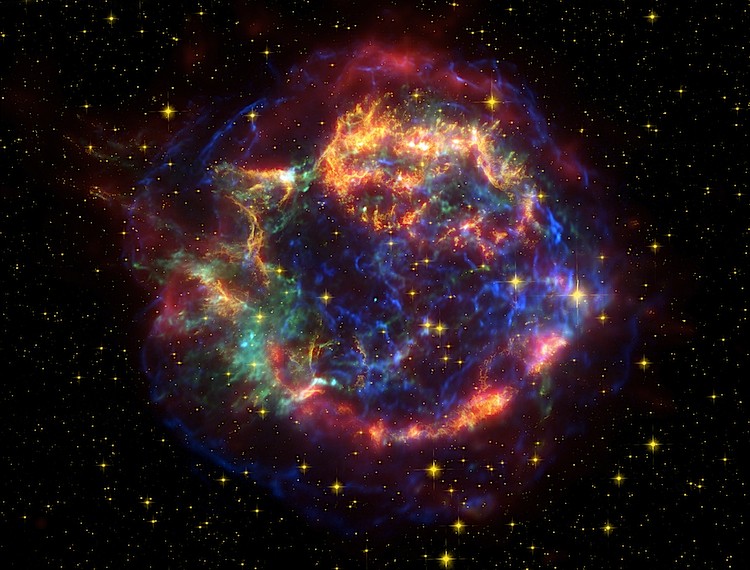
When stars die, the distribution of remnant masses would be expected to be continuous from white dwarfs through neutron stars to black holes, ranging from a fraction of our sun’s mass to nearly 100 solar masses.
However, the heaviest neutron stars are two solar masses at most, while the lightest black holes are at least five solar masses with almost nothing observed in between.
Recent observations of the masses of more than 20 black holes support this disparity. Although this lack may be due to observation biases that could hide low-mass black holes, Polish astrophysicist Krzystof Belczynski from the University of Warsaw and colleagues have tested out a hypothesis that the bifurcation is due to the supernova explosion mechanism.
Supernovae are produced during the collapse of a massive star. Stars below 20 solar masses produce strong explosions and low-mass neutron stars, while those bigger than 40 solar masses do not explode, directly forming a black hole.
Neutron stars and black holes are believed to form from core-collapse supernovae, when a star’s iron core can no longer support itself and the outer layers begin to collapse onto the dense core. This sends a shock wave outwards through the rapidly infalling layers that eventually stalls.
But if the explosion has sufficient energy to proceed past the shock wave, the supernova will be successful, and it is at this point that Belczynski’s team believes the final mass of the object is determined.
If it explodes, most of the mass will be lost, forming a neutron star. However, if it cannot push past this point, the object will collapse into a black hole. Astronomers predict that this deciding moment could last between less than a tenth of a second and one second.
According to the proposed model, the faster this phase occurs, the greater the bifurcation in the resultant objects. Therefore, the observed mass gap suggests the timing of this phase is the determining factor.
To match this gap, the team limited the explosion time to 100–200ms, which precludes any remnants in the 2–5 solar mass range. This gap is seen naturally when Rayleigh-Taylor instability fuels the explosive engine due to gravity acting differently on the inner and outer layers.
"The observed gap places strong constraints on the development of stellar collapse, with a rapid explosion model being strongly preferred," the authors wrote in their paper.
"This model predicts two distinct fates for a massive star: either a violent outburst which ejects most of the star and leads to neutron star formation, or a failed supernova wherein the entire star collapses to a black hole."
However, for other scenarios to match the gap, an extra source of energy is needed for the supernova to proceed, for example a magnetar phase.
"Alternatively, if in the future compact remnants are detected within the mass gap, this will indicate that on occasion delayed instabilities may revive the supernova explosion," the researchers concluded.
"The observation of a mass gap is thus a critical clue in unveiling the engine behind supernova explosions."
 Friends Read Free
Copy
Facebook
Tweet
Friends Read Free
Copy
Facebook
Tweet