In what could so easily be the true story that Rise of the Planet of the Apes was based on, Oscar winning Man on Wire director James Marsh trawls the archives to depict the harrowing plight of a young chimpanzee and the role he played in one doctor’s challenging theory that animals could learn language. This is the remarkable story of Nim.
Plucked from his mother’s arms shortly after birth, who’s to say that Nim would have had a better life than the one fate eventually dealt him? His home was hardly London Zoo’s Gorilla Island. But is it our right, and in particular, behavioural scientist Dr Herbert Terrace’s, to intervene in an attempt to satisfy a scientific experiment?
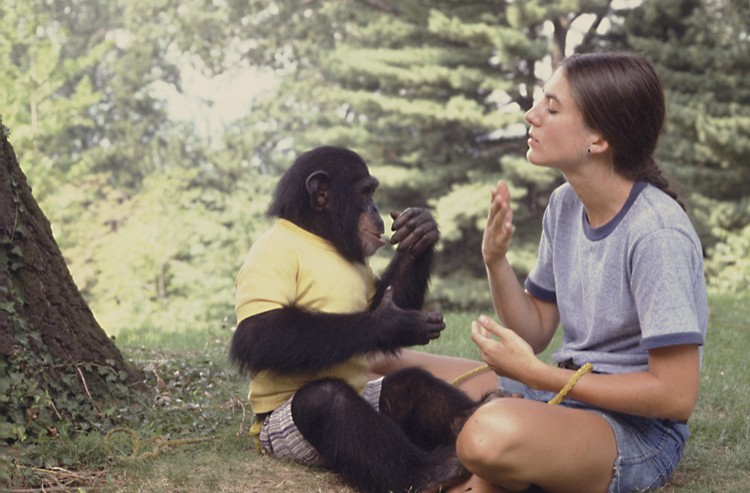
Placed in the care of a volunteer, free-spirited mother with liberal sensibilities (how Nim was administered his milk is particularly eye-opening), Nim spends his early life in a New York apartment block with several other children, raised for all intents and purposes as a human child. Nim’s journey takes him from human interaction to own-kind alienation, via some horrific animal testing, and towards a conclusion that only underlines how deplorable the human race can be towards those who share this planet.
Using a talking heads template, Marshall lines up the main influences on Nim’s life, wheeling them in and out of frame until their story is told. This is as much a study of humanity as it is that of the project; some are offered redemption for their actions without asking for forgiveness, others are nonplussed by their actions, unable to comprehend that imbuing this young primate with human characteristics from birth before abandoning him to his stunted instinct, is just plain wrong.
There are heroes and villains in the real life narrative. Dr Terrace’s underlying creepiness, especially towards those he was employing as surrogate mothers, is tempered by his statement that he never lost sight of the fact that Nim was an animal and treated him as such. The hero of the piece is Bob, a chimp handler who meets Nim in his most fragile state and forms a special bond, providing hope amongst the ignorance that has afflicted his life, and serving as a wonderful emotional pay-off come the touching finale.
As a documentary it does suffer from a lack of moving images, especially during the early years, which Marsh depicts mostly through still images and narration. What this does allow though, is for those rare moments of video to have a larger impact. A first encounter with other chimps is revelatory, and a reuniting with a long-lost friend is the doc’s strongest and most satisfying narrative arc.
It doesn’t touch Senna for documentary of the year, and the message may be one you’ve heard countless times before, but as a case-study and remarkable moral tale, this chimp is a champ.
 Friends Read Free
Copy
Facebook
Tweet
Friends Read Free
Copy
Facebook
Tweet