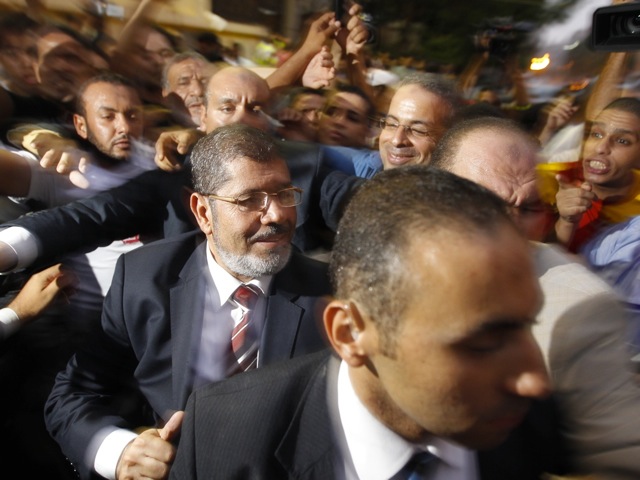
Egypt’s Muslim Brotherhood is claiming a victory for its presidential candidate Mohamed Morsi, even before votes are officially calculated from this weekend’s election.
The results of the second and final round of Egypt’s presidential elections are not expected to be announced until Thursday.
However, Morsi’s supporters have already claimed that he won with 52.5 percent of the vote, compared to 47.5 percent for rival candidate, ex-prime minister Ahmed Shafiq.
“Doctor Mohammed Morsi is the first Egyptian president of the republic elected by the people,” said the Brotherhood’s Freedom and Justice Party, in a tweet.
In a press conference on Monday morning, Morsi’s campaign manager Ahmed Abdelati said that votes at 13,000 polling stations had already been counted.
“It’s a moment that all the Egyptian people have waited for,” he said, in comments to Al Arabiya TV.
However, the result was immediately contested by supporters of Shafiq. “We are astonished by this bizarre behavior which amounts to a hijacking of the election results,” said Mahmud Barakeh, a campaign official to Shafiq, in comments to AFP news agency.
The claim from Morsi’s supporters came just hours after Egypt’s Supreme Council of Armed Forces (SCAF) issued a constitutional document giving military rulers sweeping legislative powers.
SCAF had given legislative power to the country’s elected parliament in January. However, last Thursday a constitutional court dissolved that parliament, citing irregularities in the electoral process.
The document issued by SCAF on Sunday means that the ostensibly interim military rulers will retake legislative power, and that new parliamentary elections will not be held until a constitution is drawn up by an appointed assembly.
The document also grants SCAF an effective veto power over any article in the new constitution it deems to be contrary to the interests of the country.
The move has raised concerns by analysts over the power of any newly elected president. “With this document, Egypt has completely left the realm of the Arab Spring and entered the realm of military dictatorship,” said Hossam Bahgat, a prominent human rights activist, in comments to the Washington Post.
“This is worse than our worst fears,” said Bahgat.
The Epoch Times publishes in 35 countries and in 19 languages. Subscribe to our e-newsletter.
 Friends Read Free
Copy
Facebook
Tweet
Friends Read Free
Copy
Facebook
Tweet