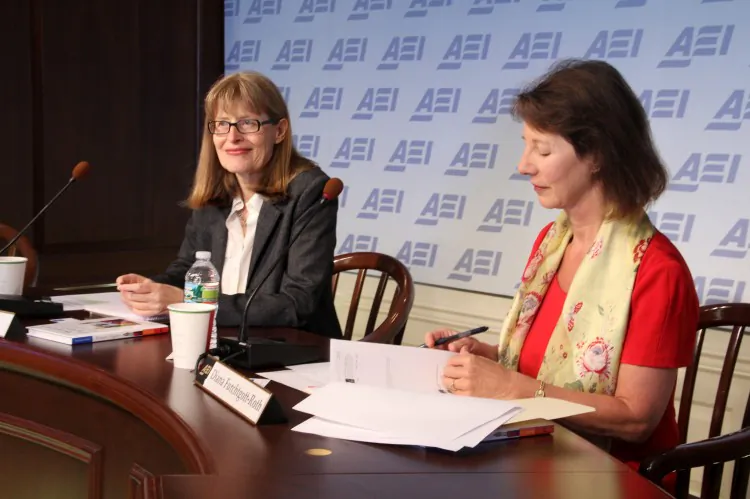

WASHINGTON—What each presidential candidate may offer women, and particularly working women, was the subject of an American Enterprise Institute (AEI) forum titled, Obama vs. Romney: What’s at stake for America’s working women? in Washington, D.C., Sept. 27.
More women than men will vote in the coming general elections, but both men and women are reacting differently to the candidates.
“Almost all polls show women prefer Obama by large margins and men prefer Governor Romney by narrow margins,” said Karlyn Bowman, political analyst with the Washington-based think tank the AEI.
Representing the conservative view was Diana Furchtgott-Roth, author and former chief of staff to President George W. Bush’s Council of Economic Advisers, who argued that there is no wage gap, that there is no glass ceiling, and that for government to regulate on perceived gender imbalances would only burden businesses already struggling with the economic downturn.
Furchtgott-Roth, a senior fellow at the Manhattan Institute, has just published a second edition of her book, titled, “Women’s Figures: An Illustrated Guide to the Economic Progress of Women in America,” in which she endeavors to debunk the glass ceiling and wage gap arguments.
She told the forum that it is true that women earn around 77 cents on a man’s dollar, but she argued that the figure is based on a simple average. It does not account for different choices women make in selecting careers, and neither does it account for the hours they work.
“It doesn’t mean that they are discriminated against, nor is it a social problem,” said Furchtgott-Roth at the forum.
Ariane Hegewisch, study director at the Institute for Women’s Policy Research (IWPR), complimented Furchtgott-Roth on her book, saying it was a “great collection of facts, ” but she disagreed with the interpretation of the data.
Like Furchtgott-Roth, Hegewisch believes that working women have made “great advances” over the last few decades, but at the forum she noted, “There are still a lot of gaps.”
Hegewisch outlined specific examples of wage inequality, explaining first how difficult it is to determine. In many workplaces, workers “are contractually barred from discussing their wages or are strongly discouraged.”
Because of the secrecy, the extent of discrimination is difficult to ascertain, and evidence is often found in lawsuits against companies for wage discrimination based on gender.
Hegewisch cited a recent case in the California Supreme Court involving Wal-Mart Stores Inc. Women were paid less in the cosmetics department than men were in the camera department of the store, and women were also excluded from working in the camera department, she said.
Hegewisch described three major areas of concern for working women in the coming elections: job security, equal pay and fair treatment, and support for juggling family commitments.
The role of government in addressing these gaps and the likely impact on the economy was where the two women differed most.
Furchtgott-Roth believes government regulation will harm businesses and the economy. “We don’t need additional regulation because that slows our economy,” she said.
Hegewisch believes public policy is important. “It supports economic growth and development if it is focused on these issues, rather than hindering economic development,” she said.
Candidate’s Positions
The Obama administration has identified investment in public services as more of a priority than Romney has, Hegewisch said. This is likely to appeal to women, as they are more likely to be employed in government services than men are.
Obama also supports the Paycheck Fairness Act, which allows a worker to disclose salary information, requires employers to justify wage discrepancies, and allows for more data collection.
Romney, who has not outlined specific policies for working women to date, has not indicated his position on the act, according to Hegewisch.
Obama has also said that he will prioritize enforcing existing wage and hour laws and minimal wage laws, which may appeal to women in low-paying jobs.
Hegewisch said she would like to see more support for working mothers.
“The United States is one of four countries in the world without a statutory right to paid maternity leave,” she said, noting that some other countries that support this right are “small and poor.”
Furchtgott-Roth said proposals like paid maternity leave, paid sick days, and more flexible working hours “all cost money.” She believes these types of changes will make American companies become over-regulated and uncompetitive.
Next Generation
Nadia Hammoud, a pre-med student who attended the forum as a congressional intern, said that it was interesting to hear both views, but it was also discouraging that women are not choosing higher-level jobs.
Wage inequality between males and females exists in the medical profession, Hammoud said, adding that she would be fighting for equal pay.
“I am working just as hard as my counterpart in the collegiate level, and I would be working just as hard in the workforce,” she said.
Ann Stehling, a government student from the University of Texas, agreed with Hammoud, saying that her peers would demand equality and would also be looking for that in policy.
“Seventy-seven cents to the dollar is not fair no matter how you frame an issue,” said Stehling.
The Epoch Times publishes in 35 countries and in 19 languages. Subscribe to our e-newsletter.
 Friends Read Free
Copy
Facebook
Tweet
Friends Read Free
Copy
Facebook
Tweet