
The Supreme Court of Indonesia ruled in favor of an independent radio station that was previously closed by the Ministry of Telecommunications and Information Technology under pressure from the Chinese Embassy. At a press conference held on Sept. 9, Lei Meng, the president of Radio Era Baru announced that the station would return to its original frequency 106.5 FM.
“The treatment against our radio station was unfair. Mounting evidence showed us that the Chinese Communist Party was behind the decision by the Indonesian government [to close the station]. We ask the government not to consider trade benefits with China only in the future,” said Lei. “The truth speaks for itself. We did not do anything wrong.”
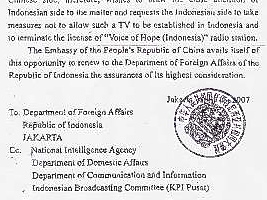
The evidence Lei spoke of included a letter directly from the Chinese Embassy in Jakarta to Indonesia’s Ministry of Foreign Affairs written in 2007. In the letter, the ministry was advised to “take measures and to not allow” the radio station “be established in Indonesia.”
The letter was copied to the National Intelligence Agency and other bodies, warning of damage to relations between Indonesia and China should Era Baru continue to broadcast.
Era Baru broadcasts in Indonesian but also in Chinese, meaning that it reaches the large population of ethnic Chinese living in Indonesia—a population the Chinese regime seeks to influence—and the heavy Chinese freighter traffic in the nearby sea lanes.
Era Baru’s programming includes reports on human rights abuses in China and political developments in China. It regularly broadcasts as a serial the Epoch Times editorial series “Nine Commentaries on the Communist Party,” which gives an uncensored account of the nature and crimes of the Chinese Communist Party (CCP).
Radio Era Baru, a branch of the outspoken, independent Chinese radio network South of Hope, opened in Batam, Indonesia, in 2005. Its broadcast consisted of programs about music, commerce, and news on China’s rights violations, politics, and society.
In 2007, the Ministry of Telecommunications and Information Technology rejected extending the permit for the station.
In 2009, Radio Era Baru’s frequency was transferred to another radio station, Sing FM.
In September 2011, authorities broke into the Batam-based office of Radio Era Baru, and despite protests by the broadcasters, took away the station’s broadcasting equipment and forced the station to close.
Gatot Machali, who was then the manager of the station, was later sentenced to a suspended six-month term in jail to be carried out a year later, according to Reporters Without Borders.
“The previous ruling against our station manager was unfair. We asked the court to reconsider the sentence and give Gatot justice,” Lei said.
Raymond Tan, director of Radio Era Baru, said in an email interview that he is awaiting two more decisions from the Supreme Court. One relates to the case of Machali, whose verdict he expects to be overturned. Another is a lawsuit filed by Era Baru against the Ministry of Telecommunications and Information Technology related to the broadcast permit.
The Epoch Times publishes in 35 countries and in 19 languages. Subscribe to our e-newsletter.
 Friends Read Free
Copy
Facebook
Tweet
Friends Read Free
Copy
Facebook
Tweet