
Civil unrest and large-scale protests have erupted this month across China. Despite the news blackout and Internet censorship strictly enforced by the Chinese Communist Party (CCP), information has spread through social networks.
The causes of these protests have been brewing for a long time, quite possibly since Deng Xiaoping said that whether it’s a black cat or a white cat, it doesn’t matter as long as it catches mice. The problem though, is that the cats are red, and this leaves no space for common people to obtain justice against official abuses of power. A lack of other avenues leads to mass protests and violent explosions of anger in the streets against officialdom.
So far this month six Chinese provinces have experienced unrest: Henan, Guangzhou, Guangxi, Zhejiang, Hubei, and Inner Mongolia. While the trigger for each protest has varied, the regime is now finding the long-festering frustrations and discontent with its rule erupt nationwide.
Thousands of angry residents surrounded a gas station in Taizhou, Zhejiang Province, Radio Free Asia reported. They demanded that the staff there produce documentation regarding compensation paid over the last nine years to a former head of a local village’s government. Residents have been skeptical that the bookkeeping for land compensation fees is reliable and suspect that funds have been embezzled by the former head and the CCP committee. When an investigation was demanded, the local government did not respond except to arrest the petitioning representatives.
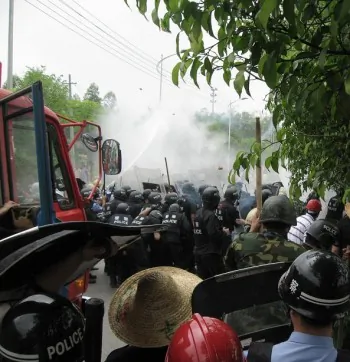
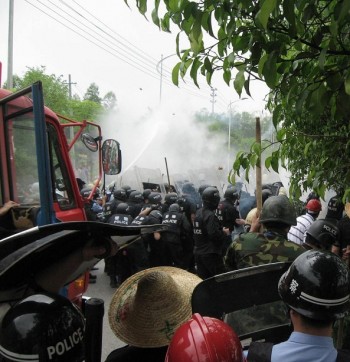
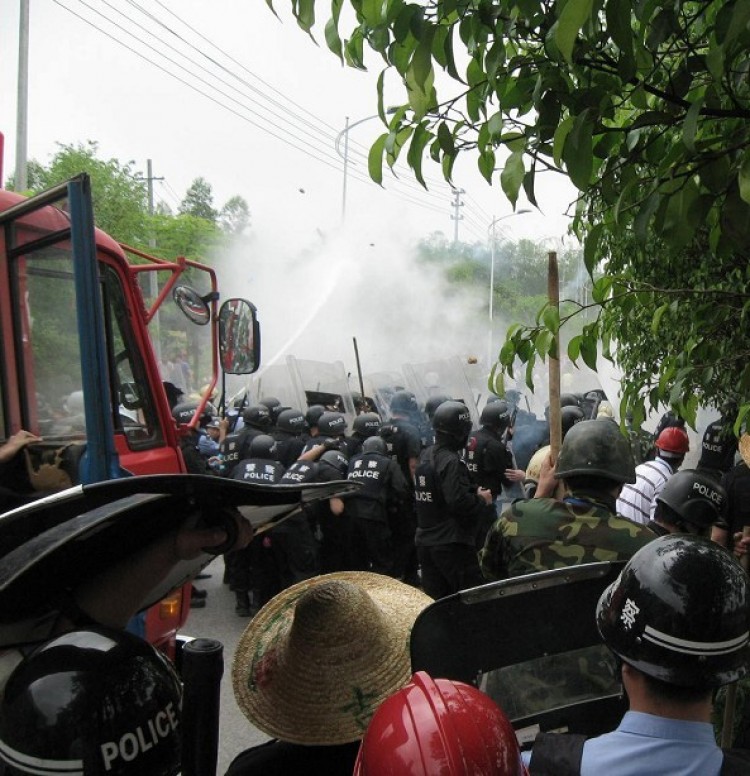
The crowd at the gas station, composed mostly of the elderly, was forcefully dispersed on the afternoon of June 15 by riot police wielding nightsticks. A dozen were arrested, including a village chief and other democratically elected representatives. The unrest in Taizhou was not quelled until June 16 when police reinforcements arrived and martial law was imposed, says the Information Center for Human Rights and Democracy, based in Hong Kong.
News of protests which occurred April 29 in Nanning City, Guangxi, also broke through the Internet blackout. The local authorities intended to forcibly tear town all the factories and warehouses in the village, which would subject villagers to financial losses in the billions of yuan. Villagers strongly resisted the demolition and thousands appeared on the streets of Sanjing.
A local resident informed The Epoch Times that when the armed police were sent in, they dispersed the crowds with tear gas and used electric batons to beat unarmed farmers.
“It’s a horrible sight. The police and local government officials were like bandits. They teamed up to attack a local man and attempted to beat him to death.” Cars, both passing-by and parked, were smashed by the police, and after arresting many people, the police went door-to-door searching for adult males.
On June 12, 400 residents in Zhengzhou, Henan, unhappy with the compensation offered for forced eviction, protested in the streets, reported Apple Daily. More than 1,000 police were brought in, resulting in bloody clashes. Some villagers said that if no acceptable solution is proposed, they would attempt to commit collective suicide.
 Friends Read Free
Copy
Facebook
Tweet
Friends Read Free
Copy
Facebook
Tweet