
Across America, opponents of President Donald Trump’s illegal-immigration crackdown have harassed, assaulted, and impeded U.S. Immigration and Customs Enforcement (ICE) officers as they make arrests.
One such confrontation turned deadly in Minneapolis, Minnesota, on Jan. 7.
Renee Nicole Good, 35, is believed to be the first fatality in clashes between protesters and ICE since the Trump administration began the enforcement wave a year ago. Federal officials said that Good weaponized her SUV against an ICE agent who then opened fire in self-defense.
As Good’s death sparked a national conversation over officers’ use of force, The Epoch Times asked its readers for their opinions about ICE enforcement in Minnesota.
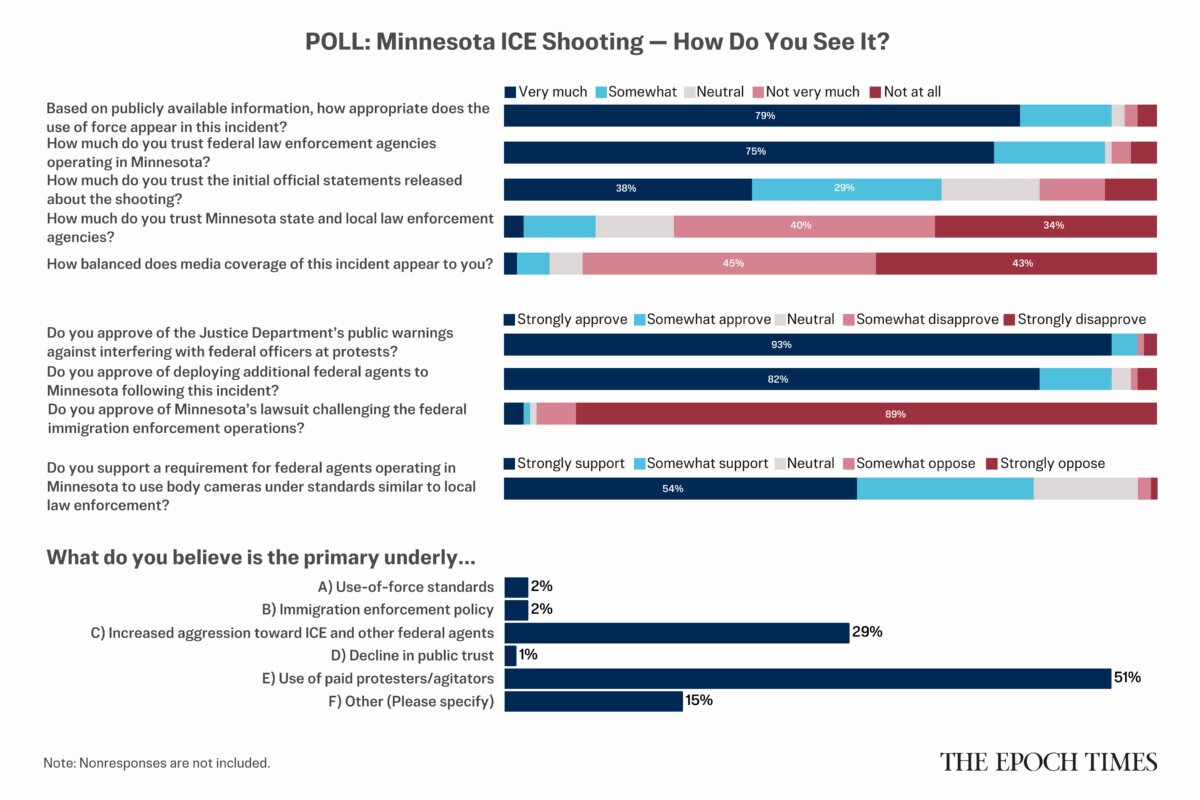
An overwhelming percentage of readers said available information convinced them the ICE officer acted appropriately in the shooting.
In a survey conducted Jan. 14–15, a combined 93 percent of readers said they agree “very much” or “somewhat” that the use of force against Good was justified; 92 percent said they trust federal law enforcement operations in Minnesota in general.
Similarly, 93 percent of readers said they “strongly approve” of Justice Department warnings against protesters interfering with immigration enforcement operations.
In addition, 82 percent of the respondents said they “strongly approve” of sending additional federal agents to Minnesota following the fatal shooting.
Meanwhile, readers expressed lower levels of confidence in officials’ initial statements about the shooting of Good—with 38 percent placing “very much” trust in those statements and 29 percent saying the statements were “somewhat” trustworthy—for a combined total of 67 percent of readers trusting the statements.
Homeland Security said an ICE officer opened fire on Good’s vehicle because he feared for his life as her vehicle struck him, causing internal bleeding. Critics reject that self-defense claim and say Good was a victim of excessive force; some say the officer should have jumped out of the way.
Readers said they believe body-worn cameras should be required for federal officers to record their on-duty activities, providing more documentation of such incidents; 81 percent of readers said they strongly or somewhat support that.
Good’s death further inflamed anti-ICE protesters, leading to more standoffs and clashes with ICE in Minneapolis. The continued aggressive resistance prompted Trump to threaten use of the Insurrection Act, which would allow him to deploy the military to quell disruptions of ICE’s attempts to enforce federal laws.
Minnesota has filed a lawsuit attempting to block federal immigration enforcement in the state—a move that drew strong disapproval from 89 percent of readers.
Readers also expressed very low levels of confidence in Minnesota’s state and local law enforcement. Only 3 percent said they place “very much” trust in those agencies, while 11 percent said they trusted those departments “somewhat.”
In the survey, readers also frowned upon media coverage of the shooting, with 2 percent saying they very much agreed that the coverage was “balanced.”
When asked what they believed was the underlying cause of the violence in Minnesota, 51 percent of the readers blamed paid protesters or agitators.
ICE launched “Operation Metro Surge” in Minneapolis, targeting “the worst of the worst” illegal immigrants with criminal histories, in early December.
The agency has encountered significant resistance from illegal immigrants and their supporters ever since.
On Dec. 21, ICE arrested an illegal immigrant from Cuba who allegedly drove a car into officers during an enforcement action.
In late December and early January, harassment of federal agents escalated in Minnesota, with protesters beating on drums and making other loud noises outside hotels where officers were staying in a bid to pressure staff to kick officers out. Protesters also threw rocks and ice at officers and took other steps to block them from arresting illegal immigrants.
During that timeframe, activists began increasingly tracking ICE and organizing disruptions of their activities.
Following Good’s shooting, Minneapolis Public Schools canceled classes, citing safety concerns, and Gov. Tim Walz authorized the National Guard to support law enforcement.
Violence continued in the ensuing days, with rioters deploying fireworks against officers, as ICE reported a 3,200 percent increase in vehicular attacks on ICE agents.
Conservative influencers also reported being attacked by protesters, as their vehicles were vandalized.
The Department of Homeland Security says more than 2,500 people have been arrested during the Minnesota operations. The agency’s leaders say they are not backing down despite the continued violent resistance in Minnesota.
 Friends Read Free
Copy
Facebook
Tweet
Friends Read Free
Copy
Facebook
Tweet