
President Donald Trump worked with pharmaceutical companies to cut the cost of over 40 popular prescription drugs in America through the website TrumpRx.
The direct-to-consumer platform launched on Feb. 5 and gives Americans—with or without insurance—major discounts.
The slashed prices came nearly one month after Affordable Care Act subsidies expired. The expiration was a major debate between Republicans and Democrats during the months-long government shutdown in the fall.
We asked readers to weigh in on the Trump administration’s approach to health care in the United States.
Prescription Drugs
TrumpRx is a platform that lets Americans download coupons for dozens of medications and redeem them at their pharmacy.
Medications available through the platform include GLP-1s, fertility drugs, inhalers, and medicines used for conditions such as rheumatoid arthritis, lupus, and severe asthma.
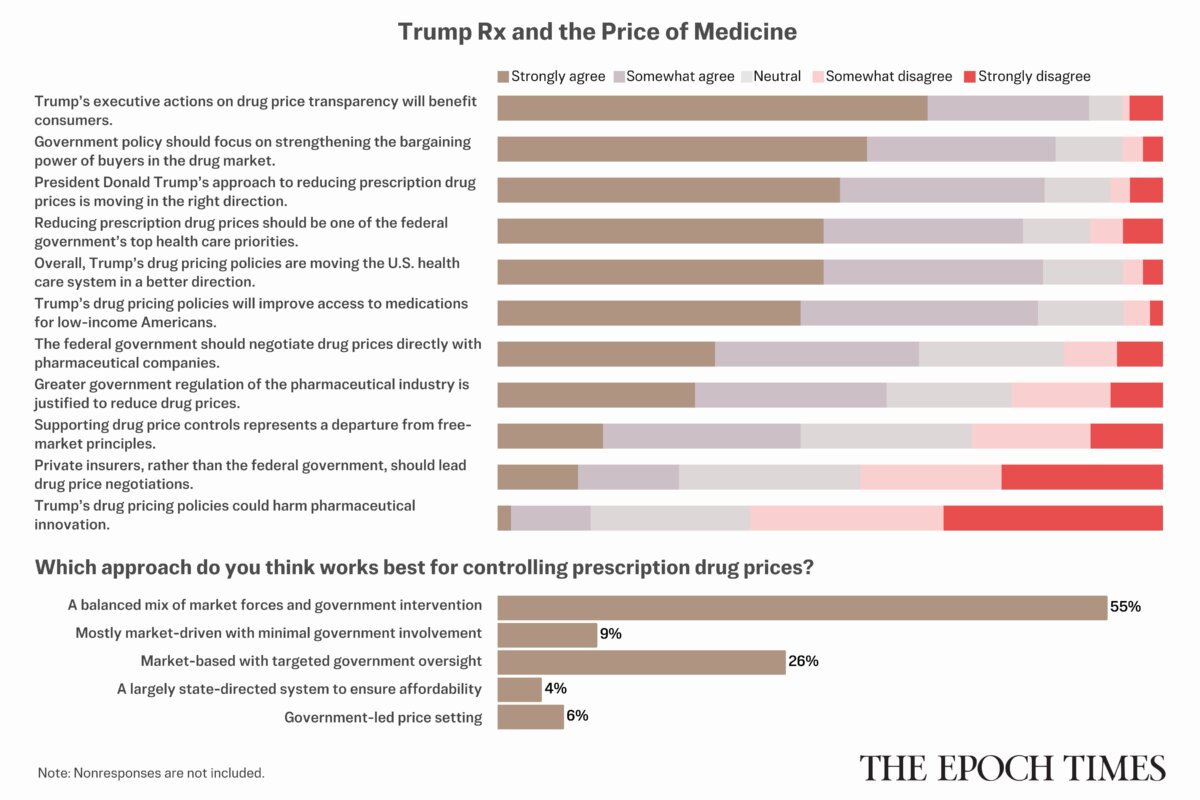
When readers were asked if they think one of the federal government’s top priorities should be reducing the cost of prescription drugs, over 79 percent agreed.
Just over 83 percent of participants polled agree that they think Trump’s approach to slashing prices is moving in the right direction.
Over 82 percent of those surveyed agreed that Trump’s drug pricing policies will improve access to medications for low-income Americans.
Transparency
Trump signed an executive order in February 2025, which directed the Departments of the Treasury, Labor, and Health and Human Services to make “hospitals and insurers disclose actual prices, not estimates, and take action to make prices comparable across hospitals and insurers, including prescription drug prices.”
An overwhelming majority of the sample group thought Trump’s executive actions on drug price transparency would benefit consumers.
Survey respondents had mixed reactions when asked if they thought private insurers should lead the setting of drug price negotiations instead of the federal government.
Over 45 percent of survey-takers said that they do not want private insurers to negotiate prices over the federal government, while 27 percent were for it, and 27 percent were neutral.
But when asked if the federal government should lead the way, 64 percent of survey respondents agreed, while 15 percent disagreed.
Regulation
Just over half of participants suggested the best way to control prescription drug prices is by a balanced mix of market forces and government intervention, while 25 percent suggested they preferred a market-based approach with targeted government oversight.
Over 82 percent of readers think Trump’s drug pricing policies are moving the U.S. health care system in a better direction.
When those surveyed were asked if government policy should focus on strengthening the bargaining power of buyers in the drug market, 84 percent agreed.
The sample group was mixed on whether they thought that more government regulation was needed to reduce drug prices, with 59 percent agreeing, 23 percent disagreeing, and the rest neutral.
Innovation
Eli Lilly and Novo Nordisk agreed to invest in expanding U.S. manufacturing in the United States in a deal with the Trump administration in November 2025.
The deal was made as the White House announced its plans to lower the cost of prescription drugs.
Sixty-two percent of people polled do not think that Trump’s drug pricing policies could harm pharmaceutical innovation.
When asked if readers thought supporting drug price controls represented a departure from free-market principles, 46 percent agreed, 29 percent disagreed, and the rest were neutral.
 Friends Read Free
Copy
Facebook
Tweet
Friends Read Free
Copy
Facebook
Tweet