
The Trump administration and Republicans have taken a series of steps to make sure that people voting in federal elections are U.S. citizens as the nation inches closer to the midterm elections.
President Donald Trump recently signed an executive order to create a nationwide list of U.S. citizens eligible to vote as lawmakers on Capitol Hill debated the Safeguard American Voter Eligibility Act, often called the SAVE America Act.
A key provision in the Save America Act requires every voter to show proof of citizenship to register to vote in federal elections, as well as photo identification to cast ballots.
We asked readers to weigh in on how voting should be handled in the United States.
Proof of Citizenship
Trump signed an executive order on March 31 that would create a list of U.S. citizens eligible to vote.
The executive order would require the Department of Homeland Security and the Social Security Administration to create a list of eligible voters in every state.
The order also bans the U.S. Postal Service (USPS) from sending absentee ballots if the recipients are not named on the list.
Meanwhile, Democrats alleged that the move is “unconstitutional.”
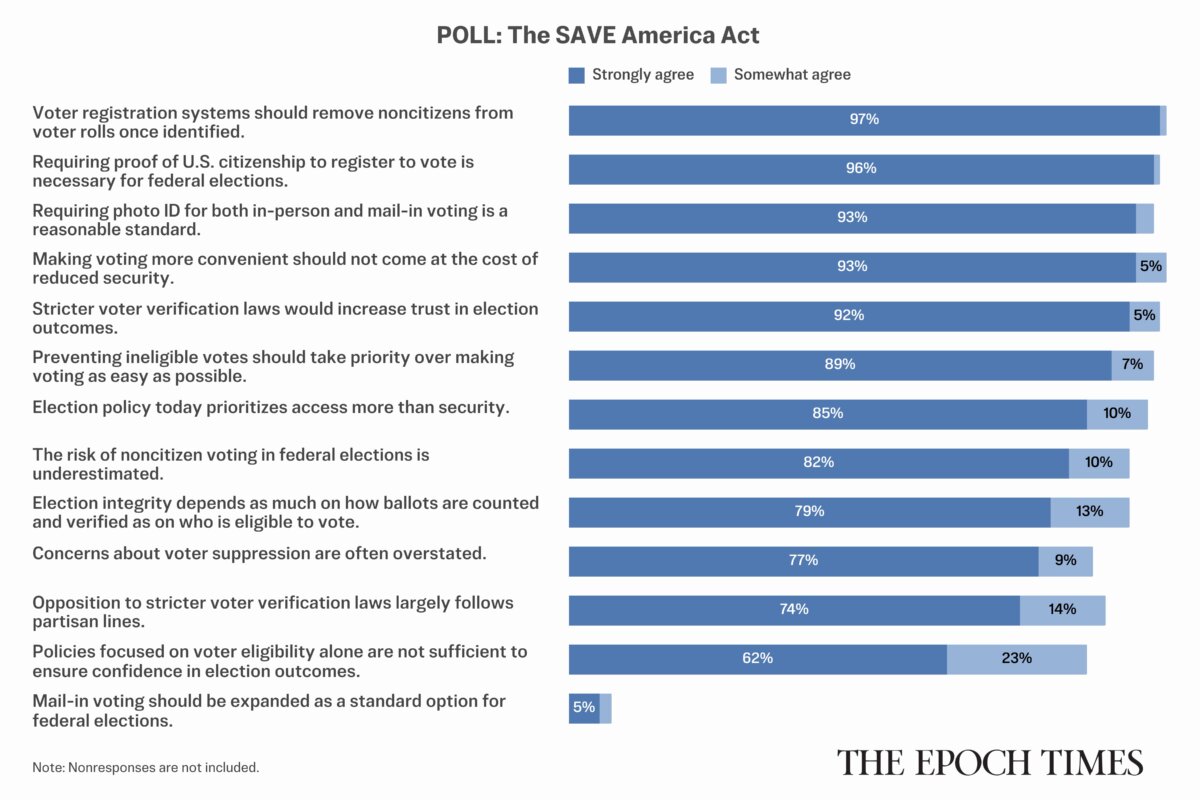
An overwhelming majority of survey takers (97 percent) agreed that requiring proof of U.S. citizenship to register to vote is necessary for federal elections.
Among the number of people polled, 96 percent agreed that preventing ineligible votes should take priority over making voting as easy as possible.
When asked if stricter voter verification laws would increase trust in election outcomes, 97 percent of readers agreed.
Non-Citizen Voting
Exactly 96 percent of people polled think requiring photo ID for both in-person and mail-in voting is a reasonable standard.
Separately, 98 percent of pollers suggested that voter registration systems should remove non-citizens from the voter rolls once they are identified.
When asked if the risk of non-citizen voting in federal elections is underestimated, 92 percent of readers agreed, while 5 percent disagreed.
As 95 percent of readers thought election policy today prioritized access over security, 85 percent of people said policies focused solely on voter eligibility are not sufficient to ensure confidence in election outcomes.
The SAVE America Act passed the House on Feb. 11, mostly along party lines, but the bill is currently stalled in the Senate, which is on a two-week recess.
Trump suggested that “the cheating on mail-in voting is legendary” when he signed the executive order to establish a list of U.S. citizens who are eligible to vote by mail.
Voter Suppression
Of the 7,234 people polled, 86 percent of readers suggested that concerns about voter suppression were often overstated, while 9 percent disagreed.
When asked if opposition to stricter voter verification laws largely follows partisan lines, 88 percent of those surveyed agreed, 5 percent disagreed, and 7 percent remained neutral or unsure.
But 98 percent of people suggested that making voting more convenient should not come at the cost of reduced security.
Mail-In Voting
On the topic of mail-in voting, 82 percent of people disagreed that it should be expanded as a standard option for federal elections, 7 percent agreed, and 11 percent remained neutral or unsure.
Still, the majority of people (92 percent) polled agreed that election integrity depends as much on how ballots are counted and verified as on who is eligible to vote.
 Friends Read Free
Copy
Facebook
Tweet
Friends Read Free
Copy
Facebook
Tweet