
Two Democratic senators said at a Georgetown University forum on March 23 that the Senate filibuster has “outlived its usefulness” and “stymied debate,” even as their party relies on the rule to block passage of the SAVE America Act.
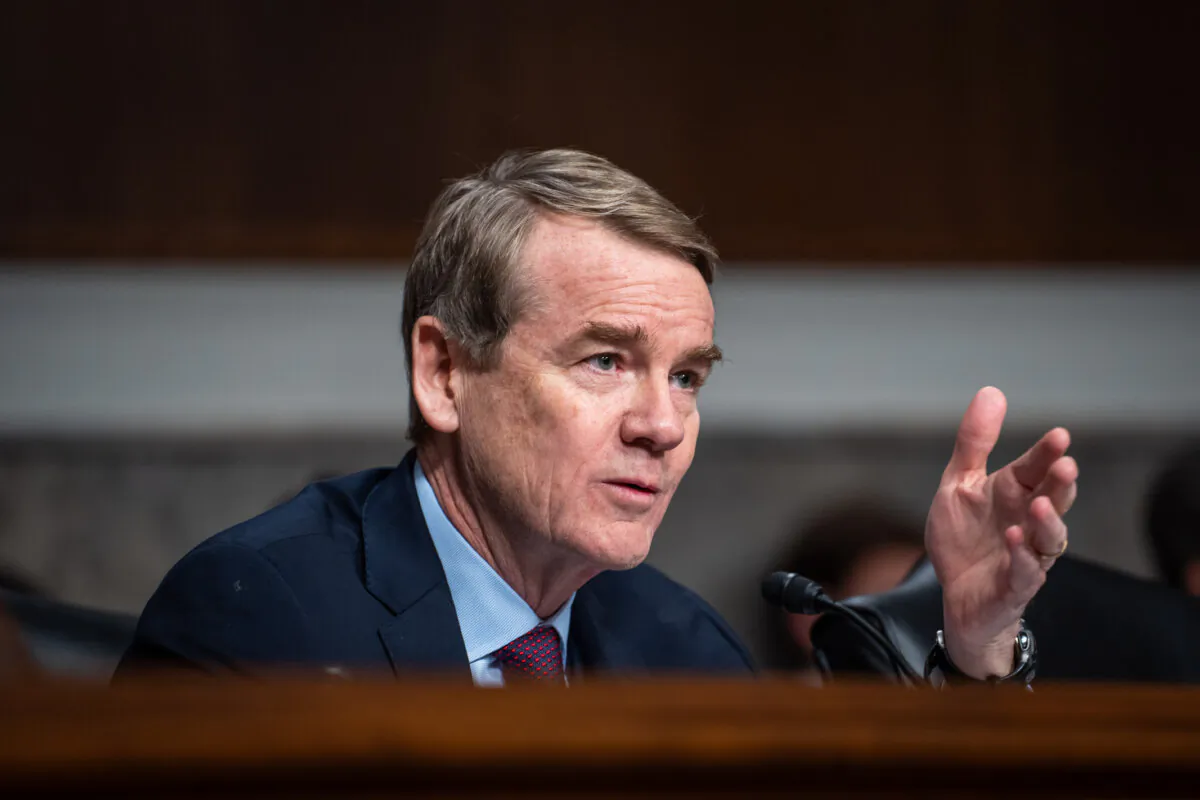
Sen. Michael Bennet (D-Colo.), who is leaving the Senate to run for governor of Colorado, said, “I think it’s outlived its usefulness,” during the forum broadcast on C-SPAN, hosted by Georgetown, and moderated by former Sen. Jon Tester (D-Mont.).
“I think that it was not part of the original framework of our Constitution. I think the founders of this country—we don’t have to do everything they told us to do— but I think the founders, sometimes they’re invoked to support the filibuster,” he said.
Bennet added that the founders wanted vigorous debate, but “at the end of the day, a majority should have to make a decision, otherwise, the government would be enfeebled.”
Sen. Tina Smith (D-Minn.), who is retiring at the end of her current term in 2027, said the rule has produced the opposite of its intended effect.
“The filibuster and the abuse of the filibuster over many, many years has stymied compromise and has stymied debate,” she said. “Do you see debate on the floor of the United States Senate? Absolutely not. There’s no debate, because the rules of the filibuster and other procedures have made it so that you don’t have to talk—you just have to block. The main tool that is used on the Senate floor is blocking action, and that’s why people are so pissed off.”
Smith has in the past more explicitly advocated for eliminating the rule, writing in a September 2024 post on X that “the filibuster is an undemocratic rule that prevents us from passing policies that a majority of Americans want.”
Smith acknowledged that tension in her own argument. Democrats are currently using the filibuster to block the SAVE America Act, a Republican-backed bill that would require photo IDs to cast a ballot, proof of U.S. citizenship for new voter registrations, and states to remove noncitizens from their voting rolls.
The filibuster allows senators to extend debate indefinitely on legislation, effectively requiring 60 votes to advance most bills to a final vote. With Democrats unified in opposition and Republicans holding 53 seats, the SAVE Act cannot reach that threshold.
President Donald Trump has pushed to attach additional provisions to the bill, including restrictions on mail-in voting and measures barring transgender athletes and transgender procedures for minors.
“Is it risky to get rid of the filibuster? You bet,” Smith said. “Without the filibuster, would we pass the SAVE Act? Maybe, but maybe not, because people would have to take responsibility for their votes.”
Sen. Jeanne Shaheen (D-N.H.) did not directly answer whether the filibuster should be eliminated, instead pointing to money in politics and gerrymandering as the underlying drivers of Senate dysfunction.
“This country was built on compromise,” Shaheen said. “If we can’t figure out how to work together, how to compromise, then we can’t get anything done, and that’s what we’re seeing too often in Washington.”
Sen. Dick Durbin (D-Ill.) also appeared at the forum but did not address the filibuster question. Shaheen and Durbin are also not seeking re-election.
The comments land in the middle of an active Senate floor fight. Some Republicans have urged Senate Majority Leader John Thune (R-S.D.) to force a talking filibuster—the original form of the tactic, which requires senators to physically hold the floor and speak continuously to block a bill, rather than simply withholding the 60 votes needed to end debate.
Thune has said repeatedly that he lacks the votes to change the filibuster rules and pass the bill with a simple majority.
“We don’t have the votes either to proceed, get on a talking filibuster, nor to sustain one if we got on it. But that’s just a function of math,” Thune told reporters at a press conference on March 10.
Thune has also defended the rule’s purpose.
“The concept that the founders had for the United States Senate was that it would be one body that was majoritarian, and one that wasn’t,” he said in a separate press conference on March 17.
Not all Republicans share that view. Sen. John Cornyn (R-Texas) wrote in a March 11 New York Post op-ed that he supports “whatever changes to Senate rules that may prove necessary” to pass the SAVE America Act, arguing that Democrats had already “dealt the filibuster a fatal blow” by trying to eliminate it in 2022.
In January 2022, then-Senate Majority Leader Chuck Schumer attempted to eliminate the filibuster to pass a pair of voting rights bills that restricted or eliminated voter ID rules, but the effort failed after two then-Democratic senators, Joe Manchin of West Virginia and Kyrsten Sinema of Arizona, voted against it alongside Republicans.
Manchin, who left the Democratic Party in May 2023 and retired in January 2025, pushed back from the other direction this week.
Appearing on NewsNation’s “The Hill Sunday” on March 22, he called the filibuster “the soul of the Senate” and urged at least five current Democratic senators to pledge not to vote for its elimination.
“The bottom line is we have stability. We have predictability in the world,” Manchin said.
The Epoch Times reached out to the offices of Smith, Bennet, Shaheen, Durbin, and Senate Minority Leader Chuck Schumer (D-N.Y.) for comment. No responses were received by publication time.
 Friends Read Free
Copy
Facebook
Tweet
Friends Read Free
Copy
Facebook
Tweet