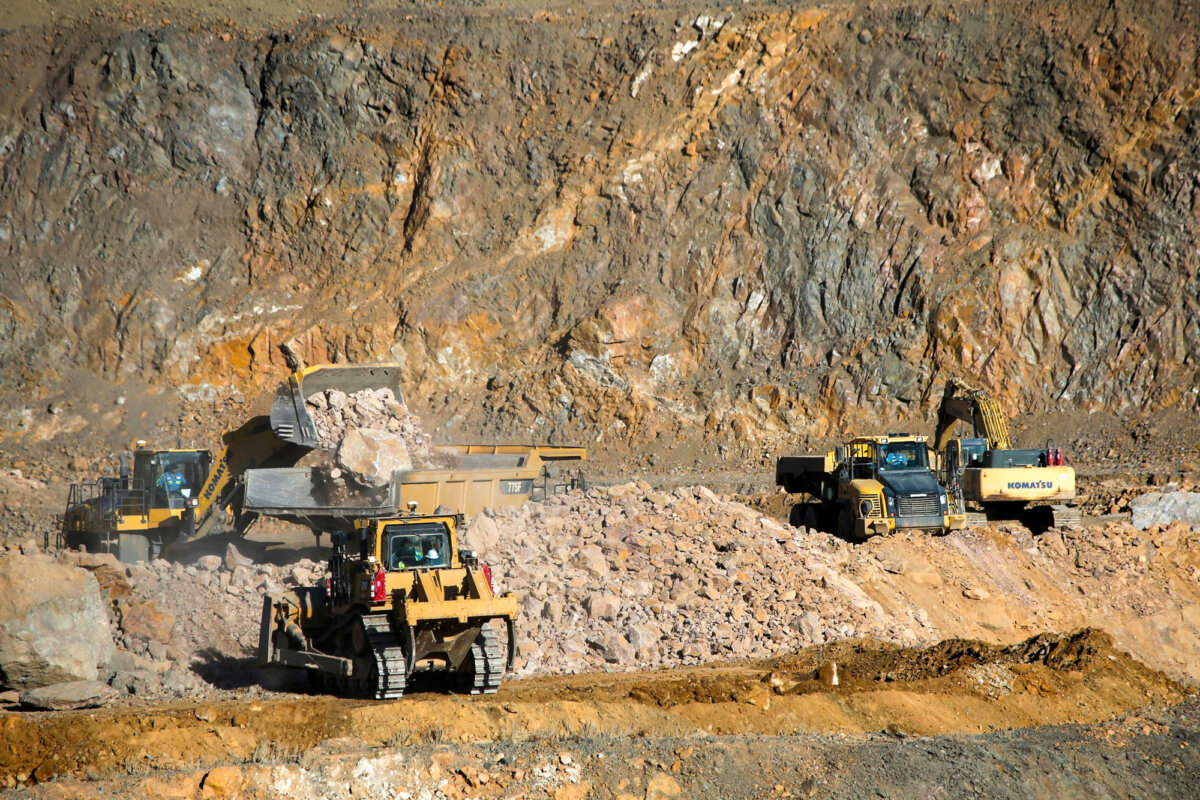

Boarded-up mines across the world are rusting symbols of how China seized the world’s critical minerals supply chain.
Now, some of these mines—closed not because they ran dry, but by Beijing’s oversupply and price dumping—could be reopened as Donald Trump’s administration rallies nations to overthrow China’s supply chain dominance.
Getting a new mine up and running can take up to 15 years. So mothballed mines could provide a timely stopgap, according to industry experts.
Rare earth elements, a group of 17 metals crucial to everything from permanent magnets in wind turbines to electric vehicle motors, are hard to extract and even tougher to process.
Much of the essential refining technology and know-how now lies in China’s hands, along with the all-important supply chains.
The same pressures apply to other critical minerals, such as lithium, cobalt, nickel, graphite, and copper, which underpin battery production and a significant portion of the modern electricity system.
Over the past few months, the trade war between the United States and China has brought the issue of Beijing’s control of critical minerals to a head.
In October, the Trump administration announced more than $10 billion in critical mineral deals with Australia, Cambodia, Japan, Malaysia, and Thailand to strengthen allied supply chains.
President Donald Trump also recently said the United States would end its reliance on China for rare earth minerals within 18 months under an “emergency program.”
Treasury Secretary Scott Bessent said on Nov. 1 that China had “made a real mistake” by threatening to curb exports, which spurred the United States and its allies to fast-track new sources.
On Nov. 6, the administration added 10 minerals, including copper and metallurgical coal, to its list of materials vital to national security.
Brussels is not sitting idly by, either. European Commission President Ursula von der Leyen said on Oct. 25 that the bloc will unveil a new plan by year-end to diversify Europe’s mineral supply away from China.
The challenge is vast. The world needs around 300 new mines over the next 25 years just to meet current demand, according to Troy Hey, executive general manager at global miner MMG, which is majority-owned by China Minmetals.
“You know how hard it is to get one mine up, let alone 300,” Hey said at a business conference on Oct. 28, according to Australia’s News.com.au. He said the required infrastructure, investment, and skills would be “an order of magnitude beyond” what the industry has seen in the past two decades.
Understanding Reopening
Reopening old mines has its limits, says veteran geologist Darren Bahrey, founder, president, and CEO at StrategX Elements Corp.
“Opening old mines makes sense where there’s clear economic potential or cleanup value, but the real contribution will come from new exploration in regions that can fast-track development into the supply chain,” Bahrey told The Epoch Times.
He noted that Canada is a “standout example,” following the federal government’s recent $2 billion investment.
“New mine development and processing capacity will be essential, and governments need to make permitting a priority rather than a bottleneck,” he said.
“The real shortage lies in our basket of critical minerals (nickel, vanadium, copper, cobalt, and graphite).”
Mining Alone Won’t Thwart China
Steve Christensen, co-founder and chief executive of the Responsible Battery Coalition, told The Epoch Times the mining industry is grateful for Trump’s leadership so far. But he said mining more material doesn’t solve the issues of China’s market manipulation.
“They’ll dump their cheap materials into a market, they’ll lower the price so far down, they’ll take a loss on it,” he said.
“When your competitor doesn’t care about profits, it’s very hard to compete.”
Bob Bilbruck, founder and CEO of the strategic consulting firm Captjur and an expert in the mining sector, told The Epoch Times via email that the Biden administration, through the Environmental Protection Agency, “made it almost impossible to expand mining at these existing or mothballed mines.”
He said the Trump administration should “federalize these mines and open and enlarge production and processing.”
—Owen Evans; Tom Ozimek; Stacy Robinson
BOOKMARKS
A federal judge on Monday ordered the Department of Justice to hand over grand jury materials related to the indictment of former FBI director James Comey. U.S. Magistrate Judge William Fitzpatrick also said the government may have violated Comey’s rights in such a way that the case may be dismissed.
The U.S. Supreme Court has agreed to review a policy that allows immigration agents to turn away asylum seekers at the border. The practice, called “metering,” began under former President Barack Obama, was repealed during the Joe Biden administration, and reinstated under Donald Trump.
Federal Emergency Management Agency (FEMA) Acting Director David Richardson resigned on Monday and will be replaced by his Chief of Staff Karen Evans. Critics have said Richardson did not adequately respond to this summer’s Texas floods, which left at least 137 people dead.
The number of nationwide infant botulism cases—linked to recalled packages of ByHeart Whole Nutrition Infant Formula—rose to 23 on Monday. The tainted formula has resulted in hospitalizations, but no deaths so far.
New enrollment of international students at U.S. universities is down by 17 percent from last year, according to a report by the Institute of International Education. The drop coincides with closer scrutiny of international students under the Trump administration.
—Stacy Robinson
 Friends Read Free
Copy
Facebook
Tweet
Friends Read Free
Copy
Facebook
Tweet