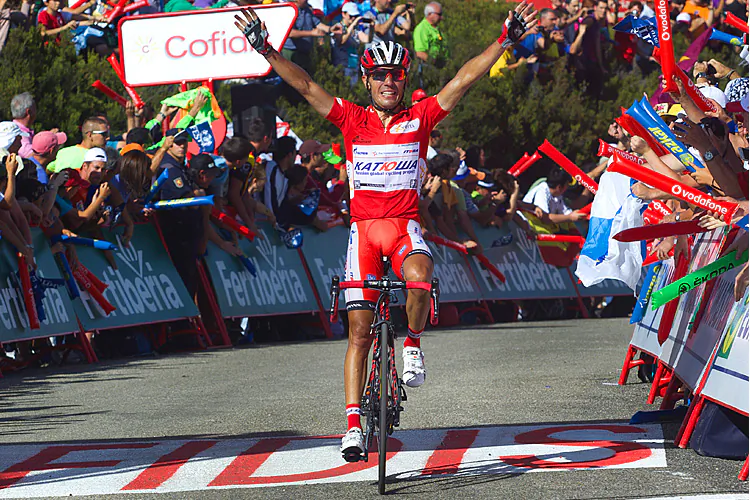
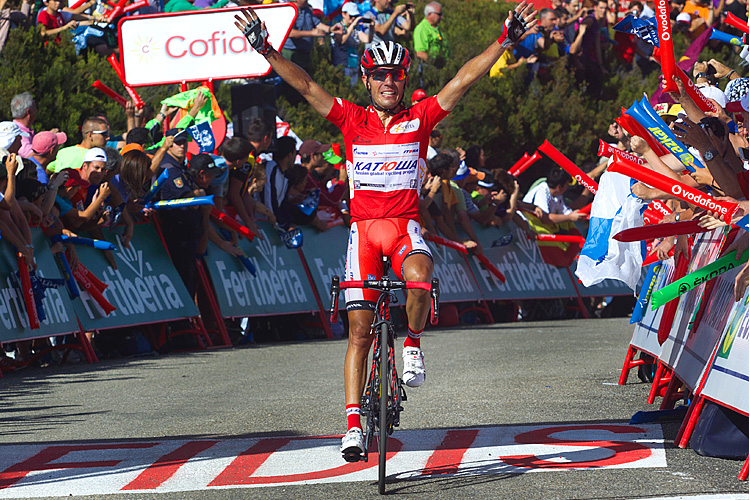
Katusha’s Joaquim Rodriguez turned in perhaps the best climbing stage of his career to win Stage 14, the first of three really painful mountain stages of the 2012 Vuelta a España.
Rodriguez astounded everyone by outclimbing the entire peloton up five categorized ascents to win a final climbing duel with Saxo-Tinkoff’s Alberto Contador in the final kilometer of the final Cat 1 climb. This was the third stage win of the race for the Katusha rider.
After following all of Contador’s attacks in the final 3500 meters, Rodriguez launched his own acceleration in the final 300 meters, and 150 meters from the line started sprinting, leaving the Saxo-Tinkoff rider five seconds behind by the finish.
With the time bonuses, Rodriguez has not only kept the leader’s red jersey but increased his lead from 13 to 22 seconds over Contador. Sky’s Chris Froome has dropped to 1:41 down, tied with Movistar’s Alejandro Valverde.
Rodriguez, formerly considered only a wall-climbing specialist, has transformed himself into a true grimpeur and a decent General Classification contender. If the Katusha rider can maintain this form through then next to incredibly hard climbing stages, there will be no way he could help winning the Vuelta.
After the finish, Alberto Contador brushed aside the microphone of an eager reporter; the Spanish champion couldn’t quite wrap his head around the fact that he had just been soundly beaten on a long steep climb, after making a series of attacks of the sort which cemented his reputation as the best mountaineer in the sport.
Perhaps the six-month layoff has dulled Contador’s edge; possibly Rodriguez really has improved tremendously. The race leader not only beat Alberto Contador, King of the Climbs; he dropped Alejandro Valverde and Chris Froome, Robert Gesink and Laurens ten Dam and Bauke Mollema.
Either Rodriguez just happens to have hit his stride at the right time while the rest of the peloton is worn out, or the sport has a new top-tier GC contender to consider.
Devastating Climbs
Stage 14, 149 km from Palas de Rei to Puerto de Ancares, featured five categorized climbs: The Cat 3 Alto de Castro, the Cat 2 Alto de Vilaesteva, and the Cat 3 Alto de O Lago in the first half of the 149-km stage, followed by the Cat 1 Alto Folgueiras de Aigas and a Cat 1 mountaintop finish at Cat 1 Puerto de Ancares.
The first three climbs were just warm-ups for the final to, both nearly ten km long. Alto Folgueiras de Aigas had an average gradient of 6.7 percent and ramps to ten percent; the climb to Puerto de Ancares averaged eight percent with ramps up to twelve.
These long climbs with steep ramps should have been perfect for both Sky’s Chris Froome and Saxo-Tinkoff’s Alberto Contador. Froome, however, has already admitted that riding all three Grands Tours has left him tired, and Contador is coming off an enforced six-month layoff; how the break might have affected his legs is being revealed in each successive stage.
The Saxo-Tinkoff rider is known for making repeated, explosive attacks on climbs exactly like these, accelerating again and again until all the competition has cracked. He tried that tactic in this stage, unsuccessfully.
The day started with four-rider breakaway which was caught quickly; another break didn’t form until 19 km in. This one contained 16 riders: Laurent Didier (RadioShack-Nissan,) Jan Bakelants (RadioShack-Nissan,) Juan Manuel Garate (Rabobank,) Simon Clarke (GreenEdge,) Serge Pauwels and Dario Cataldo (QuickStep), Maciej Paterski (Liquigas-Cannondale,) Alberto Losada (Katusha,) Amets Txurruka (Euskaltel,) Rudy Molard and David Moncoutie (Cofidis), Alessandro Ballan (BMC,) Adrian Palomares Villaplana (Andalucia,) Biel Kadri (AG2R,) Ben Gastauer (AG2R,) and Javier Moreno (Movistar.)
With Movistar and Katusha both represented in the break, the chasing was left to Saxo-Tinkoff. This team took up the load and slowly turned up the pace as the stage progressed, using the same tactic Sky employed in the Tour de France: setting a pace quick enough to discourage attacks, to wear down the opposition before the final climb.
Valverde and Rodriguez could ride contentedly behind Saxo-Tinkoff, saving their energies, while the break and the peloton splintered under Saxo-Tinkoff’s pace-setting.
The Final Ascent
At the base of the final climb, with just under ten km to go, Katusha’s Alberto Losado was the only breakaway rider making an effort; the rest had been caught or were waiting to be. At the seven-km mark, Losado was out in front alone by about a minute, while the peloton was down to about 15 riders.
Halfway up the climb, the road flattened out somewhat, then angled up at a double-digit pitch. As the difficulty increased, the final Saxo domestique started sprinting; then Contador made his first attack. Valverde, warned by the increased pace, was immediately on Contador’s wheel; Rodriguez didn’t respond.
This attack was a huge problem for Sky; Froome, already 51 seconds behind Rodriguez, couldn’t afford to surrender any more time. Pulled by Rigoberto Uran and Sergio Henao, the Sky leader began working his way across to the two attackers. Meanwhile Daniel Moreno helped his leader Joaquim Rodriguez up to the wheel of Valverde.
Seeing this, Valverde attacked; the two Katusha riders stuck with him, and this time Contador had to pull himself across a gap. The Saxo leader had been riding a bit back from the front in the first half of the climb, and it seemed he might be in a bit of difficulty. Now he was unable to respond immediately; was he nearing his limit?
Not even close. At 2900 meters Valverde made another effort to get clear of the Katusha riders, and Contador joined him quickly. As Rodriguez and Moreno caught back up, Contador attacked again.
Valverde and Rodriguez both chased down the Saxo rider; the three then slowed slightly, watching each other carefully, to see who might make the next attack.
This helped the chasing riders. At 2400 meters Moreno caught the leading trio, and Garmin’s Andrew Talansky bridged across from the peloton. Henao, Uran, and Froome were still steadily approaching; 2 km from the finish, the three Sky riders were only ten meters from the front five.
Just before they made it, Alberto Contador launched a huge attack, jumping up and sprinting for 100 meters or more. This attack earned Contador about 100 meters of free road between his pursuers and himself, but those pursuers weren’t beaten yet.
1100 meters out, the Sky trio caught Valverde and Rodriguez. Chris Froome immediately launched an attack, but it was more a psychological than a physical weapon. Like Contador’s attack as the Sky riders almost caught him, this acceleration was designed to demoralize, but it had the opposite effect.
Valverde and Roriguez took off after Froome and caught him 200 meters up the road; 100 meters later, with the pitch rising to twelve percent, the pair attacked, leaving Froome floundering.
Rodriguez pressed the attack, dropping Valverde and soon catching Contador. 400 meters from the finish Contador attacked again, but Rodriguez covered him. 300 meters from the line Contador gave a last big dig.
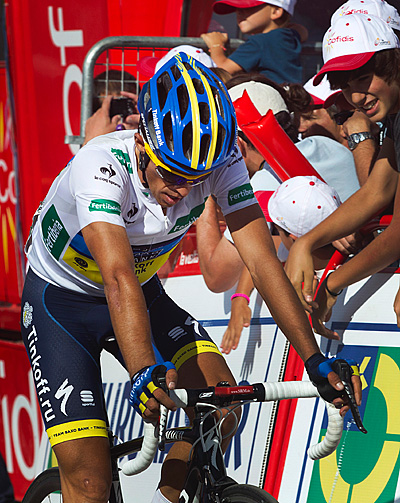
Rodriguez caught and passed the Saxo leader; Contador almost slumped on the bike, not believing that he was not only being matched, but outpaced on the climb.
With 150 meters left, Rodriguez stood up and sprinted home; Contador had nothing left to fight with. The Saxo rider had dearly wanted the winner’s 20-second time bonus; it might have halved Rodriguez’s lead. Instead, the Katusha leader kept the red jersey and increased his lead to 22 seconds over his Spanish rival.
Alejandro Valverde, previously more of a power-rider than a strict climber, made another excellent effort to come home third. He too has transformed from a specialist to a serious GC contender.
Chris Froome rolled in with Daniel Moreno, and had to suffer the final indignity of being outsprinted to the line by the Katusha rider, dropping Froome to fifth. Froome is tied for fourth in GC with Valverde, 1:41 down; both are racing for the bottom step of the podium now.
With two more drastically damaging mountain stages left before the rest day Tuesday, the whole race could change. If Rodriguez can’t maintain his excellent effort, he could end up back with Froome and Valverde after a single bad climb. If Chris Froome can find some of his form from the Tour de France, he might secure a podium spot.
If Alberto Contador is not 100 percent back to his old form, he might lose a lot of time on one of the upcoming stages. If he can recover from today and find a little extra, he might surge into the lead, particularly if Rodriguez finds himself fading as the climbs get longer and the peaks higher.
Simply, the race is far from over. The Rodriguez has dominated the first two-thirds, the final three mountain stages—15, 16, and 20—could completely reverse the order.
Worse to Come
Stage 15 is an extremely unpleasant 187 km from La Robla to Lagos de Covadonga. The stage starts with a gentle climb and a long quick descent, followed by as short cat 3 climb, a lot more hills, and the Cat 1 Alto del Mirador del Fito: 6.8 km long at 8.3 percent average, three-quarters of the way through the stage, this is a made-to-order launching pad for attacks and breakaway attempts.
None of the GC contenders will likely do much here, but anyone needing to make up a few minutes and gain some places could possibly try something here. A single really strong rider or a determined small group might even open enough of a gap to stay away for the stage win.
The stage ends with the Hors Categorie climb to Lagos de Covadonga: 13.5 km at seven percent average, with a few steeper sections and some small descents in the final 3500 meters, and a final 500 meters of considerable steepness.
One should expect all kinds of action on this climb. With the brief descents, riders can catch their breaths and rest their legs for a few seconds to launch more attacks. Any rider who can, will attack on the steeper ramps at 4600 meters, 3000 meters and the final 500 meters.
Again look for Saxo-Tinkoff to push hard before the climb; what Sky will do depends on Froome’s legs. If he is not ready to fight hard, he might be content to limit his losses and save everything for Stage 16, knowing a rest day follows.
Stage 16 will make sure riders need that rest day. 184 km from Gijón to Valgrande-Pajares, this stage has four climbs. The opening Cat 3 Alto de la Cabruñana, 4.4 km at 5.7 percent, will help riders limber up for the real climbs: the cat 1 Puerto de San Lorenzo and Alto de la Cobertoria
San Lorenzo is 10km at 8.5 percent average; Cobertoria, 8 km at 8.6 percent.
San Lorenzo starts steep and offers a little respite in the middle and two km from the end, but the final kilometer is just steep climbing. Cobertoria is just up followed by more up, with the last bit reaching a twelve-percent grade.
As soon as riders finish the quick descent from Cobertoria, they are headed uphill once more, as the route climbs for 15 km to the start of the final Hors Categorie Cuitunigru: 19.4 km of climbing at 6.9 percent average. Forget the average; this climb hits 20 percent in the final three kilometers, and 22 percent in the final few hundred meters.
This is an insanely hard climb for the finish of a hard stage. It is beyond ridiculous for the final climb of 12 mountain climbs in three days of racing.
This final climb might favor Joaquim Rodriguez; it is the kind of near-vertical wall for which he is famous. The question, of course, is what will he have left after defending the red jersey through the prior two stages?
Could Alejandro Valverde make a final huge effort here? He beat both Contador and Rodriguez on the summit finish of Stage Eight. Will Alberto Contador be able to handle the steepness? Rodriguez dropped Contador on a steeper finish in Stage Twelve.
Will everyone be too tired to attack, so the GC contenders mark each other all the way up the final climb and some of the lower-placed riders dig hard to close the gaps?
The best news of all for cycling fans is that no matter what happens here, Stage 20 offers another five categorized climbs with an Hors Categorie summit finish. Fireworks guaranteed, as the slightly rested riders will all be trying to preserve their leads or advance in GC before the final procession into Madrid.
Vuelta a España Stage 14
|
rider |
team |
time |
||
|
1 |
Joaquim Rodriguez |
Katusha |
4:20:28 |
|
|
2 |
Alberto Contador |
Saxo-Tinkoff |
0:00:05 |
|
|
3 |
Alejandro Valverde |
Movistar |
0:00:13 |
|
|
4 |
Daniel Moreno |
Katusha |
0:00:35 |
|
|
5 |
Christopher Froome |
Sky |
0:00:38 |
|
|
6 |
Andrew Talansky |
Garmin-Sharp |
0:00:44 |
|
|
7 |
Igor Anton |
Euskaltel-Euskadi |
0:00:56 |
|
|
8 |
Laurens Ten Dam |
Rabobank |
0:01:04 |
|
|
9 |
Tomasz Marczynski |
Vacansoleil-DCM |
0:01:13 |
|
|
10 |
Nicolas Roche |
AG2R |
0:01:17 |
|
|
General Classification after Stage 14 |
||||
|
rider |
team |
time |
||
|
1 |
Joaquim Rodriguez |
Katusha |
53:06:33 |
|
|
2 |
Alberto Contador |
Saxo-Tinkoff |
0:00:22 |
|
|
3 |
Christopher Froome |
Sky |
0:01:41 |
|
|
4 |
Alejandro Valverde |
Movistar |
|
|
|
5 |
Daniel Moreno |
Katusha |
0:04:16 |
|
|
6 |
Robert Gesink |
Rabobank |
0:05:07 |
|
|
7 |
Nicolas Roche |
AG2R |
0:05:51 |
|
|
8 |
Andrew Talansky |
Garmin-Sharp |
0:06:13 |
|
|
9 |
Laurens Ten Dam |
Rabobank |
0:06:34 |
|
|
10 |
Igor Anton |
Euskaltel-Euskadi |
0:07:16 |
|
 Friends Read Free
Copy
Facebook
Tweet
Friends Read Free
Copy
Facebook
Tweet