
Imagine this: it’s the humid, lowlands of Cambodia. There’s a special economic zone carved into where rice paddies used to fill the countryside. We drive along the clusters of concrete buildings until we turn into one unsuspecting warehouse.
We’re told it’s a manufacturing facility for cast iron pipes and pipe fittings. Yet, we don’t feel the heat of a furnace melting iron or hear the noise of pipe machines cutting through metals.
In fact, the machines are covered by spider webs.
This scene was what officials of the Department of Homeland Security documented during their site visit in July 2020.
That came as they were investigating an allegation of transshipments—shipping goods to a third country without adding significant value to the manufacturing process, before exporting to the destination.
The supposed manufacturing site, indicated in its trade paperwork by HiCreek Plumbing Co., Ltd., was actually a warehouse.
According to the DHS records, the workers were touching up the yellow paint on pipe fittings. Some boxes were labeled “made in China” and others “made in Cambodia.”
In February 2021, Customs and Border Protection determined that the Cambodian company HiCreek, owned by a Chinese national named Zhang, was a transshipment company that engaged in tariff evasion. Two U.S. importers, both owned by another Chinese national named Li, were determined to have evaded duties.
The party that brought the case was Cast Iron Soil Pipe Institute, a trade organization led by a leader in the industry: Charlotte Pipe and Foundry Company.
And it wasn’t Charlotte Pipe’s first battle.
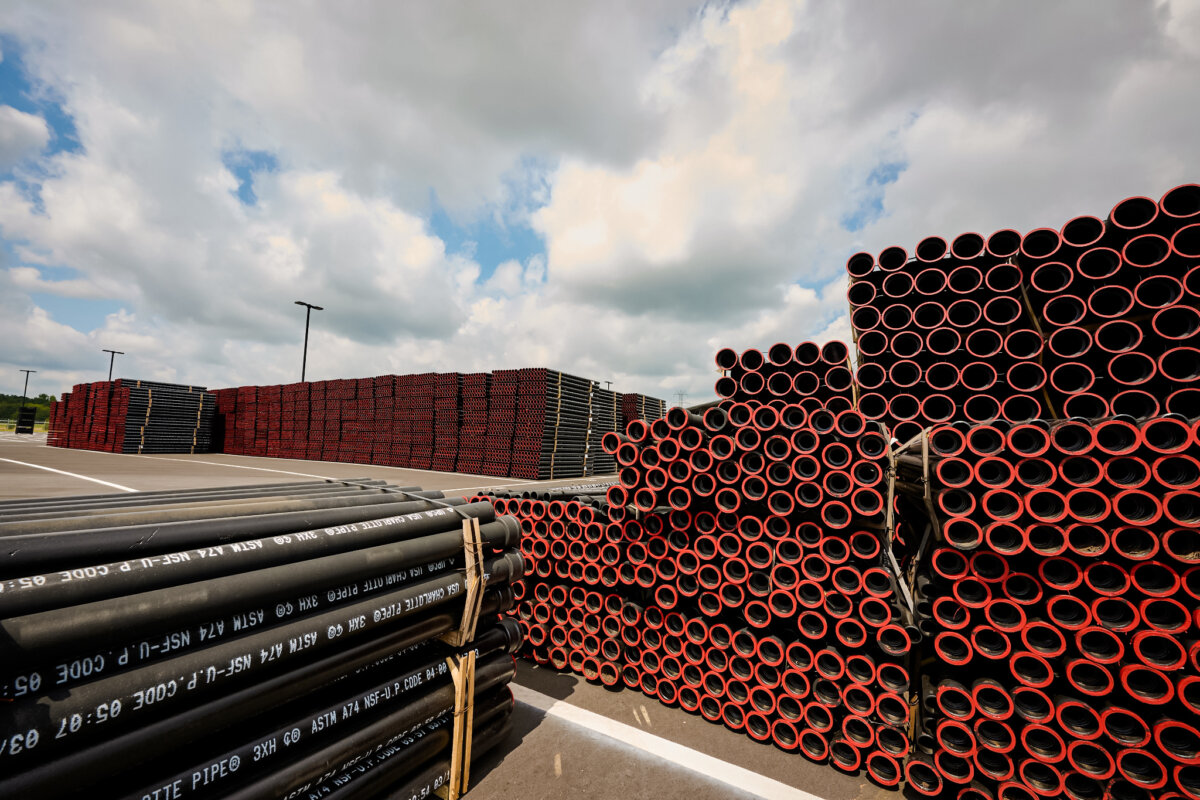
Based in North Carolina, Charlotte Pipe is a top maker of pipes and fittings for commercial and residential plumbing systems. The company touts its “100 percent” U.S.-based production.
Bradford Muller, vice president of corporate communications at Charlotte Pipe, said his company, and the entire industry, has been in a trade war with China since the communist regime joined the World Trade Organization in 2001.
He said his company has fought Chinese exporters on three fronts: technical issues such as product standards, quality, and price.
Competing on price against Chinese companies that engaged in unfair trade practices was unsustainable. In the early 2010s, the company began consulting with trade lawyers to defend its livelihood through the courts. It was not until the first Trump administration that Muller saw hope for a winnable case.
And the industry won its first trade case against Chinese companies in 2018.
The Commerce Department imposed anti-dumping duties on Chinese pipe exporters because their ultra-low prices were harming the U.S. domestic industry.
The leadership of Charlotte Pipe believed that the new high tariff rates—up to 360 percent—would deter Chinese producers, prompting them to shift to other products not subject to anti-dumping orders.
But that didn’t happen. Instead, transshipments to avoid the tariffs began almost immediately.
It was then that Muller learned a lesson: This would be a long fight.
Currently, he has a recurring problem: after Li’s importing companies were caught evading tariffs, she formed new shell entities and continued the practice of transshipment. CBP also found another transshipment company doing the same thing as HiCreek, just under a different name.
That means the harmed U.S. domestic manufacturers aren’t able to obtain a remedy even after the CBP confirms the transshipment allegation.
The private sector isn’t able to seek immediate injunctions on transshipments in the federal courts. Instead, it has to first file allegations of trade violations with CBP and wait for its determination. Muller wants to change this, and he’s pushing for legislation to do just that.
A bipartisan bill, the Fighting Trade Cheats Act of 2025, allows a private company to initiate a lawsuit against a foreign exporter for alleged trade violations. The legislation, reintroduced by Rep. Mike Bost (R-Ill.), also allows the U.S. government to take over the case on behalf of the American company.
The bill, currently before the House Committee on Ways and Means, would “really make a difference for U.S. manufacturers that, frankly, are still engaged in this trade war,” said Muller.
Although relief has been elusive, he remains undeterred: “The next highlight will be when we get the proper tools to address the problem for good.”
 Friends Read Free
Copy
Facebook
Tweet
Friends Read Free
Copy
Facebook
Tweet