
As competition with China has intensified in technology, research, and education, the United States is assessing questions about its preparedness and approach to technological leadership.
A new Epoch Times reader survey shows that Americans believe the United States is facing more challenges in science, technology, engineering, and math (STEM).
Responses also showed deep concern about weaknesses in education and the monitoring of national security risks associated with foreign researchers.
Despite those challenges, readers were optimistic that the United States can remain a global leader in this area.
Education
The education and training of both Americans and foreign nationals in U.S. STEM programs is a growing area of concern.
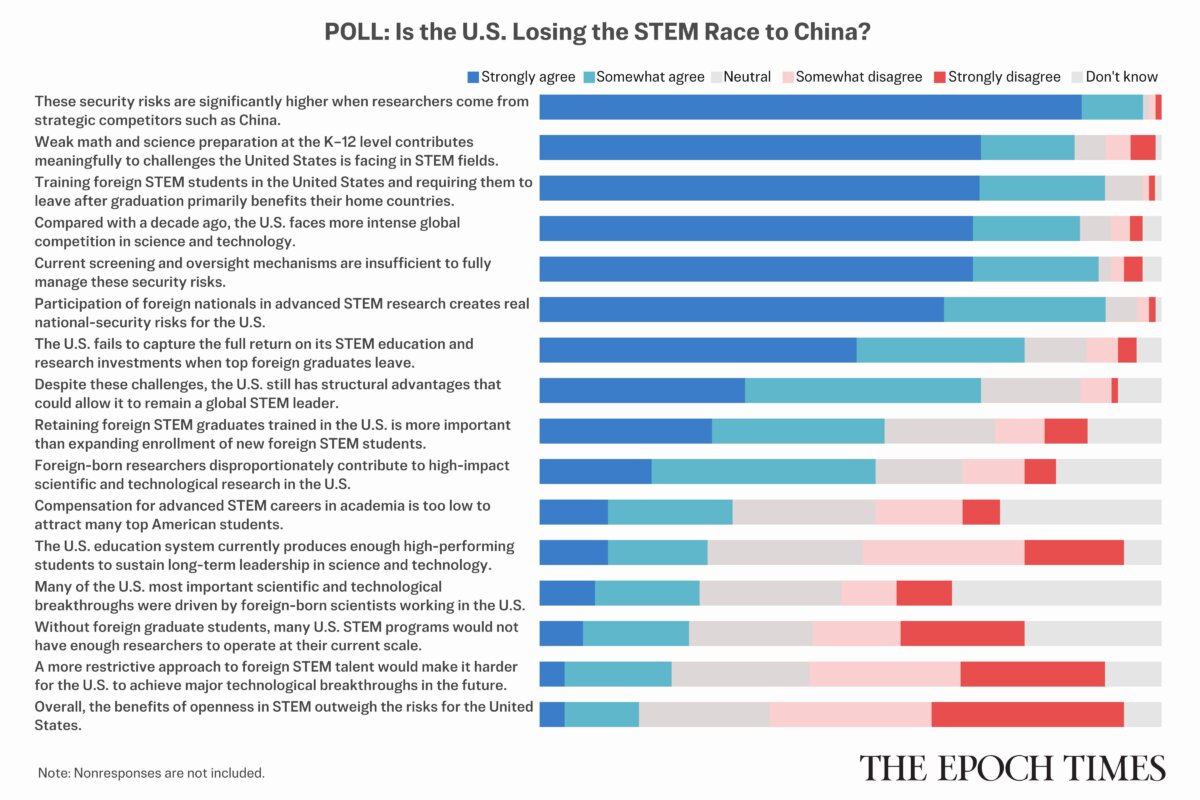
Only 27 percent of respondents agreed to some extent that the U.S. education system currently produces enough high-performing students to sustain long-term leadership in science and technology.
In addition, 86 percent agreed that weak math and science preparation at the K–12 level contributes meaningfully to the challenges the United States is facing in STEM fields.
Almost one-third (31 percent) of readers believe that compensation for advanced STEM careers in academia is too low to attract many top American students. Only slightly more (34 percent) agree that without foreign graduate students, many U.S. STEM programs would not have enough researchers to operate at their current scale.
Nearly 80 percent of those polled believe that the United States fails to capture the full return on its STEM education and research investments when top foreign graduates leave.
National Security
Respondents also expressed concern about national security, with more than 90 percent agreeing that foreign students’ participation in STEM research carries meaningful risks.
Additionally, 98 percent believe the security risks are significantly higher when researchers come from strategic competitors such as China.
Eighty-nine percent also agree that the screening and oversight mechanisms are insufficient to fully manage these security risks.
The vast majority of Americans (90 percent) also agreed that training foreign STEM students in the United States and requiring them to leave after graduation primarily benefits their home countries.
Asked whether they believe that many of the United States’ most important scientific and technological breakthroughs were driven by foreign-born scientists working in the United States, the majority of respondents (56 percent) were either neutral or didn’t know. Around one quarter agreed, and 18 percent disagreed.
However, more than half of those polled (54 percent) believe that foreign-born researchers disproportionately contribute to high-impact scientific and technological research in the United States.
Future Plans
Slightly more than half of Americans (54 percent) believe that retaining foreign STEM graduates trained in the United States is more important than expanding enrollment of new foreign students.
However, just under half (47 percent) think that a more restrictive approach to foreign STEM talent would make it harder for the United States to achieve major technological breakthroughs in the future.
While the issue is still a contentious one, about 57 percent of those polled believe that the benefits of openness in STEM outweigh the risks for the United States.
Seventy-one percent of respondents still think the United States has structural advantages that could allow it to remain a global STEM leader.
Overall, the survey found strong agreement that the United States is facing more intense competition in STEM and that there are serious security risks associated with this competition.
There was measured confidence in America’s strengths in the area, but respondents were divided about how to deal with education outcomes and foreign talent in American higher education.
The Epoch Times conducted this reader survey on Jan. 28-29, 2026, by email and social media, generating 371 responses.
 Friends Read Free
Copy
Facebook
Tweet
Friends Read Free
Copy
Facebook
Tweet