
America kicked off its 250th anniversary this year, but as millions attended fireworks shows from coast to coast over the July 4 holiday, not everyone was confident about the country’s direction in the next 250 years.
A new Epoch Times survey of 1,837 readers shows that Americans remain divided on the future of the nation and how people should remember American history, especially in the classroom.
Here are the results.
Education
In 2022, a report by the National Assessment of Educational Progress found that 40 percent of eighth-grade students tested below the most basic level in U.S. history knowledge, compared with 34 percent in 2018.
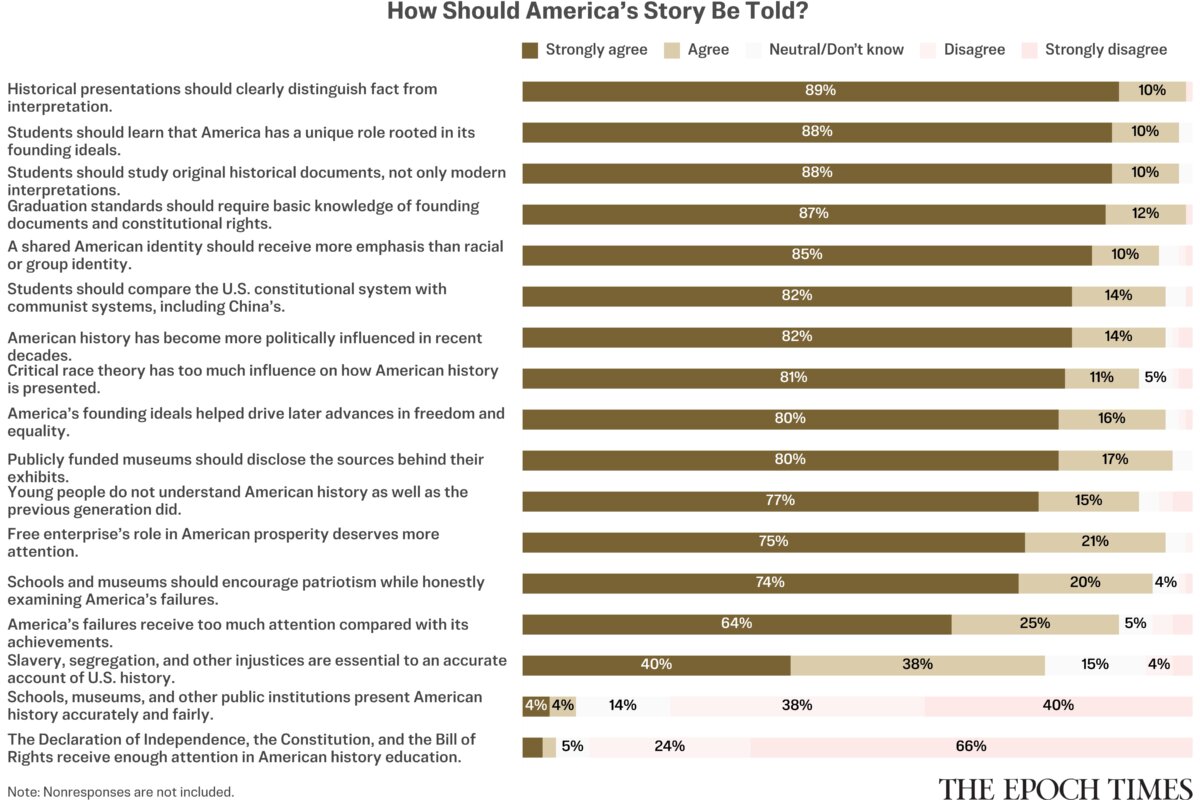
When The Epoch Times surveyed poll participants, the vast majority—92 percent—said that young people do not understand American history as well as the previous generation did. Only 5 percent disagreed.
When those surveyed were asked how they wanted to change the way American history was taught, the majority suggested stronger instruction on civics and the Constitution.
The second-place suggestion was making the educational system less political or ideologically influenced.
In third place was a greater emphasis on founding principles.
The vast majority of respondents—94 percent—agreed that schools and museums should encourage patriotism while honestly examining America’s failures, while just 2 percent disagreed.
Only 8 percent agreed that schools, museums, and other public institutions present American history accurately and fairly, while 14 percent remained neutral. The other 78 percent disagreed.
Also, only 5 percent of respondents agreed that the Declaration of Independence, the Constitution, and the Bill of Rights receive enough attention in American history education. Another 5 percent were neutral, and the remaining 90 percent disagreed.
Virtually all respondents agreed that graduation standards should require basic knowledge of founding documents and constitutional rights, with only 1 percent disagreeing.
Race
When the sample group was questioned on whether slavery, segregation, and other injustices are essential to an accurate account of U.S. history, 78 percent agreed, 15 percent remained neutral, and 7 percent disagreed.
A hefty 92 percent agreed that critical race theory has too much influence on how American history is presented, with 5 percent being neutral and only 3 percent disagreeing.
When asked if a shared American identity should receive more emphasis than racial or group identity, nearly all—95 percent—agreed, while 2 percent disagreed.
When those polled were asked if American history has become more politically influenced in recent decades, it was also nearly unanimous, with 96 percent saying yes and just 3 percent disagreeing.
Government
The vast majority of Epoch Times readers agreed that America’s founding ideals helped drive later advances in freedom and equality, with 96 percent polling yes.
The same percentage agreed that students should compare the U.S. constitutional system with communist systems, including China’s.
History
Participants almost unanimously agreed that students should learn that America has a unique role rooted in its founding ideals at 98 percent positive.
The same percentage agreed that students should study original historical documents, not only modern interpretations.
Also, 89 percent of survey-takers agreed that America’s failures receive too much attention compared with its achievements, with 6 percent disagreeing.
Most survey respondents agreed that free enterprise’s role in American prosperity deserves more attention, with 96 percent of the sample group voting yes, while 3 percent remained neutral and only one percent disagreed.
Museums
President Donald Trump ordered signs posted outside the National Museum of American History warning that some exhibits are inaccurate or biased, but the Smithsonian disputes that claim.
When asked for the opinion of survey-takers, most people polled said they supported Trump’s order, with 89 percent siding with the president, 5 percent opposing, and 6 percent remaining neutral.
A whopping 99 percent of respondents agreed that historical presentations should clearly distinguish fact from interpretation.
And 97 percent said publicly funded museums should disclose the sources behind their exhibits, while 3 percent remained neutral.
 Friends Read Free
Copy
Facebook
Tweet
Friends Read Free
Copy
Facebook
Tweet