
Children across America have started heading back to school, but the modern education system is facing fierce criticism from both parents and politicians.
A new Epoch Times survey of 1,378 readers shows that most Americans are not satisfied with what future generations are learning in the classroom.
Here are the results.
K–12
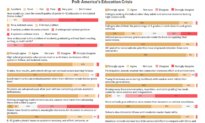
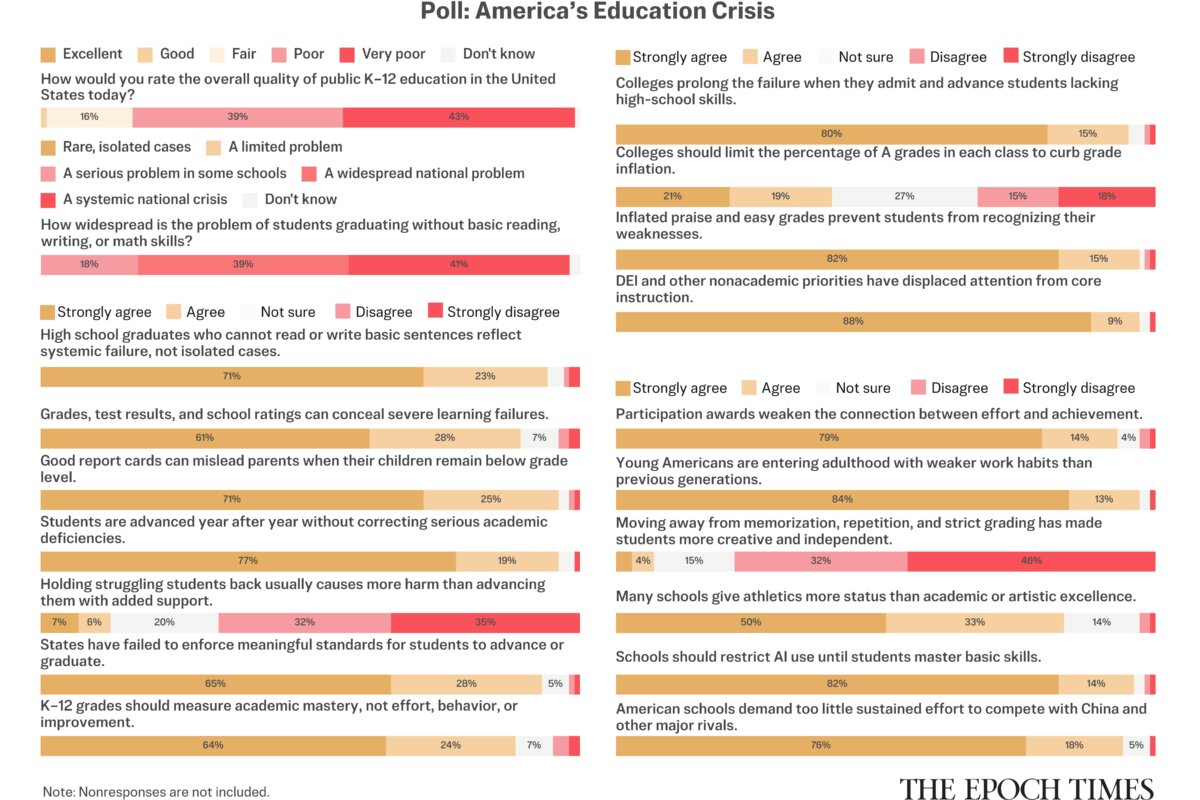
When those polled were asked how they would rate the overall quality of public K–12 education in the United States today, 82 percent rated it poor or very poor, 17 percent rated it good or fair, and none rated it excellent.
People were asked how widespread they thought the problem of students graduating without basic reading, writing, or math skills had been. Eighteen percent suggested it was a serious problem in some schools, 39 percent thought it was a widespread national problem, and 41 percent called it a systemic national crisis.
A hefty 94 percent of respondents suggested that if high school graduates cannot read or write basic sentences, that reflects a systemic failure, not isolated cases.
When the sample group was questioned on whether grades, test results, and school ratings could conceal severe learning failures, 89 percent of respondents agreed, four percent disagreed, and seven percent said they were not sure.
A whopping 96 percent of those polled agreed that good report cards can mislead parents when their children remain below grade level, two percent disagreed, and two percent were unsure.
The same percent of survey respondents agreed that students are advanced year after year without correcting serious academic deficiencies.
Poll-takers were decisive when asked if holding struggling students back causes more harm than advancing them with added support, as 13 percent agreed, 67 percent disagreed, and the rest were unsure.
Almost all survey-takers suggested that states have failed to enforce meaningful standards for students to advance or graduate, with 94 percent of people agreeing.
When people were asked if K–12 grades should measure academic mastery, not effort, behavior, or improvement, 88 percent of survey-takers agreed, five percent disagreed, and 7 percent were not sure.
College
An overwhelming number of participants agreed that colleges prolong the failure when they admit and advance students lacking high-school skills, with 95 percent of polled readers agreeing.
Readers were mixed when asked if colleges should limit the percentage of A grades in each class to curb grade inflation, with 40 percent of people agreeing, 33 percent disagreeing, and 27 percent remaining unsure.
Most readers agreed that inflated praise and easy grades prevent students from recognizing their weaknesses, with 97 percent of people suggesting it did while two percent disagreed.
The same number of survey participants agreed that DEI and other nonacademic priorities have displaced attention from core instruction.
Beyond the Books
When those surveyed were asked if participation awards weaken the connection between effort and achievement, 93 percent agreed, 3 percent disagreed, and the rest were unsure.
The large majority of those polled suggested young Americans are entering adulthood with weaker work habits than previous generations, with 97 percent of people polled agreeing.
When asked if moving away from memorization, repetition, and strict grading has made students more creative and independent, 78 percent of people disagreed, 7 percent agreed, and 15 percent did not know.
Survey respondents were again decisive when asked if many schools give athletics more status than academic or artistic excellence. Eighty-three percent of the sample group agreed, three percent disagreed, and 14 percent said they were unsure.
Most people agreed that schools should restrict AI use until students master basic skills, with 96 percent agreeing and two percent disagreeing.
When poll-takers were asked if American schools demand too little sustained effort to compete with China and other major rivals, 94 percent agreed.
Survey respondents were asked to pick three institutions or forces to bear the greatest responsibility for the education crisis.The teachers’ unions and education bureaucracies received the most votes, with 82 percent of respondents ranking them high.
The state education departments and accountability systems came in second, with nearly half (47 percent) of people picking them, and 44 percent of those polled suggested the culture of avoiding failure and honest criticism is to blame.
 Friends Read Free
Copy
Facebook
Tweet
Friends Read Free
Copy
Facebook
Tweet