
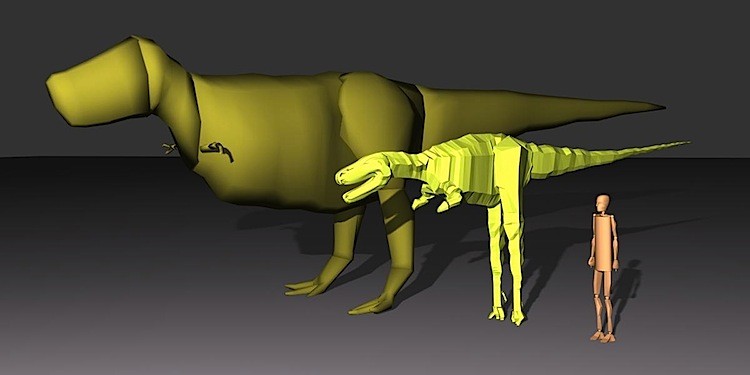
Using five mounted skeletons, including the largest best preserved T. rex specimen "SUE," a team of researchers ran three-dimensional laser scans to create a template for fleshed digital models whose body masses could be estimated.
"Previous methods for calculating mass relied on scale models, which can magnify even minor errors, or on extrapolations from living animals with very different body plans from dinosaurs," said Peter Makovicky at The Field Museum of Natural History in Chicago in a press release. "We overcame such problems by using the actual skeletons as a starting point for our study."
Body cross-sections were generated digitally for each tyrannosaur based on skeleton to soft tissue ratios in birds and crocodiles. Three types of "fleshiness" were created to account for different regions of the body, for example the head, legs, and tail. These were combined to develop a range of overall models for different masses.
"These models range from the severely undernourished through the overly obese, but they are purposely chosen extremes that bound biologically realistic values," said study co-author Vivian Allen of Royal Veterinary College, London, in the release.
"The real advantage to our method is that the models can be adjusted to accommodate the variation that is inherent in nature, so we don’t have to pick an arbitrary result, but rather deal with more meaningful ranges of results," explained co-author Karl T. Bates of the University of Liverpool in the release.
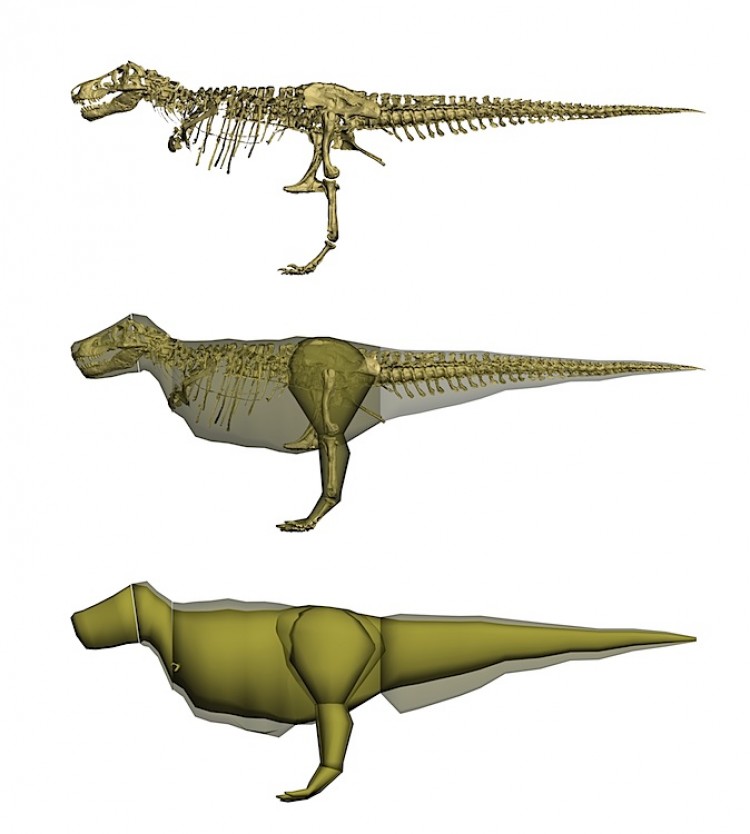
"SUE’s vertebrae were compressed by 65 million years of fossilization, which forced a more barrel-chested reconstruction," Makovicky said. "Nine tons is the minimum estimate we arrived at using a very skinny body form, so even if we made the chest smaller, adding a more realistic amount of flesh would make up for the weight."
The team found that larger individuals had higher masses, while the smallest specimen had a lower mass estimate than previously. This suggests that growth rates were similar to those of other dinosaurs, and even faster than outlined in a study five years ago.
"We estimate they grew as fast as 3,950 pounds per year (1790 kg) during the teenage period of growth, which is more than twice the previous estimate," said lead author John R. Hutchinson of The Royal Veterinary College, London, in the release.
However, growing big quickly seems to have slowed down these bipedal dinosaurs as the center of balance would have moved forward as the torso extended and became heavier, while the hind limbs remained short and light in comparison.
"The total limb musculature of an adult T. rex probably was relatively larger than that of a living elephant, rhinoceros, or giraffe, partly because of its giant tail and hip muscles," Hutchison said.
"Yet the muscles of the lower leg were not as proportionately large as those of living birds, and those muscles seem to limit the speed at which living animals can run.
The study supports a popular theory that these dinosaurs could have reached speeds of up to 10-25 miles (17-40 kilometers) per hour.
"T. rex represents a biological extreme because it’s one of the largest bipeds that ever lived," Makovicky said. "Putting numbers on that requires access to the dimensions of whole skeletons and their individual parts. For completeness and abundance, no other large predatory dinosaur can match T. rex."
Various institutions assisted with the project, particularly as SUE was too large for some of the measuring devices. For example, Ford Motor Co. in Livonia, Michigan, helped to scan the larger parts.
"SUE has become an icon of our city and it was fantastic to work with so many organizations and people as part of this process. The enthusiasm and generosity of everyone involved was incredible," Makovicky said.
The study was published in PLoS One on Oct. 12.
 Friends Read Free
Copy
Facebook
Tweet
Friends Read Free
Copy
Facebook
Tweet