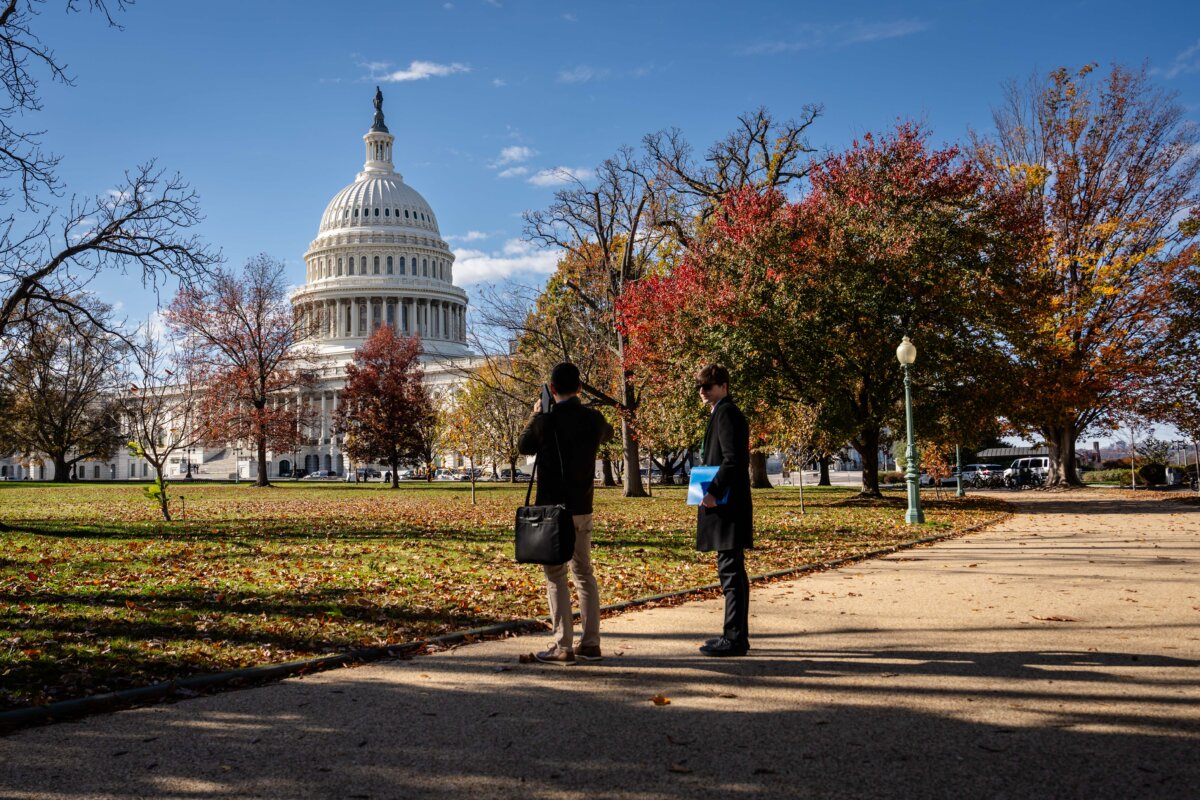

The six-week government shutdown seems nearly over.
The stalemate between Republicans and Democrats broke on Sunday when eight Senate Democrats sided with Republicans on a stopgap spending measure. The House will vote on the package on Wednesday.
Here are four takeaways from this long national experience.
Democrats Lost, and Won
“Democrats lost the public policy aspect of the shutdown, even though they won the rhetorical debate,” said David Schultz of Hamline University.
They held out on affordable health, trying to extend the temporary Obamacare subsidies, among other things.
Polls showed Democrats had a slight edge in public opinion, Aaron Dusso of Indiana University Indianapolis said.
But they gained little ground when agreeing to end the shutdown.
Senate Republicans agreed to hold a vote on extending the enhanced Marketplace subsidies, but made no guarantee of passage.
The GOP also agreed to rehire federal employees laid off during the shutdown. That just restored conditions that existed before this all started.
“This was a very, very bad vote,” Sen. Bernie Sanders (I-Vt.) said on Nov. 9.
Rep. Ro Khanna (D-Calif.) blamed Senate Minority Leader Chuck Schumer (D-N.Y.), “Senator Schumer is no longer effective and should be replaced,” Khanna wrote on social media.
Shutdowns Are Expensive
This one kept $54 billion out of the U.S. economy over the past six weeks, according to a Congressional Budget Office estimate.
Pay for federal employees will be distributed when the shutdown ends, but there’s a cost for that, too.
Between $7 billion and $14 billion in gross domestic product will be permanently lost, according to the Congressional Budget Office.
“You will re-establish your upward trajectory of economic growth, but you will never catch up,” Robert Kravchuk of Indiana University said.
Shutdowns Getting More Common
The federal government has had a lapse in spending authority 20 times since 1977, but most lasted a day or less.
The 2016 shutdown lasted 22 days. A shutdown in 2018–2019 lasted 35 days. This one has been more than 40 days.
“It is becoming the new normal,” Nicholas Higgins of North Greenville University said.
When Congress is so sharply divided, it’s tempting to leverage a shutdown to force the other party to agree.
“It’s kind of a high-stakes poker game where you’re really betting on your opponent breaking or making an embarrassing mistake,” Ken Kollman of the University of Michigan said.
The Battle Isn’t Over
This didn’t resolve the issue of health care spending, and Democrats vow to keep pushing.
“We’ll continue that fight today, tomorrow, this week, next week, this month, next month, this year, next year,” House Majority Leader Hakeem Jeffries (D-N.Y.) told reporters on Nov. 10.
“We will not give up this fight. We will deliver for the American people,” Schumer said after the spending resolution advanced in the Senate on Nov. 9.
But some experts question whether they can get far after declining to press the fight now.
Dusso believes the party has lost its advantage. “It’s over for them,” he said. “Now, their only hope is the 2026 election.”
—Lawrence Wilson
BOOKMARKS
The Department of Health and Human Services has gotten rid of a program that rewarded doctors for coming up with “anti-racist” policies. “While masquerading under the misleading ‘anti-racist’ moniker, in practice, these policies injected race-based decision making into the doctor-patient relationship,” said Dr. Stanley Goldfarb, chairman of the Do No Harm healthcare association.
Visa and Mastercard agreed on Nov. 10 to drastically reduce the transaction fees they take whenever a consumer swipes their card. The fees currently stand between 2 and 2.5 percent, but will be slashed down to 0.1 percent for the next five years.
Wendy’s restaurant chain will close hundreds of its franchises over the next two years, due to underperformance. The chain experienced a slight decline in its third-quarter U.S. sales but a boost in international business.
A U.S.-brokered peace plan between Thailand and Cambodia collapsed on Monday, after four Thai soldiers were injured by a landmine. The Thai military said the area where the landmine detonated had previously been cleared of explosives, but someone replaced them.
New York Gov. Kathy Hochul recently said she thinks more affordable public transportation is possible, but she is skeptical that it can be free, as advocated by mayor-elect Zohran Mamdani. “I cannot set forth a plan right now that takes money out of a system that relies on the fares of the buses and the subways,” she said.
—Stacy Robinson
 Friends Read Free
Copy
Facebook
Tweet
Friends Read Free
Copy
Facebook
Tweet