NEW YORK—A proposed taxi fare increase of 17 percent has been brought forth by the entity in charge of regulating the taxi industry, but taxi drivers and industry advocates want more.
The Taxi and Limousine Commission hosted a public meeting in Lower Manhattan Monday, to discuss the proposed fare increases.
“I think there should be a bigger raise—this raise is nothing,” said Vincent Sapone, managing director of the League of Mutual Taxi Owners after a public hearing on the proposed raise.
Sapone said City Council should make a law requiring an increase of about 19 percent every four years, as well as an immediate $1 surcharge during morning rush hour and a 50 cent base fare increase.
“Ideally [the fare raise] should be higher,” said Bill Lindauer, a retired taxi driver, who said fares should be raised every two years.
Breaking Down Taxi Fares
Taxi fares have multiple components.
Base fares for taxis are currently $2.50, raised in 2004 from $2.00. The charge per every fifth of a mile was also raised at that time, from 30 cents to 40 cents. The charge for the wait time, or the amount of time a taxi idles, changed slightly from 30 cents per 90 seconds to 40 cents per 120 seconds.
Another increase, for the wait time, happened in 2006. The 40-cent wait time charge ticked over every minute instead of every two minutes. Industry representatives said that increase was so slight that it’s referred to as “an adjustment.”
A $1 evening surcharge between 4 p.m. and 8 p.m. was added in May 2004, according to Schaller Consulting, while a 50-cent night surcharge from 8 p.m. to 6 a.m. began being levied industrywide in 1987.
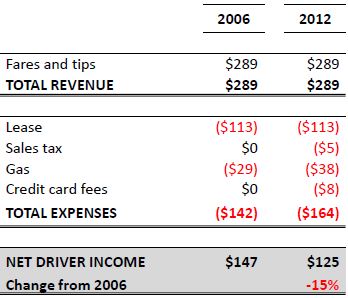
Since the last multiple component fare raises in 2004, inflation has raised living expenses for drivers and, for the taxi industry, business expenses—especially gas.
Also, credit card machines installed several years ago in taxis make paying easier for customers but garner less profit for drivers.
NYC Taxi Fares Compared
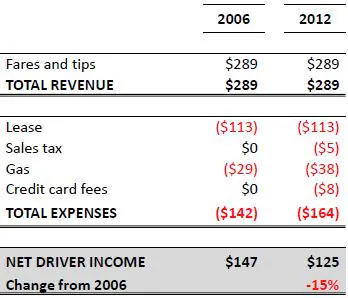
“After accounting for inflation, driver income has actually decreased 24 percent in real dollars,” said Ashwini Chhabra, deputy commissioner for policy and programs for the Taxi and Limousine Commission (TLC), the entity that governs the industry. Subway and bus fares have increased since 2006, but taxi fares have not. Chhabra said the fares should be comparable.
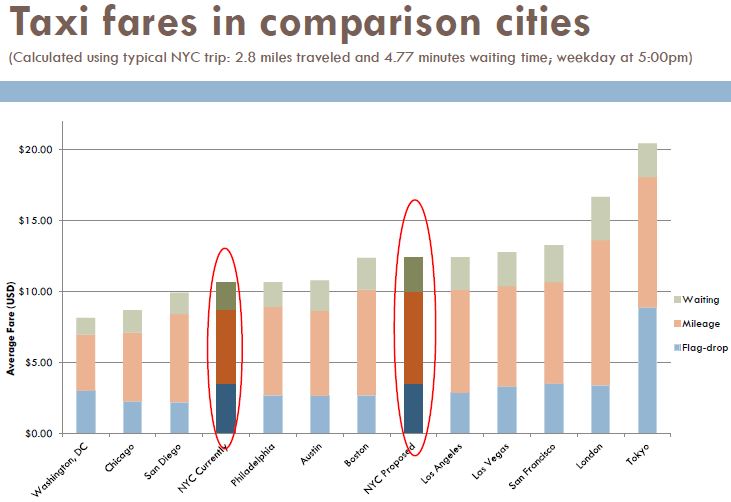
He also said that taxi fares in other major markets worldwide, such as Boston, Las Vegas, London, and Tokyo, are higher than New York City—and still would be higher even after the proposed increase.
“For these reasons,” added Chhabra, “we believe a 17 percent fare increase is needed to return drivers to their 2006 level of income.”
Chhabra and TLC Commissioner David Yassky are in favor of the planned increase. A majority vote is needed from the nine-member commission when they vote Thursday.
At the public hearing, drivers and owners gave testimony, with most in favor of the proposed increase, though some seek a higher increase.
While the fare increase was agreed upon, whether owners should receive more money is a source of contention between drivers and owners. Fleet owners, some of whom own hundreds of medallions, or licenses, already make plenty of money, drivers said.
Fleet owner representative Ethan Gerber, of the Greater New York Taxi Association, said, “It is time for a fare increase, but that increase should be equitable.” The commission studied rising costs for drivers, but not costs for owners, such as garage fees including utilities, he said.
 “Go back to the drawing board and do it again,” Gerber told the commission. “Both drivers and owners deserve increases.”
Bill Lindauer, the retired taxi driver, and an organizer with the New York Taxi Workers Alliance, disagreed. He referred to data compiled by the TLC, which showed owners of small fleets make $1.2 million a year, while owners of larger fleets—200 cars or more—make $9.6 million a year.
These figures, about 25 percent larger than ones put forth by fleet owners in a recent commission hearing, drew a visible response from the Alliance members, who lined the back of the room holding signs protesting owners charging drivers too much money to lease cabs.
 Friends Read Free
Copy
Facebook
Tweet
Friends Read Free
Copy
Facebook
Tweet