
Epimenides, a Greek philosopher of the 6th century BC, was the first to present one of the most famous paradoxes of all time: The “liar’s paradox.”
A resident of Crete, he declared that “All Cretans are liars.” If we assume that Epimenides was telling the truth and that all Cretans are liars, it follows that he too is a liar, by virtue of being a Cretan, and therefore his statement that “all Cretans are liars” is false, creating a paradox.
Modern versions of this paradox are: “I am lying right now,” and “This statement is a lie.” In her book “Paradox,” Margaret Cuonzo, a professor of philosophy at Long Island University, describes it as one of the most important and puzzling paradoxes known to humanity, as it profoundly challenges the fundamental assumption that every statement must be either true or false—but not both at the same time.
Paradoxes generally sound intuitively correct, but upon closer examination, they don’t hold up. Like a puzzle, they make us question fundamental matters, such as “truth,” “knowledge,” “beauty,” and “interpersonal relationships.”
The “paradox of tolerance” is one example. Here is the paradox:
1. For a society to be completely tolerant, it must allow the expression of all views.
2. Intolerant views are views, too.
3. Therefore, for a society to be completely tolerant, it must allow the expression of intolerant views.
4. The expression of intolerant views creates intolerance, either in thought or action.
5. Conclusion: For a society to be fully tolerant, it must permit the development of intolerance.
The paradox of tolerance is not merely a game of logic, but a real challenge throughout history, and it is especially visible today on social media. A platform wants to be tolerant. But to do so, it must, for example, permit remarks that denigrate religion. Such opinions generate intolerance toward religion, rendering a platform fully tolerant while simultaneously promoting intolerance.
If you think the solution is simple—a platform should simply block “hate speech”—you may be on the right side of history, but you have not solved the paradox, because now you are being intolerant.
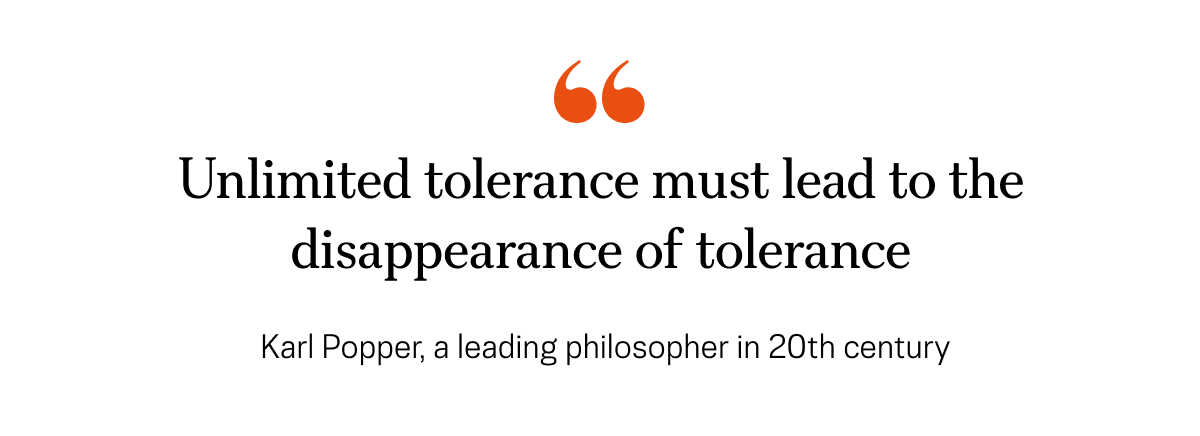
What can be done? In his book, “The Open Society and Its Enemies,” Austrian-British philosopher Karl Popper famously wrote, “Unlimited tolerance must lead to the disappearance of tolerance. If we extend unlimited tolerance even to those who are intolerant, if we are not prepared to defend a tolerant society against the onslaught of the intolerant, then the tolerant will be destroyed, and tolerance with them.”
Popper implied that in order to resolve the paradox of tolerance, the views of the intolerant should be protected only when tolerating them does not harm or restrict the views and freedom of others.
American philosopher John Rawls proposed a similar solution in his book “A Theory of Justice.” The freedom of intolerant groups, he wrote, should be restricted only “when the tolerant sincerely and with reason believe that their own security and that of the institutions of liberty are in danger.”

However, the solution proposed by Popper and Rawls is open to personal interpretation and does not offer an easy way out of the paradox. Consider, for example, the postmodernist challenge to objective truth. For centuries, scientists have argued that there is an objective truth in our world, one that can be investigated and discovered through science, such as the fact that 2+2=4.
Yet postmodernist thinkers come along wishing to voice a different opinion: there is no such thing as objective truth; there is only a shifting truth, relative to place and time. The so-called objective truth that scientists investigate is a narrative you have established by virtue of your hegemony. Who says that 2+2 must equal 4? And to the same end, who says that a man must be a male, and a woman must be a female?
Should they be allowed to voice their opinion? At the first glance, “yes,” because these views do not infringe upon others’ freedom. One should respect their right to free expression, even if one disagrees with them.
Yet Popper argued that there is a problem here. What will happen if one day this minority gains popularity and decides to overturn society and abolish its very foundations? Would all those scientific institutions and communities that believe in objective truth not be harmed? Would traditional communities not be harmed when the very concepts of “man” and “woman” are abolished and replaced by fluid identities?
The Tyranny of Democracy
A somewhat similar problem exists with the paradox of democracy, first raised by Greek philosopher Plato. The paradox asks what would happen if the public one day decided to overturn the very laws and institutions that had enabled them to do so in the first place.
Popper formulated it as follows: what would happen if the people democratically decided, as had happened in Germany in the 1930s, not to govern themselves but to be governed by a tyrant? And what should the position of democratic intellectuals be in such a case?
“On the one hand, the principle they have adopted demands of them that they resist any rule other than that of the majority, not to mention a new tyranny; and on the other hand, that very same principle demands of them to acquiesce in any decision reached by the majority, and thus in the rule of the new tyrant,” Popper wrote.
Plato argued that democracy’s deterioration into tyranny (or anarchy leading to tyranny) is an inevitable process that recurs throughout human history. He did, however, propose a preventative measure: to appoint enlightened guardians to serve as a gatekeeper against direct tyranny or against an unenlightened mob that decides to shatter the foundations of civilization and declare that 2+2=5.
Plato’s idea was that a ruling class of “philosopher kings” would lead the state and protect the society from the natural decline of democracy.
A different solution, proposed by Popper, is that democracy should not be committed to any single value, ideology, or religion. Its only commitments would be to a number of basic principles necessary for its functioning, such as the commitment to a rationalist democratic society and resistance to tyranny.
In this scenario, Popper argued, there would be no need for “a small elite of philosophers” to determine any additional values for society.
The Search for True Beauty
Another interesting paradox that is still relevant today is the paradox of taste, which questions the subjectivity of beauty. In the 18th century, Scottish philosopher David Hume put forward the following contradictory arguments:
1. It is futile to argue about matters of taste and preference.
2. We are capable of distinguishing between good and bad works of art.
If, in accordance with the first argument, matters of taste and preference are entirely subjective, it would seem that there is no logic in attempting to distinguish between good and bad art. Yet we do so all the time.
Is it possible that both claims are true? Hume thought so.
“Hume wrote that one cannot deny the fact that a person may dislike a certain work of art, or react to it negatively. But we can argue, for example, that this person is wrong to think that their feeling is a reflection of the true nature of the work,” wrote Cuonzo in her book “Paradox.”
For Hume, all of our feelings are valid, Cuonzo said, because, as she quotes from his 1757 work “Of the Standard of Taste,” a “sentiment has a reference to nothing beyond itself.”
To resolve the paradox, Hume argued that although each person may have different taste, there must be a certain standard based on “general observations, with regard to what has been universally found to please in all countries and in all ages.”
But what has been “universally found to please in all countries and in all ages?” Hume struggled to offer a straight answer, and so we return again to Plato. Plato’s sense of “beauty” is different from how we understand it today. Today, we associate “beauty” with aesthetics, but in the past, “beauty and aesthetics are two different things,” Arthur Pontynen, a professor of art history at the University of Wisconsin at Oshkosh, told The Epoch Times.
“In the Judeo-Christian tradition and Confucianism, beauty is ‘the splendor of wisdom.’ ‘Beauty’ was the same as ‘good.’ The word yafeh (יָפֶה) in Hebrew means both beautiful and good. That is also the meaning in China (美 meaning beautiful, good, and representing the aesthetic balance of nature) and in all the traditions that seek wisdom. In Greek, Kalon (καλόν) is a word that unites beauty and goodness.”
The better something is, the more beautiful it is, Pontynen said. These traditions saw a connection between a person’s good character traits and beauty, or between the good values represented by a work of art and beauty.

Aristotle also addressed the connection between beauty and goodness, but thought one should also examine whether a work had truly achieved its perfection, and how it is experienced emotionally. “It was Aristotle who began to use the word ‘aesthetics,’ which in Greek means ‘sensory perception.’ Nevertheless, for Aristotle, aesthetics existed within a theological universe—that is, a universe with a divine logic, in which every form and thing, even a hammer, has its own theological purpose,” Pontynen said.
Thus, according to Plato and Aristotle, “beauty” must be connected to the divine, to goodness, and to the search for higher wisdom. “A work of art must grant us deep insight into the meaning of existence,” Pontynen said.

After the era of Aristotle, the perception began to change, and the way in which people spoke about aesthetics shifted to focus on the artist’s notion of beauty, rather than beauty as a higher truth to be aspired to. Everything divine, ideal, or sublime began to recede.
Another element that influenced the perception of beauty was science. From the scientific standpoint, art was no longer a means of attaining wisdom and knowledge. “The scientific approach did not advance a vision of beauty, but of aesthetics—a mechanical view of reality and of life. It also advanced an atheistic view: one that offers no purpose or meaning to reality,” Pontynen said.
“According to the Western calendar, from the first century to the 10th century, spiritual idealism prevailed. In the 11th century, a shift occurred in relation to aesthetics and the divine, and gradually science and the materialist view began to take hold.”
The Liar’s Paradox
Lastly, we return to the liar’s paradox, which mathematicians and philosophers have been attempting to solve—with little success—to this day. On the surface, it appears to be an unsolvable paradox.
Epimenides claims that “all Cretans are liars,” which leaves two possibilities: He is telling the truth or he is lying.
1. If he is telling the truth, and all Cretans are liars, then he too is a liar by virtue of being a Cretan—and therefore the statement is false.
2. If he is lying, and all Cretans are truth-tellers, then as a Cretan he is in fact telling the truth—and therefore the statement is true.
In other words, the statement is sometimes false and sometimes true. From the standpoint of classical logic, in which a statement must be true or false, it is not possible for it to be simultaneously true and false. Mathematicians and philosophers have proposed a number of possible solutions over the years, and have not always agreed among themselves.
Mid-20th-century logician and mathematician Alfred Tarski explained that the core problem with the phrase in question lies in self-reference—the sentence refers to itself, creating complex circularity. If a way could be found to break this recursiveness down into different phrases, it would be possible to express the claim without the internal contradiction.
Tarski found such a way based on hierarchical languages, and it does indeed make it possible to describe the sentence without submitting to a paradox—but many argue that this is at best a workaround and not a solution to the root of the problem.
Another solution proposed for the paradox is based on a different type of logic, known as “paraconsistent,” which allows opposites to coexist. That is, a phrase can be both true and false, subject to one condition—the truth and the falsehood cannot merge, and that no reliable conclusion can be derived from them.
Many other proposals have been put forward in recent years to solve this deep and complex paradox, and it seems that more ideas will be raised in the future in attempts to crack it.
In any case, as Cuonzo concluded in her book: “paradoxes force those who attempt to solve them to confront strongly held but mutually conflicting intuitions; to discover how our intuitions can lead us astray; and to expose ways in which our ordinary concepts turn out to be problematic.”