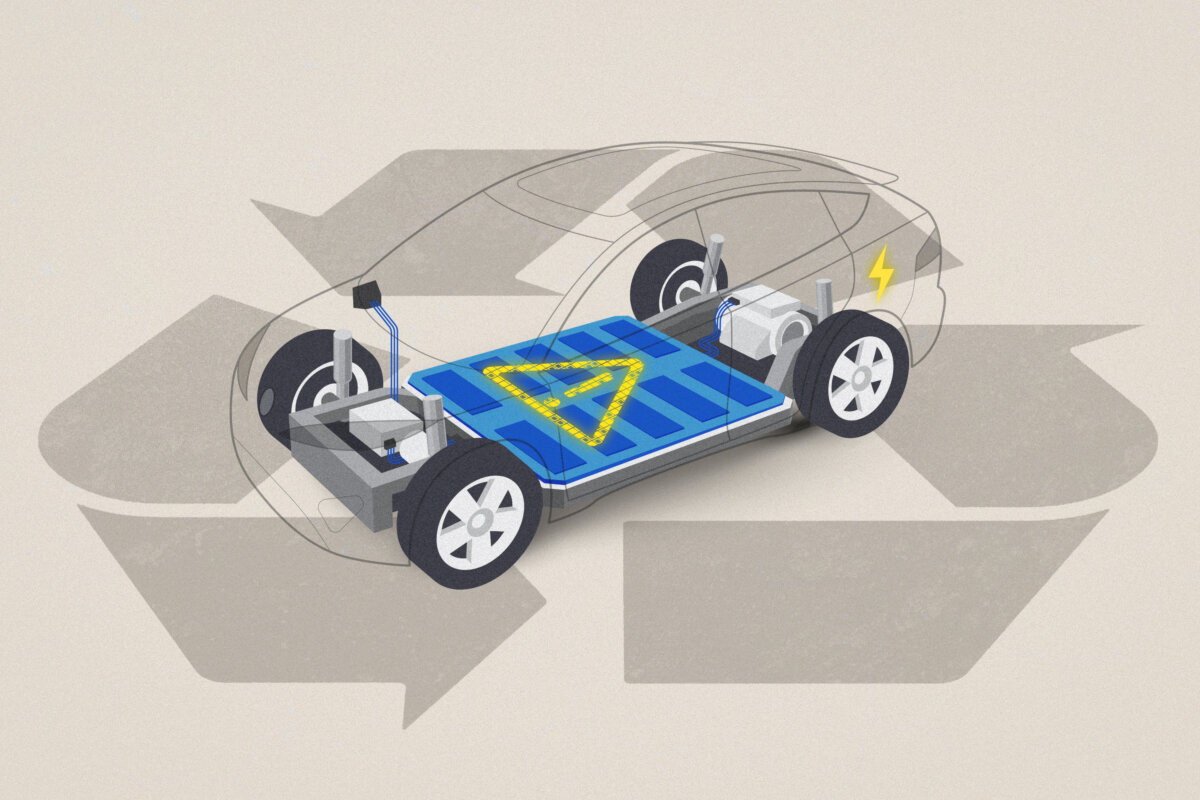

As half a million tons of electric vehicle batteries lose their roadworthiness annually, they are increasingly finding a second act in the commercial sector, powering homes and serving as emergency storage systems.
But behind the promise of a circular energy economy, experts across industry, legal, and insurance sectors say these repurposed EV batteries carry hidden risks tied to degradation and unknown histories. A lack of standardized testing compounds the issue.
A growing body of research suggests that second-life EV batteries operate in a gray zone between sustainability and safety. Unlike a new battery rolling off the assembly line, a reused battery may have an unpredictable life cycle, based on a variety of factors in its past that could influence longevity. That raises questions about long-term reliability.
Generally speaking, an EV battery is retired from its primary role when its productive capacity dips to around 75 percent, which is considered the “end of life” threshold. The battery may still have a useful “second life” ahead of it.
It might go from powering a speeding car down the freeway, to a more mundane but just as useful life in a cabinet or shipping container, supporting a building, solar array, or the power grid.
However, studies show that electric batteries can degrade unevenly and behave unpredictably.
Despite a burgeoning secondary market for EV batteries, researchers say there are significant hurdles that must be addressed. A 2025 study noted incidents of redeployed EV batteries in which “mismatches between estimated and actual performance” occurred; the units often proved “technically unsuitable or hazardous.”
It’s not that used batteries aren’t tested before being sent back out into the world. It’s the lack of an enforced, universal standard that some are worried about.
EV batteries still go through several stages of evaluation before qualifying for second life use. Some of these include data collection, electrical testing, inspection, and monitoring.
The degradation of these battery packs is nuanced, which complicates any in-depth evaluation. As an example, the physical orientation of cells within the unit—vertical versus horizontal—can lead to different rates of degradation due to gravity’s effects on components during the battery’s primary life cycle.
Meanwhile, the second-life battery market is entering a boom phase. It was valued at $942 million in 2025 and is projected to grow from $1.3 billion in 2026 to $7.6 billion by 2034, according to an April report by Fortune Business Insights.
Prior State Unknown
Some researchers consider the threat of thermal runaway the “primary technical barrier” to wider deployment of road retired EV batteries. Thermal runaway is a domino process: a rapid, uncontrollable failure of battery cells that can cause intense fires, toxic gas release, or explosions.
Aged cells in retired EV units “generate more heat and distribute it less uniformly” than new cells, according to a review published in the journal Batteries in March. Second-life designs must prioritize temperature uniformity over average temperature reduction in safety evaluations, the review advised.
The same researchers stated: “Aged cells can exhibit reduced thermal stability margins that vary with degradation pathway. Ensuring safe reuse therefore requires thermal safety evaluation and management methods specifically adapted to retired battery characteristics.”
When it comes to conflagrations, lithium-ion battery fires are among the worst. Blazes caused by these units are difficult to control, generate intense heat, and spread quickly.
Car manufacturers have issued recalls over potential battery fires, even in newer model electric cars. One such instance took place in February, when Mercedes-Benz issued a recall for thousands of 2022-2024 model electric cars over battery defect concerns.
In June 2025, a cargo ship fire that was first detected on a deck carrying multiple electric vehicles forced an emergency evacuation of the crew as the ship sank in the Pacific with all of its cargo. Multiple reports suggest the fire may have been related to an EV battery, due in part to the location where smoke was first detected.
Subsequently, some legal experts say unknown factors inherent in secondary EV battery deployments are a major red flag.
“The part I’m concerned about is the risks. Essentially, a second-life EV battery has a history. You don’t always know what that history is,” James Roswold, owner of Kansas City Accident Injury Attorneys, told The Epoch Times.
From a litigation perspective, Roswold said details are critical. “Was [the EV battery] fast-charged the entire time? Was it in a wreck? Was it water damaged? You just don’t know. When they’re put to second use, we’re talking about a system that has the potential to fail in a big way.”
Roswold pointed out that despite improved battery testing, the lack of a standardized method creates a potential pitfall. “Two different batteries might be tested in two vastly different ways depending on the testing facility,” he said. “That’s a lot of room for error.”
Auto industry experts share this sentiment. “The safety risk that doesn’t get talked about enough is what we call ‘unknown prior state.’ A second-life battery has a history you can’t fully see,” Sandeep Kumar Bomthapalli, an automotive functional safety expert, told The Epoch Times.
“How many charge cycles? What temperatures was it exposed to? Were there any micro-faults that never triggered a warning? Without that data, thermal runaway risk goes up, and any safety argument for reuse is really just educated guesswork.”
Ultimately, he said making these decisions with missing information “gets complicated.”
Bomthapalli believes regulatory frameworks need to improve.
The idea of a battery “passport,” which tracks the entire lifecycle and holds critical information, isn’t a new concept. However, it has gained momentum.
The Global Battery Alliance plans to launch its own passport program in 2027 to make EV supply chains more “visible, traceable, accountable and comparable.”
The EU also plans to make EV battery passports a requirement in 2027, making verifiable lifecycle data that’s traceable necessary for sale and operational purposes.
“A battery passport isn’t just a nice idea, it’s the only way to actually certify a second-life battery with confidence,” Bomthapalli said.
Absolute Nightmare
“Everyone is obsessed with the green tech angle of second-life EV batteries, but they are completely ignoring the massive financial liability,” James Shaffer, managing director of online auto insurance comparison service Insurance Panda, told The Epoch Times.
Electric cars tend to be more expensive from an insurance standpoint to begin with. Much of this is due to the battery, which can account for up to 50 percent of the vehicle’s value and is widely considered the most expensive single component.
Throw a used lithium-ion battery into a commercial energy grid, and its high replacement value, the unpredictability of lithium-ion batteries, and the unknown degradation history of a second life battery add up to what Shaffer called an “underwriter’s absolute nightmare.”
“I price vehicular risk for a living … You can’t insure unknown variables. If a repurposed battery pack triggers a thermal runaway event in a warehouse, the resulting chemical fire burns at 3,600 degrees. It destroys everything. Water doesn’t stop it,” he said.
He believes this is why battery passports aren’t just some “cute regulatory idea.”
“It is mandatory. We need a tamper-proof digital ledger tracking every single charge cycle, deep discharge, and temperature spike from the moment that battery left the original factory,” Shaffer said.
Without what he called the “hard data,” commercial insurance carriers have to assume the worst-case scenario and will likely price insurance premiums accordingly.
“There are regulations in place to transport the batteries. However, when they go to second use, things get a little fuzzy. I think those areas are the biggest gaps,” Roswold said.
The National Institute of Standards and Technology (NIST) has pressed for the creation of an EV battery passport since 2023, due to the looming surge in end of life units.
“Given the finite nature of material resources worldwide, developing a circular EV batteries (EVB) infrastructure is needed to keep high value battery materials in the economy, therefore, reducing the environmental and social impact and minimizing disruptions in the supply chain due to potential shortage of critical and conflict minerals,” NIST stated on its website.
From Shaffer’s perspective, it’s a win-win in terms of safety and economics. “If you want this secondary [EV battery] market to actually scale against new systems, fix the traceability gap first. Otherwise, the liability costs will bankrupt the project before you even plug it in.”
 Friends Read Free
Copy
Facebook
Tweet
Friends Read Free
Copy
Facebook
Tweet