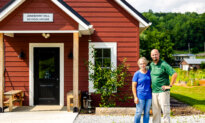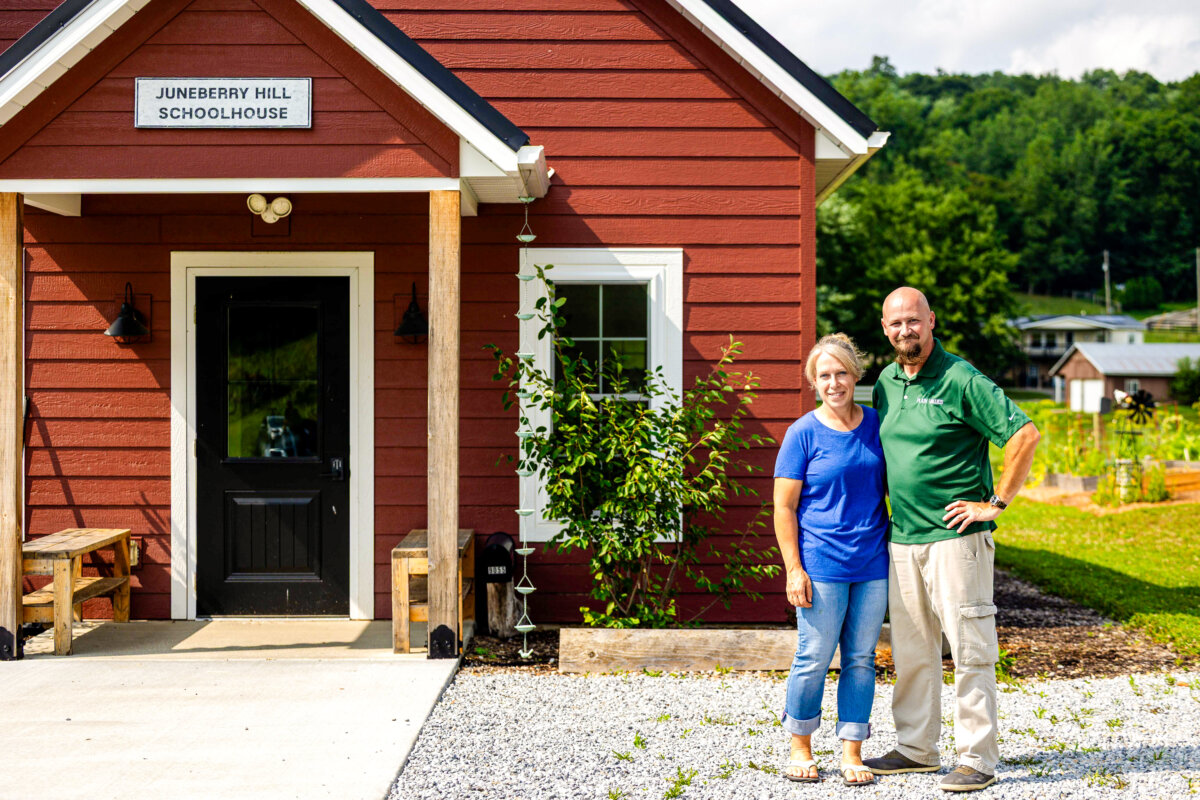

DUNDEE, Ohio—Their interest piqued by a one-room schoolhouse created by country musician Rory Feek, Marlin and Lisa Miller envisioned an alternative education for their three adopted children with Down syndrome.
The couple, who lives on a 12-acre homestead in northeast Ohio’s Amish country between Dundee and Winesburg, was further motivated while driving past the numerous Amish one-room schoolhouses in their region.
They began asking why such options weren’t available to non-Amish families. The question evolved into “What if we built a schoolhouse right here?”
The Millers created a one-room school, dubbed Juneberry Hill, out of materials from a 19th-century schoolhouse. Then they hired a teacher to run a homeschool co-op for families looking for something different from conventional classrooms for their children.
The Amish retain the same schooling principles that were embraced nationwide in the 19th century, Lisa said.
Small schoolhouses were built every few miles so students did not have to walk far to school.
The co-op began with a simple vision: a place where children could learn together in a setting that felt more like a living community than an institution. Today, 22 students attend, a mix of typical learners and children with special needs, including Down syndrome.
Marlin is the publisher of Plain Values, a magazine dedicated to faith-centered simple living.
Lisa is a former teacher who once taught first grade in a two-room public schoolhouse in the Amish community nearby.
The couple has grown their family through adoption, welcoming children with special needs. They also run the nonprofit Room to Bloom, which supports families adopting children with Down syndrome and other special needs.
“We found that church-run private schools did not extend admission to students with special needs and/or developmental and learning delays. We were told they were not equipped to meet the needs of our children with Down syndrome,” Lisa explained.
“Homeschooling allows us to focus on what our children actually absorb rather than what they manage to complete on worksheets. The co-op extends that philosophy into a small community where older and younger students learn from each other.”
One-room schoolhouses were often referred to by number, with each representing a district within a township. On average, there were eight to 10 schoolhouses in each township. A school might be renamed or referred to by the last name of the family on whose farm it was built, or named after a feature near the schoolhouse.
“The juneberry, or serviceberry, trees that graced our hilltop were by far the most unique thing to us when we moved here,” Lisa said of the inspiration for the school’s name.
Juneberry Hill is a hybrid school model, Marlin said.
Parents still homeschool, but the co-op provides “structure, shared curriculum choices, and a place where kids of different ages learn side by side.”
Education revolves around hands-on, multisensory experiences such as tending animals, raising produce in raised beds, and working together in the restored schoolhouse.
A Schoolhouse for Indiana
Country music enthusiasts recognize Rory Feek as a singer and songwriter who has written singles for Clay Walker, Blake Shelton, and Tracy Byrd, among other artists. He and his wife, Joey Feek, formed the Grammy-winning duo Joey + Rory.
Feek is vocal about his Christian faith. His life abruptly changed when Joey died of cancer in 2016.
The couple lived on Hardison Mill Farm, located on 100 acres in Columbia, Tennessee, outside of Nashville.
Their now 12-year-old daughter, Indiana, was born with Down syndrome. Before Joey passed away, the couple had intended to homeschool Indiana.
“The one-room schoolhouse was never a part of our plans. Joey was going to educate Indiana at home and teach her the things we felt were important in an environment that would give her the best opportunity to be the best person she could grow up to be,” Feek said.
“But when she passed away, we had to come up with another option.”
Cards and letters flooded the Feek home after Joey died. Many contained small gifts of cash—$5 bills, tens, twenties—and checks.
The total amount reached around $100,000.
Feek decided to use the gifted money to build a one-room schoolhouse “so Indiana could learn close to home.” The schoolhouse is a short walk from the family cemetery where Joey is buried.
But what began as a father’s attempt to honor his late wife’s wish to educate their daughter at home became something larger.
Gradually, the idea expanded.
“Why not welcome other children of different ages and abilities? Why not include a garden, a greenhouse, animals, and daily chores so that nature and real life became the primary classroom?” Feek said.
The site was an empty field of weeds and hay in 2017. A stake in the ground was followed by shovels and a backhoe pouring concrete for a foundation. The schoolhouse walls were raised over one weekend and the roof trusses were hung in barn-raising style with help from neighbors and friends.
“By the following summer, the schoolhouse was finished. The final cost matched the donated amount almost to the dollar,” Feek said.
Hardison Mill School opened in the fall of 2018 with about a dozen children, including then-four-year-old Indiana. It was named for the historic one-room school that once served the local community.
Over the years, the original building grew into a small campus with additional structures supporting gardens, livestock, and learning spaces.
“This represents re-imagining what school can be—a place where children learn to teach themselves through nature, responsibility, and community,” Feek said.
The school evolved into a place where students learned homesteading, traditional crafts, homemaking skills, “and practical knowledge that modern culture has largely lost.”
“We wanted to give Indiana more one-on-one attention as she grew while providing the same experience for other children,” he said.
Indiana is 12 now, and in sixth grade. She is recovering from open heart surgery in June.
“She just reminded me last night that ‘Papa, I’m about to be 13 and going into 7th grade, so I’m a young lady now,” Feek said with a laugh.
Feek learned about the Millers from regenerative farming expert Joel Salatin, who told him about Plain Values.
Feek and the Millers developed a friendship, and the couple visited Hardison Mill.
“It’s special to be able to inspire someone who’s already inspiring so many people,” Feek said.
“I was blessed to be a father of a special little one that God gave us. But he and Lisa chose that, and not just once. They chose it three times.”
Taking Ownership
Marlin Miller believes that one-room schoolhouses, and homeschooling in general, are popular because “more people are taking back ownership of their children’s education.”
“They’re looking for something like this where they can homeschool their children and give them a chance to learn alongside other kids from other families,” he said.
The Millers joined the Country School Association of America, a nonprofit organization that helps preserve early American schools.
“Our goal is to resurrect the one-room schoolhouse as a place where siblings and neighbors learn together as classmates. Where the reading, writing, and math concepts learned inside the classroom are incorporated and put into practical life lessons in the gardens and barnyard outside of the schoolhouse,” Lisa said.
The Millers implemented their vision by moving a former one-room schoolhouse to their property. Realizing the 1800s structure was too tiny for a dozen students and restrooms, they acquired a second schoolhouse. That building with its hand-hewn white oak beams, poplar studs, heart pine flooring, walnut ceiling, and interior shiplap was carefully disassembled and transported to Ohio.
They formed a 501(c)(3) nonprofit, registered the school as a nonchartered private school with the Ohio Department of Education, and assembled a board. The small size allows individualized support across academic levels, Marlin said.
At Juneberry Hill, students spend time outdoors every day regardless of weather. Gardens, fields, barns, and pastures are as much the classroom as the building itself, Lisa explained.
‘What Education Should Be’
Deanna Flinner had earned her early childhood education degree and spent time in public schools as a student teacher. She learned about Juneberry Hill from Marlin Miller at a wedding.
“I thought, ‘Oh my goodness, this is what education should be, this is what I’ve always dreamed of doing,’” she told The Epoch Times.
Juneberry Hill teaches traditional academics with books and paper rather than screens, Flinner said. Hands-on experiences serve as living books to bring subjects alive. The Bible, music, American Sign Language, arts and crafts, and vegetable growing are all part of the curriculum. Practical life skills and character building are taught alongside academic work, she added.
Families are drawn to the co-op by frustration with overcrowded classrooms, rigid schedules, and questionable curriculum, Flinner said.
Children learn better through hands-on education, she believes.
“I know that a lot of families of students here agree that sitting at a desk for five to eight hours a day and listening to a teacher in front of the class is not engaging,” she said. “Hands-on education is more effective because the children are engaged in what is happening.”
Parents with strong Christian values prioritize a learning environment that shares those values, she said—another reason one-room schoolhouses such as Juneberry Hill are flourishing.
The COVID-19 pandemic accelerated dissatisfaction with traditional schools and prompted more parents to experiment with small learning groups, private teachers, and co-op-style arrangements, Lisa Miller said.
Today, more families are seeking flexible, community-based alternatives that resemble the one-room schoolhouses of earlier generations, she added.
Meghan Wilson, a nurse,, and her husband, Nathan, a local newspaper editor, send their sons Josh and Jude to Juneberry Hill. Jonathan, a toddler, will join his brothers when he is old enough.
The Wilsons learned about Juneberry Hill from another family that is part of a 4-H group. They have homeschooled their children from the beginning.
Meghan’s father worked as an English teacher and a guidance counselor before retiring. Nathan was an English teacher before his current role.
“We decided we would teach our children rather than sending them away,” she said.
Wilson told The Epoch Times that she likes the individualized attention her children experience at a one-room schoolhouse.
“There is freedom in all of the opportunities that homeschooling offers, and a co-op where there is an extension of hands-on learning around children of different ages is part of that freedom.”
 Friends Read Free
Copy
Facebook
Tweet
Friends Read Free
Copy
Facebook
Tweet