
NEW YORK—Growing up in suburban Virginia with strip malls lining the streets, Erin Barnes didn’t have much opportunity to get in touch with nature’s offerings.
Luckily for Barnes, she befriended a kid whose mother was an environmentalist. They would load up the van and travel to the wildlife center for a day of eating pancakes and playing in the creek. Roaming free and getting muddy brought a smile to her face.
“It was the one time we got to leave suburban wasteland and actually see real nature,” Barnes said. “That didn’t happen again until I was around 24 years old.”
She took that love for nature she found as a kid and studied how to help preserve it as a young adult.
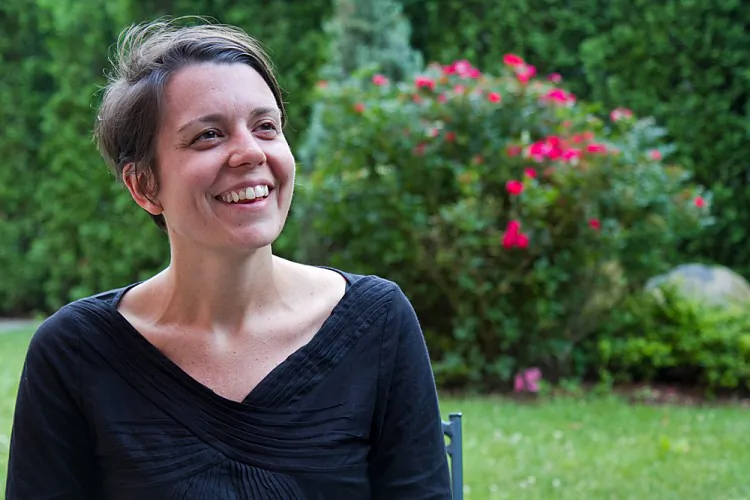
Barnes, who celebrated her 32nd birthday on June 21, is co-founder and executive director of ioby, or “in our backyards.” The organization offers a crowdfunding platform site for groups to raise money online to make their projects happen in their neighborhoods. The projects are conceived, designed, and run by neighbors, according to the website, “which ensures community buy-in, long-term caretakers, and daily reminders of what’s been achieved.”
Barnes sat down with The Epoch Times in late June to discuss how her travels to South America to change the world helped her understand that change on a local level is often the most effective.
East to West and Back Again
Barnes, a very studious child and young adult, was accepted to the University of Virginia where she completed a B.A. in English and American Studies. As an undergrad she moved to Portland, despite having never visited the city, and worked in an advocacy group called Save Our Wild Salmon Coalition. Portland was clean, the people were polite—even being quiet on public transportation and yielding to cyclists.
For the East Coast native, the West Coast mentality was nice, but almost too nice. “It was so drastically different from where I grew up,” Barnes said.
She said many environmentalists are happy there, but it was not for her. “I actually got a little bored because there are no problems,” she said. “I needed to do something where there was an actual environmental problem.”
With a clearer idea of how she wanted to help the environment, Barnes headed back to the East Coast and enrolled at the Yale School of Forestry and Environmental Studies for graduate studies.
She studied water economics, specifically evaluation systems which put a value on nature. Her studies again led her out into the field.
Barnes took her limited Portuguese- and Spanish-speaking ability to the Amazon for four months and Nicaragua for two weeks where she saw up close the destruction of the rainforest. “It was like visiting the worst place in Oklahoma during the depression,” Barnes said.
On one occasion, she was sunburned and bitten so badly by mosquitoes that the locals thought she was diseased.
After her jaunt in the jungle, Barnes graduated and decided to head to New York City. She had been away from her brother, who was about to get married, and felt a need to reconnect. Barnes didn’t have a job, but a friend offered a room, so she moved in.
Like many who move to New York on a whim, her first job was not in the field she had put so much time and effort into studying. She traded research papers for magazine articles, earning a job as a copy editor at New York Magazine.
That led to offers from both Modern Bride Magazine and Men’s Journal. The Men’s Journal gig was for an environmental column, so she took it.
The work was steady, but Barnes still yearned to make a real impact on the environmental issues she cared about and had spent so much time studying.
She met up with Brandon Whitney and Cassie Flynn, former classmates from Yale Forestry School, who were also in New York City. They had all been working to help solve global environmental crisis, but realized the answer was right in front of them.
“All of us were like, this is ridiculous, there are urgent problems now. The U.S. has the largest carbon footprint by far. We don’t actually need to stop other countries from polluting. We actually need to stop our own countries from polluting,” Barnes said.
They had, in all different parts of the world, been trying to solve problems in those areas, but had no connection to the place they were helping. The group felt if they could invest in solving problems at home, not only would it help their area, but others might take up a similar cause in their city or town.
For people living in the suburbs, taking up environmental causes is slightly easier, but doing such things in a place like New York City where space and resources are limited is a whole different game. “The whole idea of refocusing the environmental movement into the urban setting was pretty new. That was a huge reason we felt ioby should be focused into urban settings,” Barnes said.
Despite having full-time jobs, Whitney and Barnes incorporated ioby in 2008. In April 2009 they launched their project unfunded.
By the end of 2009 funding came around and it was time to leave Men’s Journal. “I told them, I was not going to work at this magazine anymore writing feature stories about strong men. I am going to do something nobler,” Barnes said.
Both Whitney and Barnes started as full-time staff for ioby in January 2010. Barnes called the experience terrifying, but exciting.
“We both quit our jobs. We were both really scared because we had gone to grad school and taken on these professions and then we decided to do this other thing,” Barnes said.
NYC and Beyond
More than two years after taking the leap of faith, Barnes looks back with a smile at the almost 200 projects she has helped get funding for.
While picking a favorite project is like picking a favorite child, Barnes says she always speaks of a project called Don’t Flush Me. The creator installed Internet-connected remote sensors in the New York City sewer systems that sends users a text message saying “Don’t flush me” when there is a combined sewer overflow.
“I think that is an extraordinary tool for teaching people that the sewer is there,” Barnes said. “I don’t think that New Yorkers know that there is a sewer system, let along that there is a combined overflow.”
ioby is not only helping bring environmental awareness to local communities, but an added bonus is also helping those in need.
“I think we always knew ioby projects would be local and community-based, and I think we always wanted them to be social justice-oriented,” Barnes said. “We just did an inventory of all our projects and we just found that more than 70 percent of them have an intentional social justice objective in addition to their environmental one. About 60–75 projects intentionally serve an under-served community of some kind.”
ioby recently expanded its reach beyond New York City, announcing a nationwide presence three months ago. Now, people looking to make their project known, or help with a project can use the ioby.org site to pitch in and make a difference.
After 32 years, Barnes is also trying to tackle a lifelong environmental issue, albeit on a personal level—gardening. She spends much of her day helping others organize space for community gardens, (or Community Supported Agriculture—CSA), but has never grown her own veggies.
“I actually don’t know how to at all!” Barnes said with a laugh. “I do have a lot of help, so if it doesn’t work out, I have my CSA.”
As long as there are no mosquitoes, she should be fine.
The Epoch Times publishes in 35 countries and in 19 languages. Subscribe to our e-newsletter.
 Friends Read Free
Copy
Facebook
Tweet
Friends Read Free
Copy
Facebook
Tweet