
A new survey of 47,489 Epoch Times readers shows overwhelming support for the Trump administration’s response to riots in Los Angeles sparked by stepped-up immigration enforcement.
Respondents backed a strong law-and-order approach, including federal raids by Immigration and Customs Enforcement (ICE), the deployment of troops, and prosecution of violent protesters.
After winning the race for the White House in part on a promise to crack down on illegal immigration, President Donald Trump directed ICE and other agencies to intensify apprehensions and deportations of people residing in the United States unlawfully. While praised by immigration hawks, the move drew criticism from progressive groups, who called it a violation of due process and a source of fear in immigrant communities.
Protests erupted in Los Angeles—a self-described “sanctuary city”—after ICE arrested over 100 illegal immigrants in early June. The demonstrations quickly escalated into riots involving looting, arson, and attacks on officers. In response, Trump deployed thousands of National Guard troops and 700 U.S. Marines, and warned he might invoke the Insurrection Act if violence continued.
“If we didn’t get involved, right now Los Angeles would be burning,” Trump said at the White House. “We are not playing around.”
California Gov. Gavin Newsom sued to block the deployments, calling the federal raids “chaotic” and accusing Trump of “terrorizing communities.” The Justice Department fired back, calling the lawsuit a “crass political stunt” that jeopardizes public safety.
As unrest spread to other cities, The Epoch Times asked readers to weigh in on the ICE raids, the federal military response, and whether violent protesters should face charges.
In open-ended responses, many readers blamed the violence on outside agitators—including ideological radicals, foreign interests, and Marxist or pro-Chinese Communist Party (CCP) groups.
Chaos, Crackdowns, and Community Risk
What began as peaceful demonstrations in response to the ICE raids soon escalated into riots, with cars set ablaze, stores looted, and violent clashes with law enforcement.
As tensions boiled over into street battles, rioters threw chunks of concrete at police, who responded with tear gas and other non-lethal force.
The LAPD has made about 470 arrests, mostly for refusing to disperse, with a few for assault or weapons possession. Nine officers were injured, none seriously.
Two rioters, including one illegal immigrant, were charged with possessing Molotov cocktails—federal crimes carrying up to 10 years in prison.
“We will not relent in dispensing swift justice to criminals who take advantage of our country’s freedoms to engage in lawlessness,” said U.S. Attorney Bill Essayli.
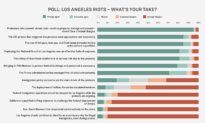
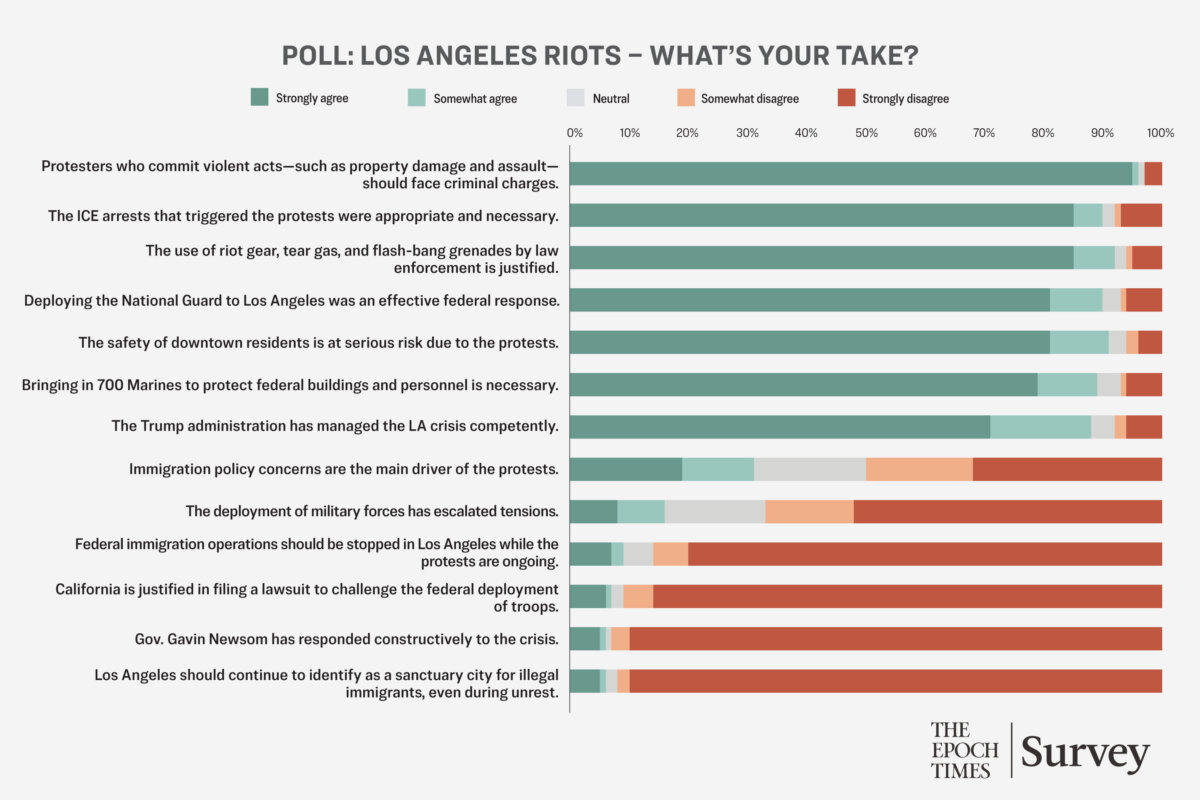
Reader support for prosecuting violent protesters was nearly unanimous in the Epoch Times poll, with 96 percent in favor of criminal charges for violent acts and only 4 percent disagreeing or undecided, reflecting readers’ firm backing of law and order.
The protests stemmed from a series of targeted actions by ICE, which Homeland Security officials described as part of a broader federal strategy to enforce immigration laws and deport illegal immigrants, starting with those with the most serious criminal histories.
Officials in Los Angeles reacted critically. Mayor Karen Bass condemned the raids within hours, saying the tactics “sow terror in our communities and disrupt basic principles of safety in our city.”
News of the arrests spread quickly, and by nightfall, protesters had gathered outside the Metropolitan Detention Center where some detainees were being processed. Demonstrators chanted slogans against ICE and demanded the immediate release of those held, setting the stage for the wider unrest that would follow in the days ahead, including its spread to other cities.
Despite media controversy, poll respondents overwhelmingly supported the ICE actions. When asked whether the arrests were appropriate and necessary, 85 percent strongly agreed and 5 percent somewhat agreed. Just 8 percent expressed disagreement, with 2 percent neutral—reflecting solid backing for the enforcement effort, which came as part of the Trump administration’s broader crackdown on illegal immigration.
Reader support extended to law enforcement’s handling of the protests. As clashes intensified, police deployed riot gear and used non-lethal crowd control tactics—including tear gas, pepper balls, and flash-bang grenades—to disperse demonstrators. According to the poll, 92 percent of respondents approve of those measures, with 85 percent strongly agreeing they were justified. Only 6 percent disagreed in any measure, with the numbers suggesting broad support for the view that the use of force as proportional and necessary to restore order in the face of escalating violence, despite outcry from some circles.
In response to the unrest, Trump issued a memorandum on June 7 invoking 10 U.S.C. § 12406—a provision that lets the president call the National Guard in cases of “rebellion against the authority of the Government of the United States” and situations where regular forces are unable to enforce U.S. laws. Since then, Trump has requested two California National Guard units, totaling 4,100 soldiers, to be ready for orders to assist state law enforcement, in addition to 700 Marines, to protect federal buildings and personnel.
California officials filed a lawsuit to block the deployments, with the governor accusing Trump of “trying to provoke chaos by sending 4,000 soldiers onto American soil,” alleging presidential overreach and an “unmistakable step toward authoritarianism.”
When it came to Trump’s deployment of the National Guard, 90 percent of readers approved, with 81 percent saying they strongly supported the move. Seven percent disapproved and 3 percent were unsure—indicating broad acceptance of military assistance in restoring order.
An equally strong 91 percent agreed that the protests posed a serious risk to the safety of downtown residents. Only 5 percent disagreed, with 4 percent unsure—reinforcing the view that demonstrations have increasingly become flashpoints for lawlessness, with peaceful marches often morphing into looting and violence.
Force, Leadership, and Underlying Tensions
While U.S. Marines have been deployed domestically for disasters, it’s rare for troops to be used inside the United States for matters related to policing. Amid the protests, Trump activated 700 Marines from Camp Pendleton to Los Angeles to protect federal property and personnel. While trained in crowd control, the Marines lack arrest authority and can only detain offenders briefly for the police to arrest, officials have clarified.
Trump’s decision to deploy the Marines was backed by an overwhelming 89 percent of respondents, suggesting the vast majority of readers see the move as a reasonable response to the riots. Seven percent opposed it and another 4 percent remained neutral—possibly reflecting concern about the optics or precedent of using active-duty troops in a civilian context.
Besides the Guard and the U.S. Marines, agents with the Border Patrol Tactical Unit have also been deployed to Los Angeles amid the riots, with more Customs and Border Protection agents on standby to deploy if needed.
Reactions on Capitol Hill and elsewhere to the administration’s response to the unrest have been mixed. Newsom called the deployment of military assets “deranged,” while Rep. Nancy Mace (R-S.C.) praised it, accusing Newsom of letting California “burn to the ground.”
Supporters, such as Sens. John Kennedy (R-La.) and Markwayne Mulin (R-Okla.), argued that local officials were too weak in their reaction and Trump “didn’t have a choice.” Opponents, including Sens. Mazie Hirono (D-Hawaii) and Elizabeth Warren (D-Mass.), claimed the president was deliberately inflaming tensions, calling the deployment of military assets a “recipe for confrontation.”
Former Vice President Kamala Harris, said to be mulling a run for California governor, also weighed in, calling the deployment of the Guard “a dangerous escalation meant to provoke chaos.”
Some California officials—such as Bass and Newsom—have described the federal response as not just ineffective, but inflammatory and illegal.
Trump and members of his administration have stood by their response, arguing that it has been instrumental in preventing the protest violence from spiraling out of control.
Approval of the Trump administration’s overall handling of the crisis was strong among readers. Eighty-eight percent said the administration responded effectively, with 71 percent expressing strong confidence. Only 8 percent disagreed, while 4 percent were neutral, suggesting that federal leadership during the unrest is broadly seen as effective and responsive.
Meanwhile, there has been speculation that the Los Angeles riots are about more than grassroots protests voicing opposition to immigration enforcement and deportations of illegal immigrants. Trump has called some of those involved in the violence “paid insurrectionists,” saying if the violence spirals further out of control, he might invoke the Insurrection Act and dial up the federal response.
The FBI has said it’s investigating what is fueling the riots, amid concern that foreign influence might be involved, sowing chaos to divide Americans, with groups linked to socialist or communist causes known to be cheering on the protests, or backing them more materially.
Readers of The Epoch Times seemed sympathetic to the view that opposition to immigration enforcement actions is not the only factor behind the unrest. Only 31 percent believe immigration policy is the primary cause of the protests, while a combined 50 percent disagree and 19 percent remain unsure, with the results pointing to a broader suspicion that other social or political issues—or interference by foreign or nefarious sources—may be fueling the unrest.
At the same time, a clear majority—67 percent—reject the idea that military deployment has inflamed the situation. Just 16 percent believe tensions have worsened as a result, while 17 percent are unsure, with the findings suggesting that most respondents view the deployment as a stabilizing, rather than inflammatory, action.
Raids, Resistance, and Rejection of Sanctuary Policies
The Trump administration appears resolute in its crackdown on illegal immigration, undeterred by protests or legal challenges.
Thom Homan, who is leading the administration’s deportation efforts, told The Telegraph that ICE will “flood the zone” with enforcement—especially in sanctuary cities—in the face of unrest. Homeland Security Secretary Kristi Noem echoed the message, saying agents have thousands of targets and won’t back down despite threats and assaults against them.
The White House has confirmed that immigration enforcement operations will continue, with over 300 illegal immigrants arrested during the riots now facing deportation.
According to the survey, 86 percent of readers oppose halting enforcement during protests. Only 9 percent support a pause, and 5 percent are undecided—suggesting most view civil unrest as reason to reinforce, not relax, law and order.
Meanwhile, Newsom and California Attorney General Rob Bonta sued to block Trump’s deployment of federal troops and National Guard units in Los Angeles, arguing the president overstepped his authority. Their lawsuit cited a lack of statutory basis, violations of the Posse Comitatus Act, and failure to consult the governor.
A federal judge sided with California on June 12, issuing a temporary restraining order. The ruling found that Trump’s invocation of 10 U.S.C. § 12406 did not meet the legal threshold for rebellion and that the Guard must be returned to state control. The Justice Department appealed immediately, with the Ninth Circuit quickly issuing a temporary stay, allowing the Trump administration to retain control of the California National Guard for the time being.
Poll respondents strongly rejected California’s legal challenge. Only 7 percent support the lawsuit against the federal government’s military actions, while 91 percent oppose it and 2 percent remain undecided. The overwhelming majority appear to view the litigation as an obstruction of lawful federal enforcement efforts.
California’s political leadership fared no better in the court of reader opinion. A striking 93 percent of respondents disapprove of Newsom’s handling of the unrest, with just 6 percent voicing any level of support, possibly reflecting frustration with the state’s approach to both the protests and immigration policy.
Opposition to Los Angeles’ sanctuary status was also overwhelming, with 92 percent against, only 6 percent in favor, and 2 percent neutral—a signal that readers reject leniency in immigration enforcement.
Marxism, Manipulation, and the Specter of Foreign Subversion
Thousands of open-ended responses to the final survey question—asking whether Marxist or pro-CCP groups had influenced the Los Angeles protests—revealed widespread suspicion that the unrest was fueled by outside forces.
A dominant theme was the belief that the protests were not spontaneous, but orchestrated by ideological actors, foreign interests, and progressive donors. Many cited Marxist or CCP-aligned groups, Antifa, and even illegal immigrants as key players, allegedly backed by dark money, NGOs, and political donors.
Numerous respondents described the demonstrators as “paid agitators” or “professional protesters,” pointing to anecdotal signs of coordination—such as pre-positioned supplies like stacks of bricks and gas masks, Craigslist ads, and uniform signage.
Many saw the unrest as part of a broader campaign to destabilize the United States from within, with frequent references to billionaire financier George Soros, past BLM protests, and CCP-linked influence efforts. Some viewed it as a form of “hybrid” or “unrestricted” warfare against America.
Even among those uncertain about direct foreign involvement, most agreed that paid protesters were stoking violence and division. Calls to “follow the money” were common, with widespread support for investigating—and prosecuting—not just rioters, but also those believed to be funding the chaos.
 Friends Read Free
Copy
Facebook
Tweet
Friends Read Free
Copy
Facebook
Tweet