
Former FBI Director James Comey was indicted on Wednesday on charges of making a false statement and obstruction. Read more here.
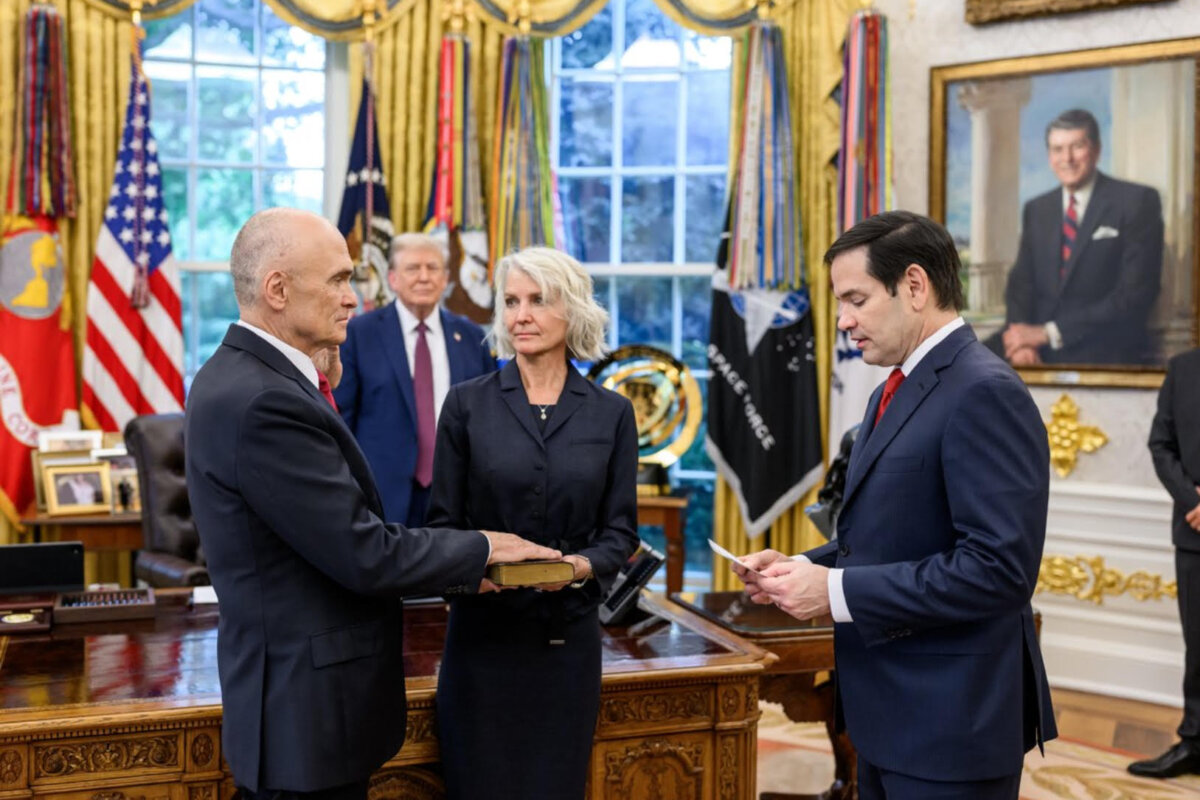
Leaving his home in Tennessee, former business executive Andrew Puzder has taken up residence in Brussels as the new U.S. ambassador to the European Union.
He’s working to find common ground with America’s largest trading partner and longstanding ally, despite recent disputes on issues like tariffs, censorship and military spending.
Puzder was confirmed in August and formally began his service on Sept. 11.
As the retired CEO of CKE Restaurants and an outspoken advocate for free markets, his business savvy may serve him well, as trade and economics are at the top of the issues being hammered out.
“We need a Europe that is strong economically because we want a strong trading partner. We want a Europe that can defend itself and we want a Europe that maybe is able to help the United States in various trouble spots around the world,” Puzder told The Epoch Times.
First on his agenda is finalizing trade and business agreements between the United States and the EU, based on the framework that was negotiated in July.
That includes a 15 percent tariff ceiling on most EU exports, with special treatment for aircraft components and select chemicals, drugs and natural resources, as well as an agreement to jointly protect the American and European steel, copper, and aluminum industries from predatory competition.
The deal also includes a pledge by the EU to invest $600 billion in U.S. industries.
“It was a very good trade agreement for both sides,” Puzder said.
Beyond tariffs, Puzder said, the United States is pushing back on EU laws that American officials say target U.S. companies unfairly.
These include elements of the Digital Services Act, that restrict online “hate speech” and “disinformation,” and the Digital Markets Act, which has imposed antitrust fines on American tech companies including Meta, Apple, and Google.
“The way the law is written, it looks facially neutral because it says it applies to companies with over a certain level of revenue,” Puzder said.
“But the reality is that those are primarily American companies, and so the regulations hit American companies hard.”
Americans have expressed concerns that the Digital Services Act and other European laws, which proponents say protect Europeans from harmful content, will not only suppress free speech in Europe, but will compel U.S. tech companies to apply the same criteria to American users.
Europe Faces Stark Choices
Europe is known for its expansive social welfare programs—including taxpayer-funded health care, childcare and family leave, housing, college tuition, unemployment, and pensions— but now faces a future in which its social systems are beginning to fray, economists and some top EU officials say.
By 2040, Europe’s workforce is projected to shrink by about 2 million workers each year, according to a 2024 report by Mario Draghi, former prime minister of Italy and former president of the European Central Bank.
Combined with current lackluster growth rates, this means that Europe faces stark choices.
“If Europe cannot become more productive … we will not be able to become, at once, a leader in new technologies, a beacon of climate responsibility and an independent player on the world stage,” Draghi wrote. “We will not be able to finance our social model.”
Led by industrial nations such as Germany, France, and the United Kingdom, the EU’s GDP was larger than America’s in 2008, but is now 30 percent smaller if the UK (which left the EU in 2020) is included, and 50 percent smaller if it is not, Puzder said.
Germany’s GDP per capita is lower than the state of West Virginia; France and the UK both have lower per capita GDP than Mississippi, he said.
“You’re not seeing the economic growth” in the EU, Puzder said.
The Draghi report has had an impact, he said.
“In the EU, people do understand that their economy has been slowing and that this has been impacting their GDP per capita as well as their GDP overall,” he said.
“There are efforts going on here in Europe to do what they call simplification, which is simplifying their laws, eliminating red tape … and the restrictions on companies.”
—Kevin Stocklin; Stacy Robinson
BOOKMARKS
President Donald Trump on Thursday signed an executive order allowing the sale of social media giant Tik-Tok. Per a law passed last year, the company’s current owner—China-based ByteDance—will have to divest, and will be limited to a 20 percent stake in the company.
Trump wants to funnel tariff revenue to farmers as a financial cushion, he said on Thursday. “We’re going to take some of that tariff money that we made, we’re going to give it to our farmers who are, for a little while, going to be hurt until … the tariffs kick in to their benefit,” he said at the White House.
On Sept. 25, FBI Director Kash Patel posted a letter to X that was allegedly written by the man who shot three people at an Immigration and Customs Enforcement (ICE) facility. “Hopefully this will give ICE agents real terror, to think, ‘is there a sniper with [armor-piercing] rounds on that roof?’” the note said.
Leucovorin, which was previously given to patients as part of a chemotherapy protocol, may hold promise for those suffering from autism. Read Marina Zhang’s latest report to find out more.
Rep. John Moolenaar (R-Mich.) is asking the city of Philadelphia to cancel a plan to commemorate the Chinese Communist Party’s (CCP) National Day by raising the country’s flag at City Hall. “A flag raising is used to show respect for a nation that can inspire unity and pride between our two peoples; but it can also be inadvertently used to misrepresent support for another nation’s actions and values,” he said in a letter.
—Stacy Robinson
 Friends Read Free
Copy
Facebook
Tweet
Friends Read Free
Copy
Facebook
Tweet