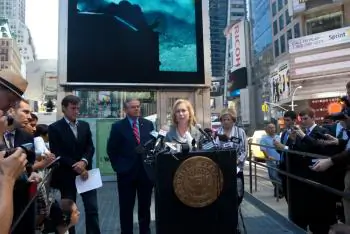

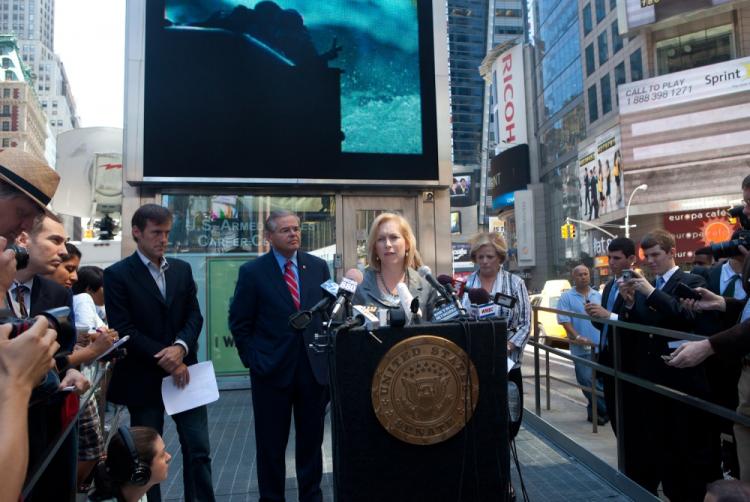
“This is supposedly our strongest ally in our fight against terrorism. And they have completely betrayed us, betrayed the victims, and betrayed all the people who worked for dozen of years to try to bring some modicum of justice to this horrible act,” said Brian Flynn, who lost his brother in the bombing, at Times Square on Monday.
Alongside bombing victims’ families, U.S. Sens. Robert Menendez (D-N.J.) and Kirsten Gillibrand (D-N.Y.) urged British and Scottish officials to testify at the Senate Foreign Relations Committee hearing this Thursday regarding the release of Abdelbaset Ali al-Megrahi, the man convicted for the terrorist attack.
“The abundance of incredible coincidences surrounding al-Megrahi's release deserves a real, open, transparent hearing. Full information regarding the most dubious aspects of a decision to release him should be made public,” said Menendez.
Sen. Menendez is heading the Senate hearing scheduled for July 29.
On Aug. 20, 2009, al-Megrahi was released on “compassionate grounds” after doctors determined that he only had three months to live as his health had deteriorated from cancer. But as he is still alive today 11 months after his release, allegations have surfaced that he may have been released in exchange for a deal with BP to drill in Libya, where there are lucrative oil reserves.
A copy of a letter from British House of Lords member, Lord Trefgarne, to the Scottish Cabinet Secretary for Justice Kenny MacAskill, was revealed at the press conference. In the letter, dated July 17, 2009, Lord Trefgarne, who is also chairman of the Libyan British Business Council (LBBC), a group representing British business interests in Libya of which BP is also a member, warned MacAskill of the “serious implications for U.K.-Libyan relations” should al-Megrahi die in prison.
Contents of the letter was previously reported back in September 2009 by The Times, a U.K. newspaper, but the evidence holds particular significance now after BP admitted this month that they indeed lobbied to the British government for a prison transfer agreement. In 2007, Sir Mark Allen, a former MI6 agent who by then worked for BP as a consultant, made two phone calls to then-British justice secretary, Jack Straw. During talks with Libya, Straw worked to exclude al-Megrahi from a $900 million deal with the country to drill there, reported The Times in September.
 Friends Read Free
Copy
Facebook
Tweet
Friends Read Free
Copy
Facebook
Tweet