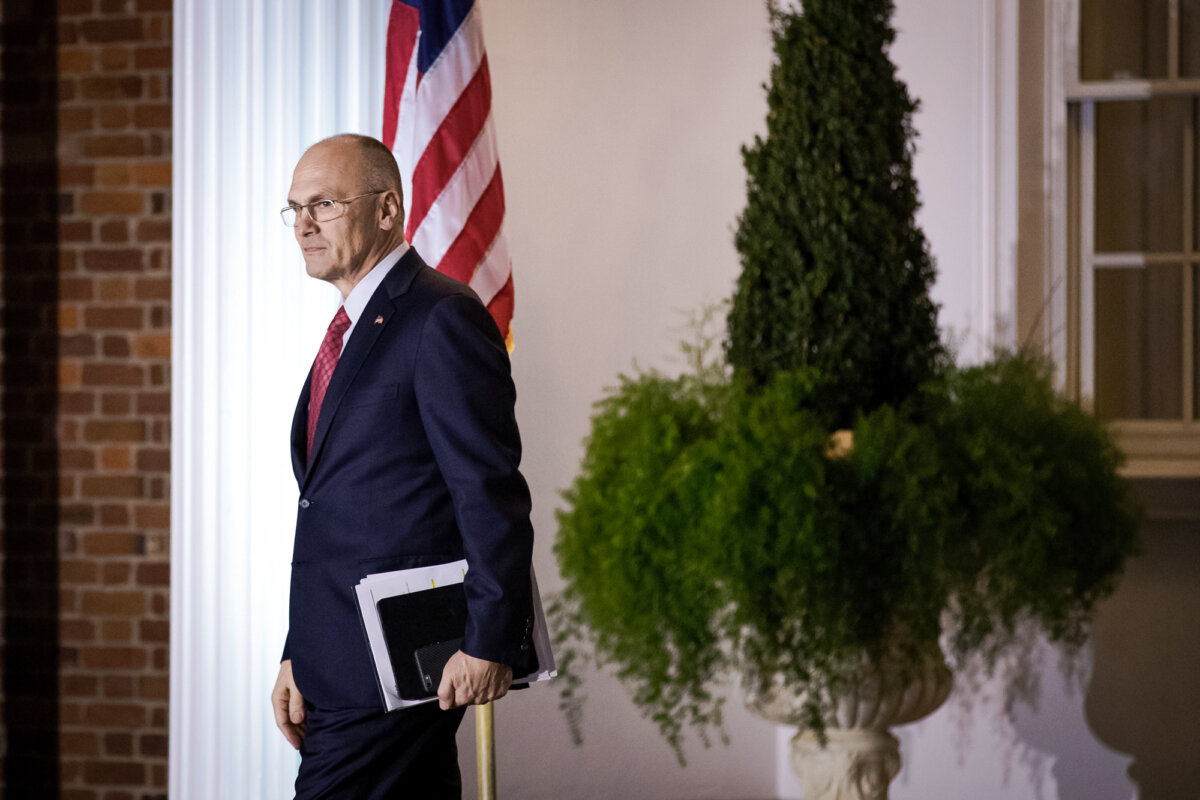
Leaving his home in Tennessee, former business executive Andrew Puzder has taken up residence in Brussels as the new U.S. ambassador to the European Union.
He’s working to find common ground with the United States’ largest trading partner and longstanding ally, despite recent disputes on issues such as tariffs, censorship, and military spending.
Puzder was confirmed in August and formally began his service on Sept. 11. As the retired CEO of CKE Restaurants and an outspoken advocate for free markets, he may be served well by his business savvy, as trade and economics are at the top of the list of issues being hammered out.
“We need a Europe that is strong economically because we want a strong trading partner,” Puzder told The Epoch Times. “We want a Europe that can defend itself and we want a Europe that maybe is able to help the United States in various trouble spots around the world.”
First on his agenda is finalizing trade and business agreements between the United States and the EU, based on the framework that was negotiated in July. That includes a 15 percent tariff ceiling on most EU exports, with special treatment for aircraft components and select chemicals, drugs, and natural resources, as well as an agreement to jointly protect the U.S. and European steel, copper, and aluminum industries from predatory competition.
The deal also includes a pledge by the EU to invest $600 billion in U.S. industries.
“It was a very good trade agreement for both sides,” Puzder said. “How it was good for us is very obvious … but I think they did a good job negotiating and got a good deal.”
Beyond tariffs, Puzder said, the United States is pushing back on EU laws that American officials say target U.S. companies unfairly.
These include elements of the Digital Services Act that restrict online “hate speech” and “disinformation” and the Digital Markets Act, which has imposed antitrust fines on U.S. tech companies such as Meta, Apple, and Google.
“The way the law is written, it looks facially neutral because it says it applies to companies with over a certain level of revenue,” Puzder said. “But the reality is that those are primarily American companies, and so the regulations hit American companies hard.”
Americans have expressed concerns that the Digital Services Act and other European laws, which proponents say protect Europeans from harmful content, will not only suppress free speech in Europe, but also compel U.S. tech companies to apply the same criteria to American users.
“When a company like Facebook or Twitter or X has to change its algorithm, and that algorithm might impact the free speech rights of Americans, that’s something that we really can’t tolerate,” Puzder said. “I know President Trump is not going to allow a foreign government to restrict the free speech rights of American citizens in ways that even our own government couldn’t restrict them.”
Europe Faces Stark Choices
Europe, which is known for its expansive social welfare programs—including taxpayer-funded health care, housing, college tuition, and unemployment—now faces a future in which its social systems are beginning to fray, economists and some top EU officials say.
By 2040, Europe’s workforce is projected to shrink by about 2 million workers each year, according to a 2024 report by Mario Draghi, former prime minister of Italy and former president of the European Central Bank. This, combined with current lackluster growth rates, means that Europe faces stark choices.
“If Europe cannot become more productive … we will not be able to become, at once, a leader in new technologies, a beacon of climate responsibility and an independent player on the world stage,” Draghi wrote. “We will not be able to finance our social model.”
In August, German Chancellor Friedrich Merz echoed that theme, warning, “The welfare state that we have today can no longer be financed with what we produce in the economy.”
Although the rate of economic growth in Europe has increased in recent years, it essentially flatlined between 2008 and 2020, according to World Bank data.
Led by industrial nations such as Germany, France, and the UK, the EU’s gross domestic product was larger than the United States’ in 2008, but is now 30 percent smaller if the UK (which left the EU in 2020) is included and 50 percent smaller if it is not, Puzder said.
“If you look at some of the individual nations, Germany now has a GDP per capita that is lower than the state of West Virginia,” Puzder said.
“France and the UK both have a GDP [per capita] lower than the state of Mississippi.”
West Virginia and Mississippi currently have the lowest GDP per capita among U.S. states, but they are leading most European countries in creating prosperity for their citizens, according to an analysis of IMF data published in Euronews.
“You’re not seeing the economic growth [in the EU],” Puzder said. “You’re not seeing the new corporations, the new companies, the new large companies, develop in Europe.”
However, Puzder said he believes that Europe can turn the tide with the right policies.
“I think Europe right now has very good leadership,” he said.
Seeking a Solution in ‘Simplification’
The Draghi report has had an impact, he said.
“In the EU, people do understand that their economy has been slowing and that this has been impacting their GDP per capita as well as their GDP overall,” he said.
“There are efforts going on here in Europe to do what they call simplification, which is simplifying their laws, eliminating red tape … and the restrictions on companies.”
Among the factors that have contributed to Europe’s malaise is heavy-handed regulation, analysts say.
“EU regulation is not only becoming more cumbersome but it is also [piling up],” stated a 2024 report by the European Centre for International Political Economy. “The amount of new regulation accumulated during the last years has been staggering.”
This is a sentiment echoed by some European officials, including French President Emmanuel Macron, who stated on Bloomberg Television in 2024 that the EU was “overregulating and underinvesting.”
Included in that are EU energy mandates to comply with the United Nations’ 2015 Paris Agreement commitments regarding greenhouse gas emissions. This effort has entailed a continent-wide transition from oil, gas, and coal to wind and solar energy, with states such as Germany also shuttering nuclear plants.
“They’re walking away from fossil fuels, which are powering growth in both the United States and China,” Puzder said.
“China is using every form of energy they can possibly get their hands on to try and generate enough electricity so that they can compete with us in the AI space. The United States is talking about adding 100 gigawatts of energy during the remainder of President Trump’s term.”
In the short term, however, Europe’s transition has also increased its dependence on Russia. Speaking before the U.N. on Sept. 23, Trump criticized the financial support Russia is getting through its oil and gas sales, not only to China and India, but also to the United States’ European allies.
“Inexcusably, even NATO countries have not cut off much Russian energy and Russian energy products,” Trump said. “Think of it, they’re funding the war against themselves.”
EU officials have pledged to end imports of liquified natural gas from Russia by Jan. 1, 2027.
In addition, Europe now struggles with some of the highest energy prices in the Western world. To help alleviate this, the United States will supply $750 billion in liquified natural gas, oil, and nuclear energy products to Europe over the next three years, under the July agreement.
Although some EU countries have moved away from nuclear power, many others, such as France, have continued to rely heavily on nuclear power, and nuclear energy is increasingly being heralded as a “clean energy” source in Europe because of its low CO2 emissions.
“The debate for years has been, can you power an industrial economy, can you make Volkswagens and Mercedes-Benzes and BMWs and Peugeots with an economy that’s based on a renewable energy such as wind and solar? And today, the answer to that has been no,” Puzder said.
“Now there’s a belief that if they continue on this path, if they add nuclear, that over time they’ll get to the point where you can do that, but they certainly haven’t done that yet.”
Finding Common Ground
Despite some disagreements, there are many areas where the United States and Europe see eye-to-eye, including ending the Ukraine war, which Puzder says is “one of the president’s top priorities.” They also share concerns about China.
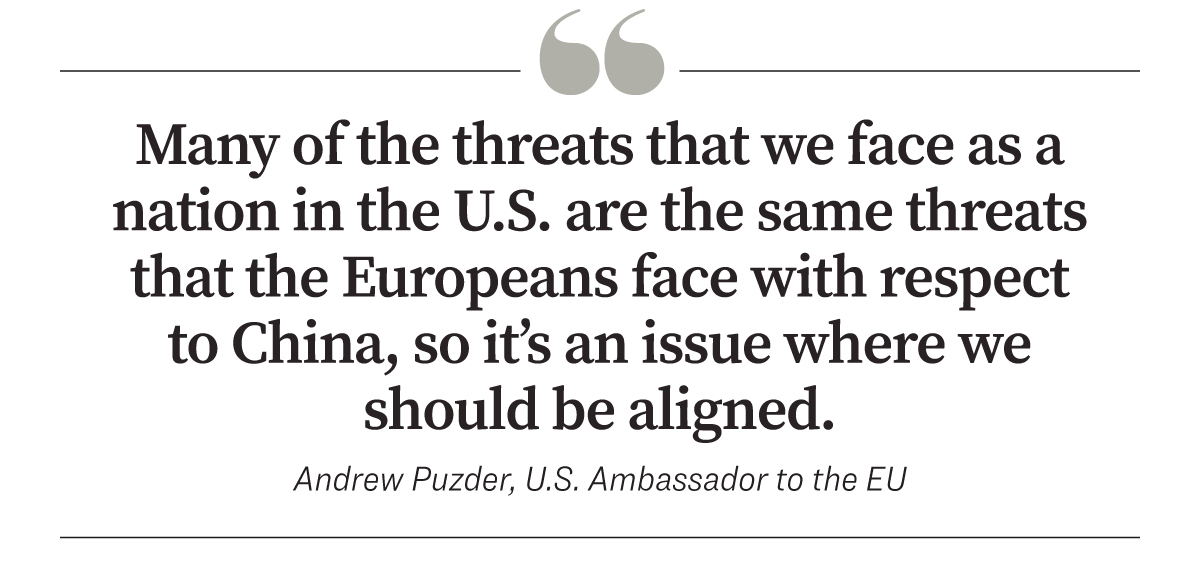
“Many of the threats that we face as a nation in the U.S. are the same threats that the Europeans face with respect to China, so it’s an issue where we should be aligned,” Puzder said.
“I think there’s a realization in Europe now that China is mercantilist, that they will use their economic power to coerce behavior, that they don’t play by the rules.”
In April, China imposed a moratorium on exports of rare earth minerals and related magnets, an essential component for automakers, the aerospace industry, semiconductor companies, and military manufacturers, which caused some European auto parts plants to suspend production.
“[China] will destabilize economies if it’s in their best interest,” Puzder said. “They will dump product in Europe if they can’t dump it in the United States, and they are supporting the war in Ukraine by supporting the Russians.”
Puzder said the experience he shares with the president in running companies means they are often on the same page when working through negotiations.
“I find him very easy to work with, and I know that hasn’t been everybody’s experience, but maybe it’s because we share a common business background that I generally know where he’s coming from, and have found working with him to be a pleasure,” he said.
“When you see President Trump in public—when he’s not in an intense argument with somebody in the media, for example—but the person you generally see in these interviews, when he’s talking one-on-one with the reporter, is the same person you’ll see in the Oval Office. It’s the same person you’ll see on the golf course. It’s the same person you’ll see, you know, if you’re out at a restaurant with him. He’s just a very sincere, very good man.
“He’ll listen to you, he’ll try and understand what you’re doing, he’ll let you know what he wants, and if you need support, he’ll give it to you.”
 Friends Read Free
Copy
Facebook
Tweet
Friends Read Free
Copy
Facebook
Tweet