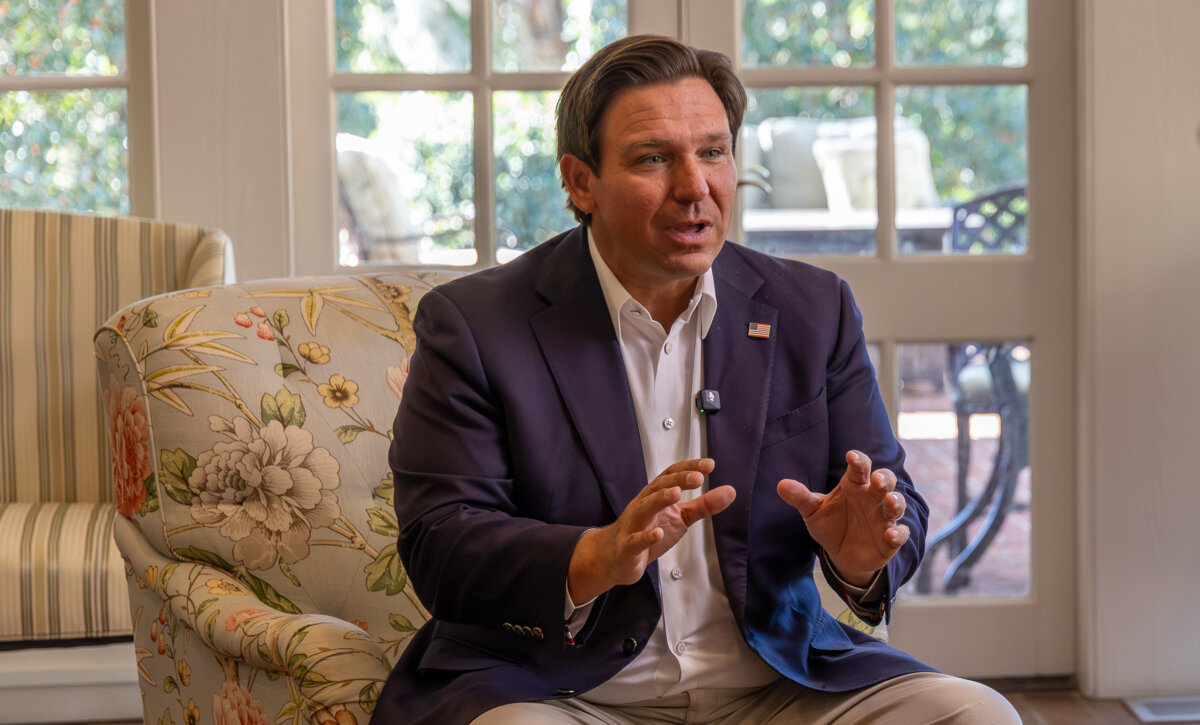

TALLAHASSEE—As Florida lawmakers debate legislation in the state’s capital, Gov. Ron DeSantis is making an all-out push to a finish line.
The 47-year-old Republican is in the last year of his second four-year term as governor, making him ineligible to run again.
So he’s spending his political capital as he runs “through the tape,” he told The Epoch Times during an interview at the Florida Governor’s Mansion.
He’s hoping for this prize: for lawmakers to pass his proposed AI Bill of Rights. He said it’s needed to protect Floridians and the state’s natural resources from potential harms of unrestricted and explosive growth of artificial intelligence.
Senate Bill 482, dubbed the AI Bill of Rights, and the identical House Bill 1395 are taking separate journeys through the Florida Legislature, being examined by committees in both chambers. Lawmakers have until mid-March to pass the legislation.
DeSantis hopes they’ll pass, be merged into one bill, and be sent to his desk for his signature, along with another bill meant to regulate the growth of data centers needed to power AI.
The governor realizes this legislative push may set him up for clashes with President Donald Trump, who has called for states not to meddle much in regulating AI. He and Trump, a former political mentor who helped DeSantis get elected in 2018, have vacillated between being allies and adversaries, with a warming of relations in the past year.
But DeSantis, a Harvard-trained lawyer, former congressman, and father of three young children, said curbing the creep of AI can’t wait.
Guardrails are needed now, he said, to protect the state’s people, jobs, economy, and environment from harm.
In December 2025, DeSantis announced his proposal for the AI Bill of Rights, which covers data privacy, parental controls for children’s interactions with AI, requirements for consumers to be alerted when dealing with AI, and much more.
The measure is needed, he said, because rapidly expanding AI technology already infiltrates daily life in everything from retail purchases to medical care. And often, people don’t realize they’re interacting with a technological tool rather than a human, he said.
“Any new technology, as it’s developed, needs to be developed in an ethical way, in a moral way, and it’s got to reinforce our values as Americans,” DeSantis said. “And it cannot be something that is seeking to supplant the human experience. It needs to enhance the human experience.
“I get very nervous when I hear these people talk about this transhumanism as where somehow humans aren’t going to be in control, and the AI is going to rule the world.”
That goes against what it means to be an American, he said.
“Our Founding Fathers, 250 years ago—they set forth the rule: We’re endowed by our Creator with certain inalienable rights, not [by] machines,” he said.
“There’s a lot of good that can come with technological innovation,” such as in medicine and national defense, he said. “We welcome that in these particular areas, but there’s also really big downsides.”
Protecting Privacy
Some of the proposed legislation would reinforce protections Florida previously passed against so-called “deepfakes” and explicit AI-created materials, including those depicting minors.
Deepfakes are realistic-looking images, videos, or audio recordings altered to make them appear as if a person has done or said something he or she didn’t do or say. Using AI, deepfakes can mimic a person’s likeness or voice well enough to fool others into believing they’re real.
The legislation would prohibit using AI to depict an individual without consent, such as in an advertisement or criminal scheme. And it would require notice when a person is interacting with AI, such as in a chatbot.
Chatbots simulate human conversations, often in customer service phone calls or messaging tools.
The new measure would prohibit state and local government agencies from using AI tools created by “foreign countries of concern,” such as China. And it would require what’s put into AI platforms by users to be kept private and prohibited from being sold.
DeSantis’s proposal would also prohibit businesses from offering what they call “licensed” therapy or mental health counseling to clients who interact with AI for that care.
And it would establish controls allowing children’s conversations with AI to be limited and monitored by parents. If a child “exhibits concerning behavior” when interacting with AI, the legislation would require that parents be notified.
The legislation also would limit how insurance companies use AI to decide on whether to pay insurance claims.
Data Center Demands
Around the world, there’s been widespread concern that facilities needed to support AI may affect the environment, natural resources, and the health of people living nearby in negative ways.
Digital hubs that process AI use massive amounts of resources. Data centers used 4.4 percent of the country’s electricity in 2023, according to the U.S. Department of Energy. By 2028, data center demand is expected to swell to up to 12 percent of total electricity usage across the country.
Large data centers use up to 5 million gallons of water per day. That’s about the same amount used by a town of 10,000 to 50,000 people, according to the Washington-based Environmental and Energy Study Institute.
DeSantis acknowledged that hyperscale data centers, as they’re known, can bring jobs and add lots of tax money to state coffers. But they need careful regulation, he said.
A related bill he’s pushing would prohibit taxpayer subsidies for Big Tech, would hold down energy costs, and would give local governments the option of turning away proposed development of the massive facilities needed to support AI workloads.
That bill would strengthen protections of Florida’s natural environment. And it would prohibit electric, gas, and water utilities from charging Florida residents more, as growing data centers demand more energy and water.
As AI use grows, Floridians likely will lose jobs, he said. Amazon announced on Jan. 28 that it would be cutting 16,000 positions. The company increasingly uses AI in its operations.
Yet taxpayers facing job loss to AI often are forced to help pay for AI expansion through federal subsidies to data centers, DeSantis said.
That could lead to “a generation of college students” who “won’t be able to find jobs,” he said. “That’s not going to be good for our society.”
DeSantis also described his concern that “whoever is controlling the data sets—they’re going to have a huge amount of power, the more pervasive these applications are in society.”
“And human nature being what it is—they will abuse that power. That will happen. And so, we need to have some protections against that abuse of power,” he said.
That power, put under the control of a “handful of tech companies,” could be “more significant than has ever been wielded by a king or a president,” he said.
Opposition
Officially opposing Florida’s AI Bill of Rights is the Washington-based Computer and Communications Industry Association, an international group representing Google, Meta, and others.
The association sent members of the Florida Senate a letter saying that the proposed legislation “would impose an expansive and fragmented regulatory regime that risks chilling innovation, undermining free expression, and placing Florida significantly out of step with recommended federal and international approaches to artificial intelligence governance.”
The group’s top complaint is that the legislation “contains an overly broad and vague regulatory scope” and that the policies may cause privacy concerns.
Trump has been critical of states’ efforts to impose regulations on AI, too. It’s unclear whether Florida’s proposed AI Bill of Rights and data center restrictions could conflict with an executive order he signed a week after DeSantis announced the proposed legislation.
Among other things, the White House directive instructs federal agencies to identify states with “onerous laws” affecting AI and to restrict some of their federal funding. The order focuses on establishing a nationwide framework for AI so that states’ differing laws don’t create a “patchwork of 50 different regulatory regimes.”
It also aims to eliminate “cumbersome regulation” for AI companies and seeks to foster innovation within the area so that the United States “wins the AI race.”
Until Congress passes a national standard for AI, the administration will challenge “excessive” state laws that hinder AI innovation, Trump’s order states.
The framework passed by Congress “must forbid state laws that conflict with policy set forth in this order,” and also should “ensure children are protected, censorship is prevented, copyrights are respected, and communities are safeguarded.”
“We remain in the earliest days of this technological revolution and are in a race with adversaries for supremacy within it,” the order states.
Last year, state lawmakers across the nation introduced more than 1,000 bills related to AI, with 38 states adopting laws targeting the technology, according to a recent report from the Cato Institute. In addition to Florida, laws in California, New York, and Texas could be affected by Trump’s order, which specifically calls out a Colorado statute prohibiting algorithmic discrimination.
AI Aversion
Opposition to unchecked AI continues to grow within the United States and internationally.
As of Feb. 4, more than 800 artists, writers, and actors had signed on to a new anti-AI campaign in which they called for an end to the “theft” of their work.
The Human Artistry Campaign’s letter, signed by celebrities including Scarlett Johansson, Cyndi Lauper, Jason Aldean, and members of the band R.E.M., argues that tech companies are “using American creators’ work to build AI platforms without authorization or regard for copyright law.”
The letter states: “Stealing our work is not innovation. It’s not progress. It’s theft—plain and simple.”
Also speaking out is PauseAI, an international movement decrying the rapid expansion of artificial intelligence. The organization calls for “a prohibition on the development of superintelligence, not lifted before there is broad scientific consensus that it will be done safely and controllably, and [with] strong public buy-in.”
The group favors the DeSantis proposal.
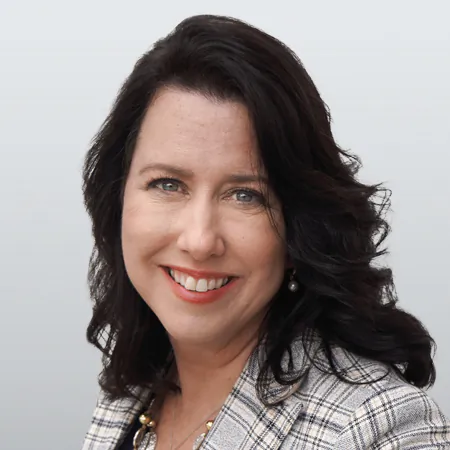
It goes further than bills in California and New York, said Holly Elmore, PauseAI’s U.S. executive director.
Florida’s proposed bill “highlights how AI development practices threaten individual rights, including parents’ ability to control their children’s AI use,” Elmore told The Epoch Times in a text message.
“We need these angles and much, much more to begin addressing the ways frontier AI will disrupt our society and threaten our rights and safety. … The states are the governments pushing AI safety legislation forward, so a new state joining that number is exciting.”
Building on Past Actions
This isn’t the first time Florida has considered precautions against potential harms from digital information.
In 2023, DeSantis added his signature to the Florida Digital Bill of Rights. Among other things, that law gives Floridians rights to access, delete, and correct personal data stored online.
In 2024, the legislature enacted a law to regulate the use of AI in political advertising, requiring it to be identified as created with AI.
In the same year, the legislature enacted legislation to require age verification for online access to materials that are harmful to minors.
Meanwhile, the White House under President Joe Biden was taking a hard look at how to allow AI to expand safely. The White House Office of Science and Technology Policy released its Blueprint for an AI Bill of Rights in 2022.
That document focused on making sure AI was safe, secure, and effective with the use of unbiased algorithms, privacy measures, and notifications when AI was being used. It also called for users to have the ability to opt out if they prefer to interact with a human.
What’s Next for AI Bill, DeSantis?
Despite the opposition, if Republicans stay loyal to their state’s top executive, the proposal should pass.
DeSantis governs as part of what’s known as a political trifecta, when the governor and majorities in both chambers of the legislature belong to the same party.
As of Feb. 3, the bill had passed unanimously through the state’s senate commerce and tourism committee and was under consideration by the senate appropriations committee.
In the state house, the bill had been referred to four committees and was being reviewed by one of them. No action had been taken.
This year’s regular legislative session—DeSantis’s last as governor—began on Jan. 13 and is scheduled to conclude on March 13.
The governor spoke with The Epoch Times in a sunny first-floor room in his official residence. Within tall perimeter fences guarded by security officers, children’s bikes, scooters, and a football festooned the lush grounds.
His successor will be elected in November and will take office in January 2027. DeSantis declined to endorse a candidate.
There are 11 Democrats running for his job and 11 Republicans, including Florida Lt. Gov. Jay Collins. There are 16 candidates with other political affiliations.
Trump, Elon Musk, Sen. Ted Cruz (R-Texas), and many others have endorsed Florida Congressman Byron Donalds, a Republican from Naples. He’s the only candidate currently polling in double digits.
“Byron believes that America must lead the world in AI innovation,” his campaign spokeswoman, Danielle Alvarez, told The Epoch Times in an email.
“He agrees with the governor that the development of AI must be responsible—protecting children is non-negotiable, power bills for Floridians cannot increase, and cannot create damage to our environment and water quality.”
Meanwhile, during his interview, DeSantis deflected questions about his own political future.
“I’m running through the tape,” he said. “Everything I promised the voters I’d do, I’ve delivered on. So I’m kind of playing with house money now.
“I want to spend all the capital I have. So we’re going to spend those chips and try to deliver big results throughout the rest of my term.”
 Friends Read Free
Copy
Facebook
Tweet
Friends Read Free
Copy
Facebook
Tweet