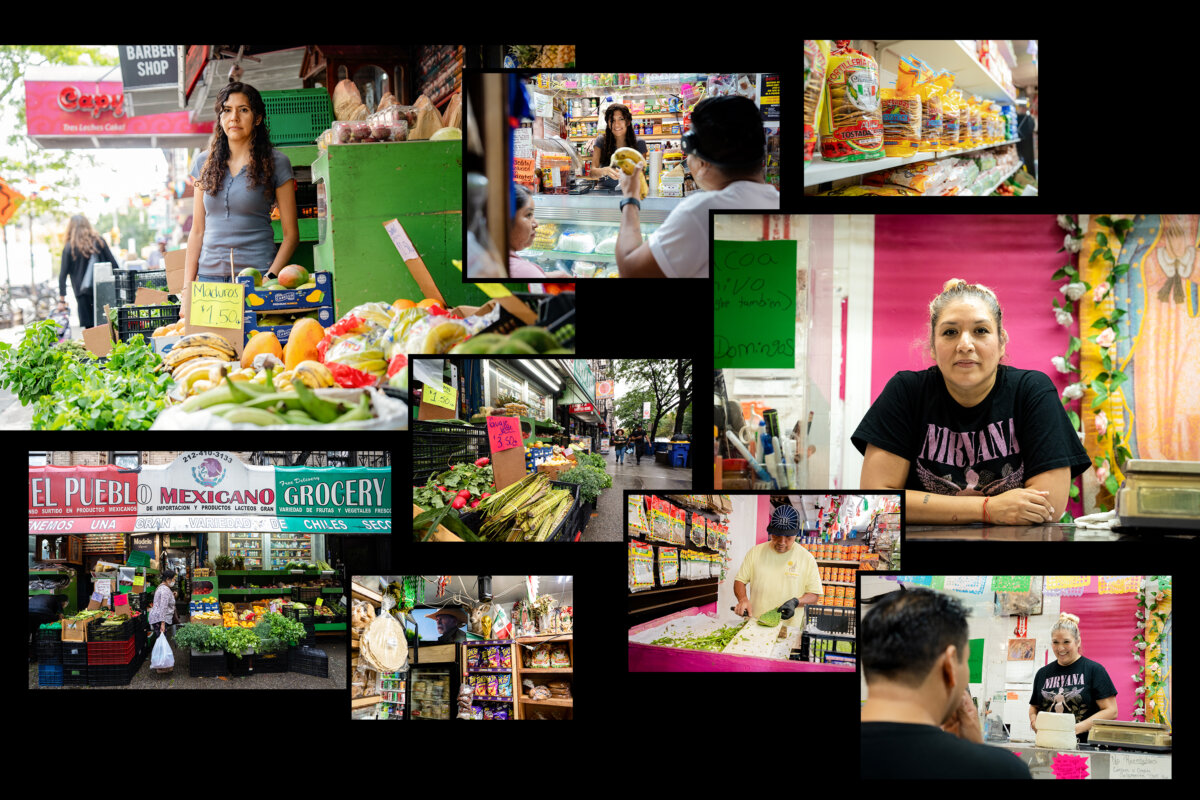

Josefina Aguirre grew up among the piñatas hanging from the ceiling of Little Mexico Meat Grocery, the store her parents opened in El Barrio in 1997, three years after her father crossed the border from Mexico at 17.
She has a bachelor’s degree in business management, a qualification her parents, Oscar and Guadalupe Aguirre, insisted on. But she came back to work at the store anyway—to the same three coolers of fresh cheese and cilantro, the same shelves of jalapeños and tomatillos, and the same customers who still bring in their mail so she can read it to them in English.
The store has survived the opening of a Costco nearby. It survived COVID-19, barely. Her father caught the virus and died before he ever got to enjoy the retirement he had worked 28 years for.
Now, Aguirre and her sisters, who run the shop together, are bracing for what they see as the biggest threat yet: a city-subsidized grocery store that can sell a $10 steak for $7, because, unlike them, it doesn’t have to turn a profit.
“We’re not scared of competition,” Aguirre told The Epoch Times on Aug. 29 from behind the counter in Spanish Harlem. “We just want fair competition.”
A dozen blocks south on the Upper East Side, Yessica Lezama hears the same fear from her parents. Benito and Carmen immigrated from Mexico and became U.S. citizens before opening El Pueblo Mexicano between Second and Third Avenues 25 years ago. They were drawn to the stretch of neighborhood known for its Mexican community.
Lezama, 38, has worked with her parents for three years, serving the same customers and stocking the same shelves of fruits, vegetables, and Mexican products that have kept the store going for a generation.
“I think it will have a bad impact on sales,” Lezama said of the mayor’s grocery store plan. “Since we’re a Mexican store, the city-run store won’t sell the same products, but it will still hurt us.”
Lezama said nearby business owners have formed an informal network to share information and support one another as the plan moves forward, meeting regularly to talk through their options.
“We help each other,” she said. “It is hard enough already. We don’t get a lot of help, and we’re worried about going out of business.”
Her parents are hoping to do more than just survive, Lezama said. They are working with a small-business association to modernize the store.
“My parents need help to make it more beautiful,” she said.
2 Lawsuits, 1 Target
Aguirre is one of hundreds of small-business owners now represented in two lawsuits filed against New York City by the Multicultural Business Coalition, a group representing roughly 1,000 minority-owned bodegas, delis, and supermarkets that argues Mayor Zohran Mamdani’s plan to open city-run grocery stores will drive them out of business rather than help their neighborhoods.
The coalition filed a class-action complaint in the New York County Supreme Court on Aug. 24, alleging antitrust violations and predatory pricing, and a second suit the same day alleging that the city retaliated against members after they began organizing against the mayor’s plan.
Together, the suits mark one of the most direct legal challenges yet to a marquee policy of Mamdani’s first year in office.
The first complaint states, “The Defendants’ municipal grocery stores deny the Class Members, hundreds of grocers, many small grocers equal protection, as they are not able to offer discounts that markedly depart from globalized commerce, thereby violating New York’s Civil Rights Law.”
The second suit states that the “opening of the underlying municipal grocery stores … is diametrically opposed to the City’s longstanding reasons for refusing to allow Walmart to operate grocery stores in the City: that the fallout from allowing Walmart to operate deep discount business, while bringing ‘affordability,’ further enriching a multibillion-dollar business, would eliminate an untold amount of opportunity for minority businesses, and small business at large.”
Mamdani responded to the suits the same day they were filed.
“I’m confident in both the legality of this—that it will stand up in court—and the importance of delivering it,” he said at an Aug. 24 press conference.
Frank Garcia, the coalition’s chairman and head of the New York State Coalition of Hispanic Chambers of Commerce, said the mayor’s confidence misses what’s actually at stake for the coalition’s members.
“My grandfather opened up one of the first bodegas in the late 1960s, when East Harlem was burning,” he told The Epoch Times.
“I am proud to be following in his tradition, because what Mayor Mamdani is doing is disgracing his memory.”
Inside the $70 Million Plan
Under the plan, first unveiled last year, the city will spend $70 million to open five publicly owned grocery stores, one in each borough, offering staples at prices roughly 30 percent below market rate.
The stores won’t sell beer, cigarettes, or lottery tickets and will be designed to keep prices low rather than turn a profit. The goal, Mamdani has said, is to make food more affordable in neighborhoods with high poverty rates and limited access to full-service supermarkets.
The Bronx location, in an affordable housing complex in Hunts Point, is expected to open in 2027. The East Harlem store will be located at the 9,000-square-foot marketplace La Marqueta and is projected to open in 2029, according to city officials.
Mamdani has repeatedly defended the initiative.
“I continue to be fully confident in both the legality and the importance of our initiative to deliver five city-run grocery stores, one in each borough, to the people of our city,” he said in a statement in July, adding that grocery prices in the city have climbed roughly 30 percent in recent years and that City Hall could also ease regulations to help existing store owners in the meantime.
Garcia said the coalition tried repeatedly to meet with Mamdani before filing suit, without success, and that the city moved ahead without ever conducting an economic impact study.
“Why are they going against immigrant business owners who can’t speak English and defend themselves?” Garcia said. “I don’t see that the mayor is being fair.”
Mark Jaffe, general counsel for the Multicultural Business Coalition and president of the Greater New York Chamber of Commerce, told The Epoch Times that the city’s plan goes further than officials have admitted.
“Their plan is to eventually put every independent store owner out of business,” Jaffe said. “And if you’re lucky, maybe they’ll give you a job.”
When he pressed city officials for details on how the stores would actually be run, he said, he got no real answer.
“We asked what the business plan was,” Jaffe said. “They told us, ‘We don’t need a plan, because the people we select will be responsible for coming up with the plan.'”
Jaffe also questioned whether a single store per borough would even reach the people Mamdani says he wants to help.
“Who is this really going to serve?” he said. “By the time you get on the train and spend two hours traveling, you’re paying more” than you would have shopping at a neighborhood store.
An Economist’s Warning
Economists are divided on what the lawsuits and the underlying policy mean for the city’s food supply chain.
Christian Briggs, a political and economic analyst who has advised members of Congress, argues the plan fits a broader pattern of government expansion into private markets.
“This is a manmade takeover of the food supply system,” Briggs told The Epoch Times, comparing the initiative to nationalization efforts he attributed to past presidential administrations.
He noted that grocery stores typically run on net margins of just 4 to 5 percent, making a government-subsidized competitor selling goods 30 percent below market what he called “the beginning of the nationalization of our food chain supply system.”
Briggs also predicted that despite the coalition’s legal argument, consumer behavior would ultimately favor the city-run stores.
“‘Free’ is the most powerful word in the English language,” he said, likening the grocery plan to the long-term trajectory of entitlement programs.
“The lawsuits are valid. They’re justified. But in the end, you will not win over the word ‘free,’ because voters love free.”
‘Using Taxpayer Money’
Back at Little Mexico Meat Grocery, Aguirre said the math is simple and unforgiving. Her margin on a $10 steak helps cover her mortgage, her children’s tuition, her rent, and utilities.
A city-run competitor selling the same steak for $7, funded by taxpayers rather than sales, doesn’t have to make that math work.
“He can afford it because he’s using taxpayer money,” Aguirre said. “We don’t have any help. Loans have been made difficult to get.”
She and her sisters have quietly begun discussing plan B, such as teaching or other careers, or anything that doesn’t mean losing more of what their father built before he died. That loss follows her behind the register every day—behind the same counter where her father used to stand.
“Is it fair for me to leave and start a new career?” Aguirre asked.
It’s not a question she wants to answer. Not yet, anyway.
 Friends Read Free
Copy
Facebook
Tweet
Friends Read Free
Copy
Facebook
Tweet